Guides
When Should You Claim Social Security?
By Editorial Team · Published May 14, 2026 · Updated August 22, 2026 · 15 min read
The most consequential irreversible retirement decision: 62 vs. FRA vs. 70, break-even math, and the spousal/survivor strategy that matters most.
Most retirement decisions can be revised. Spend too much one year, you tighten the next. Pick the wrong fund, you switch. The age you claim Social Security is different in kind: it permanently sets a government-backed, inflation-adjusted income stream that can vary by more than 70% depending on a single choice, and once the decision settles it is, for practical purposes, locked. That combination — enormous magnitude, near-total irreversibility — is why it deserves more deliberation than almost anything else on a retirement checklist. And yet the most common behavior is to claim at the first possible moment without running a single calculation.
This guide is a framework, not a verdict. There is no universally correct claiming age, and anyone who gives you one without knowing your health, marital status, and other income is guessing. What follows is the structure for reaching your answer: how the benefit is built, what 62 versus full retirement age versus 70 actually does to the numbers, where break-even helps and misleads, why the survivor benefit quietly dominates the math for couples, and how work and taxes complicate the timing.
Start with what you're claiming, not when
A surprising number of claiming decisions go wrong at the very first step, because people reason about the timing before they understand the amount. The Social Security Administration does not pay off your last paycheck. It pays off a lifetime formula, and the formula has four moving parts:
- Your highest 35 earnings years. The SSA indexes past earnings for wage inflation, then keeps the top 35. Work fewer than 35 years and zeros get averaged in, dragging the result down.
- AIME. Those 35 indexed years collapse into an Average Indexed Monthly Earnings figure.
- PIA via bend points. AIME runs through a progressive formula with "bend points" to produce your Primary Insurance Amount — the monthly benefit if you claim exactly at full retirement age. The formula replaces a higher share of income for lower earners.
- The claiming-age adjustment. Your PIA is then permanently cut for early claiming or raised with delayed credits.
Two practical things fall out of this. A 36th year of work can knock out a low or zero year and lift your PIA. And because the formula is progressive, the percentage boost from extra earnings shrinks as income rises. Estimate your numbers with the Social Security Calculator, then check them against your official statement at ssa.gov — and treat that record audit as non-optional, because an error or missing year silently lowers your PIA before any claiming strategy can help.
Why the formula's shape changes the strategy
The progressive, bend-point structure has a consequence for when to claim that isn't obvious. Lower lifetime earners get a much higher replacement rate — Social Security may replace a large slice of a modest worker's pre-retirement income but only a small slice of a high earner's. So the program is proportionally far more valuable to lower earners, which makes protecting and maximizing it through claiming strategy especially consequential for them. For a high earner the relevant question shifts: not "what fraction of my income does this replace" but "how large and durable is this inflation-protected, government-guaranteed stream, and how does my claiming age multiply it." The 8%-per-year delay credit applies identically to everyone; its real weight in your plan depends on how big a share of your retirement Social Security represents. Generic rules of thumb are exactly the wrong tool here.
The three anchor ages
- 62 — earliest. A permanent reduction, graduated by month. With an FRA of 67, claiming at 62 cuts the monthly benefit by roughly 30%.
- Full retirement age — 66 to 67. 100% of PIA. FRA is 67 for anyone born in 1960 or later, slightly lower for those born before 1960. Confirm your exact FRA with the SSA rather than assuming.
- 70 — the last age worth waiting for. Delayed retirement credits add roughly 8% per year between FRA and 70, lifting the benefit to about 124%–132% of PIA depending on FRA. Credits stop accruing at 70. There is no reason whatsoever to wait past it.
The numbers, monthly and lifetime
Take a PIA of $2,000/month at an FRA of 67.
| Claiming age | Approx. monthly | Approx. annual |
|---|---|---|
| 62 | ~$1,400 (≈ −30%) | ~$16,800 |
| 67 (FRA) | $2,000 | $24,000 |
| 70 | ~$2,480 (≈ +24%) | ~$29,760 |
Now the cumulative dollars actually received, ignoring COLA and investment returns to keep the comparison clean:
| By age | Claimed at 62 | Claimed at 67 | Claimed at 70 |
|---|---|---|---|
| 75 | ~$218,000 | ~$192,000 | ~$148,000 |
| 80 | ~$302,000 | ~$312,000 | ~$297,000 |
| 85 | ~$386,000 | ~$432,000 | ~$446,000 |
| 90 | ~$470,000 | ~$552,000 | ~$595,000 |
That table is the entire decision compressed into a grid. Claiming early wins if you die relatively young. Delaying wins, and the gap keeps widening, the longer you live.
Break-even: useful, but don't let it decide
The break-even age is where total benefits from a later claim overtake an earlier one. In the example, claiming at 67 versus 62 breaks even in the late 70s to around 80; 70 versus 67 breaks even in the early 80s. The rough rule: delaying pays off if you live into your late 70s or early 80s, which — per population longevity data — a large share of healthy 65-year-olds do, especially women and at least one member of any married couple.
But break-even is one input, not the answer, and it leaves out three things that frequently matter more:
- COLA compounding. Cost-of-living adjustments apply to a larger base when you delay, so the delayed benefit's dollar advantage widens every year — pushing the true break-even somewhat earlier than a no-COLA table implies.
- Longevity insurance. A bigger inflation-adjusted check for life is most valuable in the exact scenario you can least afford: living a very long time. Delay isn't only an investment bet; it's insurance against outliving your money.
- Survivor effects. A single-person break-even calculation misses these entirely, and for couples they are usually the largest dollars on the table.
Reading delay as a guaranteed return
There's a second way to see delaying that break-even doesn't capture: as the return you earn on the benefits you give up. Skip checks from 67 to 70 and you exchange three years of payments for a roughly 24% permanently higher, inflation-adjusted, government-guaranteed benefit — for the rest of your life and a surviving spouse's life. In financial terms that's an unusually attractive risk-free, inflation-protected payout, and one that's hard to replicate by buying a commercial annuity with the same money, because Social Security's pricing ignores your individual health and bundles COLA at no extra charge. Break-even tells you when the delayed path pulls ahead in raw dollars; this framing tells you why it's often worth doing even when break-even looks far off. The catch is unavoidable: you only collect on the purchase if you (or your spouse) live long enough — which puts personal and family longevity at the dead center of the decision.
For couples, the survivor benefit is the real game
If you're married, claiming is a joint decision, and the biggest dollars hide in a feature most people barely consider.
Spousal benefit. A spouse can receive up to 50% of the higher earner's PIA, reduced if claimed before the spouse's own FRA. The spousal top-up is based on the worker's PIA at FRA — it does not grow with the worker's delayed credits — and the worker generally must have filed for the spouse to collect the spousal portion.
Survivor benefit — this is the decisive one. When one spouse dies, the survivor keeps the larger of the two benefits, not both, and can receive up to 100% of what the deceased was actually receiving, including any delayed credits the higher earner banked.
That single rule drives the standard, evidence-based strategy for couples: the higher earner delays as long as possible, ideally to 70, while the lower earner may claim earlier for cash flow. The higher earner's enlarged, COLA-boosted benefit becomes the survivor's benefit, protecting whichever spouse lives longer (statistically, often the wife) for what can be decades. The lower earner's early claim costs comparatively little, because that smaller benefit likely disappears at the first death anyway.
Concretely: if the higher earner's PIA is $2,800 and they delay to 70, the benefit grows to roughly $3,470 plus COLAs. If that spouse dies first, the survivor steps up to about $3,470/month for life instead of being stranded at a reduced figure — a gap that can total six figures across a long widowhood. Model the household's combined income paths with the Social Security Calculator and the Retirement Income Calculator.
A full couple's scenario
Pat (higher earner, PIA $2,800) and Jordan (lower earner, PIA $1,100) are both 62 and in average-to-good health; actuarially there's a strong chance at least one reaches the early 90s.
| Strategy | Pat | Jordan | Combined while both alive | Survivor benefit |
|---|---|---|---|---|
| Both claim early | 62 (~$1,960) | 62 (~$770) | ~$2,730/mo | ~$1,960/mo + COLAs |
| Higher earner delays | 70 (~$3,470) | 64 (~$880) | ~$4,350/mo (after Pat turns 70) | ~$3,470/mo + COLAs |
Early on, "both claim early" delivers more household cash, which genuinely matters if savings are thin — that's a real trade-off, not a wrong choice. But look down the survivor column. Whichever spouse lives longest is locked into roughly $1,960 versus roughly $3,470 a month, potentially for 20-plus years. Over a long widowhood that one decision swings total household lifetime benefits well into six figures. Jordan claiming a bit early in the delay strategy barely matters, because that smaller benefit largely vanishes at the first death anyway. The core asymmetry: the lower earner's claiming age is mostly a near-term cash-flow question; the higher earner's is a multi-decade survivor-protection decision. The "bridge years" — covering 62-to-70 expenses from savings — are the price of admission, and for many couples that price is worth paying.
Two complications that change the timing
The earnings test
Claim before FRA and keep working, and the earnings test temporarily withholds benefits once earnings clear an annual limit (the limit is higher, and the withholding rate eases, in the year you reach FRA — confirm the current-year thresholds with the SSA). Three things to hold onto: it applies only before FRA, after which you can earn unlimited income with no withholding; withheld benefits are not gone forever, because the SSA recalculates and credits them back at FRA via a higher monthly benefit; and still, claiming early while working is usually inefficient, since you absorb a permanent reduction and trigger temporary withholding. For most still-working people under FRA, delaying the claim is simply cleaner.
Taxation
Social Security can be partially taxable at the federal level. Depending on "combined income" (adjusted gross income + nontaxable interest + half your benefits), up to 85% of benefits can be subject to federal income tax; some lower earners owe none. A minority of states tax benefits too — most don't, so check yours.
Two planning consequences follow. Large withdrawals from pre-tax accounts — traditional 401(k)/IRA, including RMDs — can push more of your Social Security into the taxable range, so the order of withdrawals matters. And delaying Social Security while drawing down pre-tax accounts in your 60s can lower lifetime taxes and shrink future RMDs, on top of enlarging the benefit itself. Model the RMD interaction with the RMD Calculator.
The personal factors no table can capture
The arithmetic narrows the choice; it doesn't make it. A few human variables finish the job:
Health and family longevity. Serious health problems or a family history of early mortality argue for claiming earlier; good health and long-lived relatives argue for delaying. For couples, what matters is joint longevity — the odds that at least one of you lives a long time are high.
The portfolio bridge. Delaying only works if you can pay the bills in the gap years, and that bridge deserves its own analysis rather than a hand-wave. Suppose a single retiree needs $40,000 a year and would receive about $24,000 at 67 or about $30,000 at 70. Delaying from 67 to 70 means funding roughly three extra years largely from savings — on the order of $120,000 of withdrawals here — to "buy" a permanently higher, COLA-protected benefit. Hand that same $120,000 to a commercial insurer for an inflation-adjusted annuity and you'd get considerably less income, because Social Security's pricing ignores your individual health and includes COLA for free. The real questions: do you have enough liquid, relatively safe assets to cover the bridge without selling growth assets into a downturn, and does spending that money early leave the rest of the plan intact? If yes, the bridge is one of the highest-value uses of a portfolio in all of retirement planning. If it would force selling into a bad market or drain emergency reserves, a partial delay — to FRA rather than 70 — is a defensible compromise.
Single versus married. A single person in average health is closer to a coin flip and can reasonably claim around FRA. A married higher earner has a strong, survivor-driven case to delay.
Need for the money now. If claiming at 62 is the difference between dignity and hardship, the "optimal" math is irrelevant. Take it.
Where people stumble
The default mistake is claiming at 62 without ever checking longevity, taxes, or survivor impact. Right behind it: ignoring the survivor benefit, the single most overlooked factor, even though the higher earner's claiming age sets the survivor's lifelong income. Then there's treating break-even age as the whole answer (it skips COLA compounding and longevity insurance), claiming early while still working before FRA and stacking the earnings test on top of a permanent cut, letting uncoordinated pre-tax withdrawals make more of the benefit taxable, waiting past 70 for zero additional credit, and never auditing the earnings record that directly determines the PIA.
Questions people actually ask
Best age to claim? No single answer. 62 helps if you need income now or expect a shorter life; FRA is a neutral midpoint; 70 maximizes a lifelong, inflation-protected benefit and the survivor benefit. For most healthy people — and especially the higher earner in a couple — delaying tends to win.
How much more by waiting to 70? Roughly 8% per year of delayed credits between FRA and 70. With an FRA of 67, that's about 124% of PIA, and COLAs then compound on the larger base for life.
What happens when my spouse dies? The survivor keeps the larger of the two benefits, not both, up to 100% of what the deceased was actually receiving, delayed credits included. That's the whole reason the higher earner delaying protects the surviving spouse.
Can I work and collect at once? Yes, but below FRA the earnings test temporarily withholds benefits above an annual limit. After FRA there's no limit, and withheld amounts are credited back through a higher benefit.
Are benefits taxed? Up to 85% can be subject to federal income tax depending on combined income; some lower-income retirees owe none. A minority of states also tax them — confirm current federal thresholds and your state's rules.
Higher or lower earner delay? Generally the higher earner, ideally to 70, because that benefit becomes the survivor benefit. The lower earner can often claim earlier for cash flow at modest long-term cost.
Can I undo a claim? Only narrowly. There's generally a short window — within the first 12 months of starting benefits — to withdraw the application entirely, which requires repaying everything received. Separately, anyone who's reached FRA can voluntarily suspend benefits to earn delayed credits up to 70. Outside those two mechanisms the decision is effectively permanent, which is the entire reason to run the numbers before filing. Confirm current rules and deadlines directly with the SSA.
Does claiming age affect Medicare or spousal benefits? Medicare eligibility is tied to age 65 regardless of when you claim, though claiming Social Security can affect how Medicare premiums are paid. Your claiming age also interacts with spousal benefits: a spouse generally can't collect the spousal portion until the primary worker files, and the spousal amount is based on the worker's PIA, not the delayed-credit-enhanced benefit. These interactions are easy to get wrong — verify specifics with the SSA and model the household together rather than each person alone.
Sources
- Social Security Administration — official benefit estimates, your earnings record, FRA by birth year, delayed credits, the earnings test, and survivor rules
- Internal Revenue Service — federal taxation of Social Security benefits, combined-income thresholds, and RMD interaction
- Medicare — age-65 eligibility and how premiums interact with claiming Social Security
- Consumer Financial Protection Bureau — consumer-facing guidance on claiming-age trade-offs and the portfolio bridge
- U.S. Department of Labor — coordination of Social Security with employer retirement plan income
Key takeaways
- The benefit is built from your top 35 inflation-indexed earnings years through a progressive PIA formula — audit your earnings record before doing anything else.
- Claiming at 62 permanently cuts the benefit ~25%–30%; delaying to 70 raises it to roughly 124% via ~8%/year credits; never wait past 70.
- Delaying typically wins if you reach your late 70s–80s and adds longevity insurance plus COLA compounding that break-even alone understates.
- For couples the higher earner's claiming age is a multi-decade survivor decision, not just a cash-flow one — usually delay it.
- Coordinate the claim with the earnings test, taxation, RMDs, and a credibly funded portfolio bridge, and verify every figure with the SSA.
Final framing: this is general education about US Social Security, not advice calibrated to your finances or family, and the dollar thresholds and percentages here are adjusted by the SSA and IRS over time. Pull your own statement at ssa.gov, confirm the current-year numbers, and walk a qualified advisor through your health, marital, and tax picture before you file — because this is one of the few choices you won't get to take back.
Run the numbers
Everything below came out of this site's own Social Security Calculator. The figures are not quoted from anywhere else: each row is one run of the same calculation the tool page performs, using August 2026 rules. Put the same inputs in and you will get the same output.
How the result moves with avg earnings
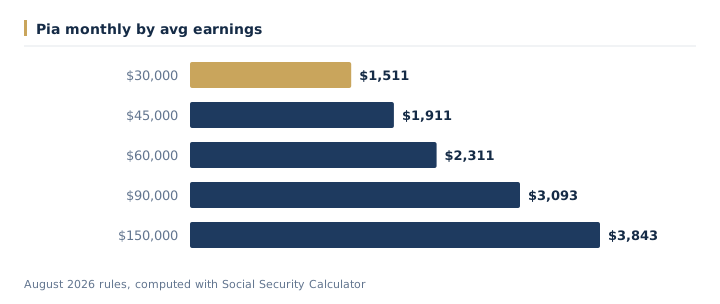
We ran 5 values of avg earnings through the calculator and left every other input at its default. As of August 2026, the output was:
| Avg earnings ($) | Pia monthly ($) | Chosen monthly benefit ($) | Chosen annual benefit ($) |
|---|---|---|---|
| 30,000 | 1,511.08 | 1,511.08 | 18,132.96 |
| 45,000 | 1,911.08 | 1,911.08 | 22,932.96 |
| 60,000 | 2,311.08 | 2,311.08 | 27,732.96 |
| 90,000 | 3,092.55 | 3,092.55 | 37,110.6 |
| 150,000 | 3,842.55 | 3,842.55 | 46,110.6 |
Running avg earnings from $30,000 up to $150,000 moves pia monthly from $1,511 to $3,843 — a spread of $2,331. That gap is the part a single headline rate never shows.
The same runs seen through chosen monthly benefit
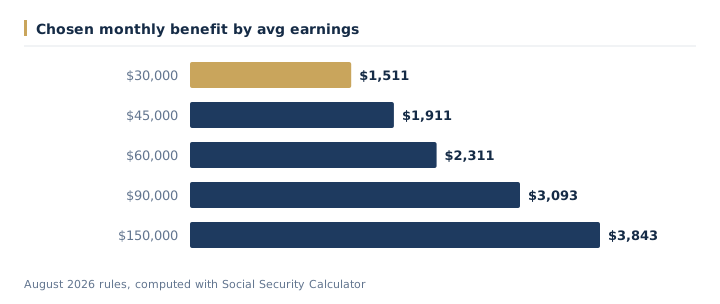
At $30,000, chosen monthly benefit works out to $1,511; at $150,000 it is $3,843. Looking only at pia monthly tends to understate how much the outcome shifts across that range.
Assumptions behind these figures
| Input | Value |
|---|---|
| Avg earnings | $60,000 |
| Birth year | 1975 |
| Claim age | 67 |
| As of | August 2026 |
| Method | identical to /tools/social-security-calculator |
Brackets, thresholds and rates change from year to year, so treat these as August 2026 figures for the 2026 tax year. For your own situation, open the Social Security Calculator and enter your real numbers — the calculator runs the same code that produced every figure on this page.
Frequently Asked Questions
What age should I claim Social Security?
There is no single correct claiming age — it depends on your health, marital status, other income, and how long you expect to live, so it's worth running your own numbers or discussing it with a financial professional. Claiming at 62 locks in a permanently reduced benefit for life, while waiting until full retirement age or as late as 70 increases the monthly amount significantly. Because the decision is largely irreversible once made, it deserves more deliberation than simply claiming as soon as you're eligible.
How much more do I get if I wait until 70 to claim Social Security?
Waiting past full retirement age generally adds delayed retirement credits of roughly 8% per year up to age 70, which can raise the monthly benefit to somewhere around 24%–32% above your full-retirement-age amount, depending on your exact full retirement age. There is no additional benefit to waiting past 70, since credits stop accruing at that point. This increase is generally permanent and applies for the rest of your life.
How much is my Social Security benefit reduced if I claim at 62?
Claiming at the earliest eligible age of 62 generally results in a permanent reduction of roughly 30% compared to your full benefit, assuming a full retirement age of 67. The exact reduction is graduated by month and depends on how many months early you claim relative to your specific full retirement age. This reduction lasts for the rest of your life, so it's worth weighing against your expected longevity and other income sources.
What is the Social Security break-even age?
The break-even age is the point where the total cumulative benefits from claiming later catch up to and surpass what you would have received by claiming earlier. Generally, delaying tends to pay off if you live well into your late 70s or beyond, which a large share of healthy 65-year-olds do. However, break-even analysis is only one input to the decision — it doesn't account for factors like cost-of-living adjustments compounding on a larger base or the value of a bigger guaranteed check late in life, so it shouldn't be the sole basis for your decision.
Does working affect my Social Security benefit calculation?
Yes, your benefit is based on your highest 35 years of indexed earnings, so working additional years can replace a lower-earning or zero-earning year in that calculation and potentially raise your benefit. If you have fewer than 35 years of earnings, the formula fills the gap with zeros, which lowers your average. Because the benefit formula is progressive, the relative boost from extra high earnings tends to shrink as your income rises.