Guides
Pension vs 401(k): Which Is Better?
By Editorial Team · Published April 25, 2026 · Updated August 22, 2026 · 16 min read
Defined-benefit vs. defined-contribution is really a question of who carries the risk — plus the lump-sum-vs-annuity pension decision and PBGC.
Ask "is a pension better than a 401(k)?" and you'll get a debate that mostly misses the point. The two plans aren't competing products on a shelf. They're two different answers to a single question: when your retirement income falls short because markets disappointed or you lived longer than expected, who eats that loss — you, or someone else?
That's the whole comparison, really. Everything else is detail hanging off it. A pension hands the risk to your employer. A 401(k) keeps it on your side of the table. Once you see the decision that way, the usual "which is better" framing dissolves, because the honest answer changes depending on how much risk you can personally afford to carry and how much guaranteed income you'll already have from elsewhere.
So let's not crown a winner. Let's trace the mechanics, work a real lump-sum decision, look at what the PBGC actually does and doesn't do, and figure out what to do if — best case — you have both.
Two plans, two ways of keeping a promise
US retirement law (ERISA) draws a hard line between two plan families, and the line is exactly the risk question.
A defined-benefit plan — the traditional pension — promises a specific benefit. The plan sponsor commits to paying you a defined monthly amount for the rest of your life, and it's the sponsor's job to invest, hire actuaries, and come up with the cash regardless of what the market did along the way.
A defined-contribution plan — the 401(k) being the common example — promises a specific contribution. Money goes in (yours, plus often an employer match). What comes out at the end is whatever contributions, fees, and three or four decades of market returns produced. Nobody owes you a number.
Read those two definitions again and notice what's missing from the 401(k): a promise. That absence is the entire story.
How the pension number gets made
Most US pensions, public and private, run a formula along these lines:
years of service × a multiplier (often 1%–2.5%) × final or high-3 average salary
Thirty years of service, a 1.8% multiplier, a high-3 average salary of $90,000:
30 × 0.018 × $90,000 = $48,600 a year, for life
The benefit starts at the plan's normal retirement age and runs until you die, with survivor options if you elect them. The employer funds it and absorbs any investment shortfall. You don't see the volatility; the plan's actuaries do.
How the 401(k) number gets made
You pick a contribution rate, you pick funds from a menu, you collect the match if there is one, and you accept whatever the market hands you. For the 2025 tax year the IRS employee deferral limit sits in the low-$20,000s, with a catch-up for those 50 and older, and SECURE Act 2.0 layered on a higher "super catch-up" for ages 60–63 beginning in 2025. Those limits are indexed and move every year, so verify the current IRS figure for whatever year you're contributing in. You can model contribution and match scenarios with the 401(k) Calculator.
Here's the consequence that matters. When you retire from a pension job, someone has already solved the hard problem: how to fund a 30-year payout through unknown markets and an unknown lifespan. When you retire from a 401(k) job, that problem is now yours. This is why a guaranteed $40,000 a year feels sturdier than a $1,000,000 balance — the balance is a pile of money you still have to convert into lifelong income yourself, with no do-overs.
It helps to think of the two not as opposites but as endpoints on a single risk-transfer spectrum. A COLA-adjusted public pension sits near the all-employer-risk end. A no-match 401(k) parked in one volatile fund sits near the all-employee-risk end. Most real situations live somewhere in between. The useful exercise isn't picking the "better" plan in the abstract — it's figuring out where your plans sit on that spectrum and how much guaranteed income you'll actually walk away with.
Vesting: a trap that's sharper on the pension side
Both plans use vesting, but the stakes differ enormously. Your own 401(k) contributions are yours from day one; only the employer match is subject to a vesting schedule. A pension is harsher: leave before the vesting cliff (often five years for the formula benefit, though schedules vary) and the entire benefit can vanish. Quitting a pension job at year four can mean walking away with nothing. Quitting a 401(k) job at year four still leaves every dollar you contributed intact. That asymmetry deserves more weight than people give it when they're tempted to job-hop near a cliff.
Who actually carries each risk
This table is the article in miniature.
| Risk | Pension (DB) | 401(k) (DC) |
|---|---|---|
| Investment / market risk | Employer | You |
| Longevity risk (outliving the money) | Employer (lifetime payments) | You |
| Inflation risk | Often you (private plans rarely have COLA) | You |
| Sponsor solvency / plan termination | You (PBGC mitigates) | Minimal (assets segregated) |
| Sequence-of-returns risk near retirement | Employer | You |
A pension takes a heap of uncertain returns and converts it into a predictable paycheck; the sponsor's investment team eats the volatility so you don't have to. A 401(k) gives you the full upside and the full downside. A strong run of markets can leave you wealthier than any pension would have. A bad stretch of returns right before you stop working can permanently dent your standard of living, and there's no sponsor to absorb it.
One risk runs toward the pensioner instead of away: inflation. Most US private pensions carry no cost-of-living adjustment, so a fixed $48,600 loses roughly a third of its purchasing power across 20 years at modest inflation. Many public-sector pensions do include a COLA, and that feature is worth far more than the headline number suggests — it's an underrated reason public pensions are often more valuable than they look. A 401(k) has no built-in inflation protection either, but at least you control the assets and can hold growth investments to fight back.
The part people get wrong: control isn't free
A 401(k) is portable. Change jobs, roll it to an IRA or the new plan, keep choosing investments, leave whatever's left to your heirs. In a labor market where 30-year tenures are rare, that flexibility is genuinely valuable.
A pension is the opposite animal. It rewards staying and punishes leaving. A "deferred vested" pension from a job you left at 35 may pay something decades later, but it's frozen at your old salary and quietly eroded by inflation in the meantime. And a single-life pension typically pays nothing after you (and your survivor, if elected) die — there's no account balance to inherit. A 401(k)'s remaining balance goes to your named beneficiaries.
But control cuts both ways, and this is where the comparison gets uncomfortable. With a 401(k) you can over-concentrate, panic-sell in a crash, pay bloated fees, or simply under-contribute for a decade. The pension structurally removes every one of those mistakes by never letting you touch the dial. Plan-level data keep showing the same thing: the typical participant underperforms the very funds they own, through bad timing and performance-chasing. A pension closes that behavior gap by force. For a disciplined saver who captures the match, holds a cheap diversified allocation, and doesn't flinch when the market drops 30%, the 401(k)'s control is an asset. For an anxious or tinkering saver, the pension's enforced passivity is worth real money. Be honest with yourself about which one you are — that self-assessment changes the answer more than any feature comparison.
The pension decision that actually keeps people up at night
Many pensions hand you a one-time, irreversible choice at retirement: take the lifetime annuity (your formula benefit) or take a lump sum you roll into an IRA. This is among the highest-stakes decisions in your financial life, and unlike most financial decisions it has no undo button.
The lump sum is just the present value of your promised pension, and that calculation is brutally sensitive to interest rates. Rates rise, lump sums shrink — it takes less money today to fund the same future stream. Rates fall, lump sums swell. Retiring a few months earlier or later in a different rate environment can move the offer by tens of thousands of dollars. People rarely realize they're partly making an interest-rate timing bet.
Running the numbers side by side
Say your pension offers either $48,600/year for life starting at 65, or a $760,000 lump sum.
Divide the annual benefit by the lump sum and you get a payout rate near 6.4% ($48,600 ÷ $760,000). To safely self-fund $48,600 a year for a 30-year retirement, you'd typically plan around a 4%–5% withdrawal rate — meaning you'd realistically need closer to $970,000–$1,215,000 to safely replicate that guaranteed income. By that yardstick the annuity is priced generously.
But generous-on-paper isn't the same as right-for-you. The lump sum can still win if you have ample other guaranteed income (Social Security plus, say, a spouse's pension), expect a shorter lifespan, want to leave assets to children, or genuinely distrust the sponsor's long-term solvency. Model the guaranteed stream with the Pension Calculator and the invested-lump-sum path — growth, withdrawals, sequence risk — with the 401(k) Calculator before you commit. A common, sensible middle path: annuitize enough to cover essential expenses, invest the rest for growth.
Framed as a break-even: giving up $760,000 today for $48,600 a year means cumulative raw payments cross $760,000 around year 15.6, so a 65-year-old who lives past roughly 80 has out-earned the lump sum on dollars alone — before you even price in the value of the guarantee itself.
A second case that flips the verdict
Devin spent eight years at a DB-pension employer, then left at 38 for a bigger paycheck. His deferred vested pension will pay roughly $9,000 a year at 65, frozen at his age-38 salary, no COLA. At the new job he contributes 12% with a 4% match. By 65 that frozen $9,000 has lost most of its real value while his 401(k) carries his retirement almost entirely. Devin is the long-tenured pensioner's mirror image: for a mobile career, the portable 401(k) does the work and the frozen pension is a small bonus. The lesson isn't that one plan type wins. It's that your career pattern decides which structure pays you more — the plan in the abstract can't tell you anything.
Don't fumble the survivor election
If you take the annuity, you also pick a payout form. A single-life annuity pays the most and stops dead at your death. A joint-and-survivor option (50%, 75%, or 100% continuing to a spouse) pays less monthly but keeps a surviving spouse afloat. Federal law requires a spouse's written consent to waive survivor protection in qualified plans, and that requirement exists because waiving it has left many widows and widowers in poverty. Choose the survivor percentage based on what the survivor will otherwise have to live on, not on the headline monthly difference between the options.
What the PBGC will and won't do for you
"What if my employer goes bankrupt?" is a fair worry, and the answer depends entirely on what kind of plan you have.
For most private-sector DB plans, the Pension Benefit Guaranty Corporation (PBGC) — a federal agency — insures benefits up to legally set maximums that vary by age and year. If a covered plan terminates underfunded, the PBGC takes over and pays guaranteed benefits. High earners with very large promised pensions can see their benefit capped below what the plan promised, so it's a backstop, not a guarantee of full payment.
Two limits worth memorizing:
- The PBGC does not cover government (federal, state, municipal) pensions or most church plans. Public pensions ride on the sponsoring government's funding and, in the end, taxpayers.
- The guarantee is capped and has special rules for recently granted benefit increases. Treat it as a real safety net with a ceiling, never a blank check.
A 401(k) handles sponsor failure differently and arguably more cleanly: the assets are held in trust, segregated from the employer's balance sheet. If the company collapses, your balance is still yours, administrative headaches aside.
If you have both — and you should hope you do
Holding a pension and a 401(k) is the strongest position in retirement planning, but only if you coordinate them instead of comparing them.
Start by treating the pension plus Social Security as your income floor. Add up that guaranteed monthly income and lay it against your essential expenses: housing, food, healthcare, insurance, utilities. Then use the 401(k) to fill whatever gap remains and to fund the discretionary, flexible spending — travel, gifts, hobbies — along with inflation defense, since that's where you can hold growth assets and flex withdrawals. Always capture the full employer match first; it's an immediate guaranteed return on money you're already setting aside, rarely worth skipping even with a pension in hand. And coordinate the moving parts: pension start age, Social Security claiming age, and the age 401(k) RMDs begin (per current SECURE Act 2.0 rules — confirm the current RMD age, which has been moving) all interact in your tax picture.
Maria's blended plan, and why it isn't finished at 65
Maria, 65, expects $30,000/year from a non-COLA pension and $28,000/year from Social Security — $58,000 of guaranteed income against $54,000 of essential expenses. Her floor covers essentials with a small cushion, which makes her $500,000 401(k) "flexibility capital." She can run a fairly aggressive growth allocation and a flexible ~4% withdrawal (about $20,000/year) for discretionary spending, knowing a bad market threatens her travel budget, not her rent. A same-age neighbor with no pension and a $700,000 401(k) has the opposite reality: every essential dollar rides on the market, forcing a more conservative allocation and tighter withdrawal discipline.
But Maria's plan isn't done at 65 — that's the part most people stop too soon to see. Her pension has no COLA, so at 3% inflation its real value falls every year while COLA-adjusted Social Security and her portfolio quietly take on more of the load. By her late 70s the pension's purchasing power may be a third lower, and her small cushion over essentials can invert into a shortfall without anything dramatic happening. So the plan has to anticipate that erosion: keep the 401(k) tilted toward inflation-beating assets, don't drain it early, and treat its later years as a deliberate top-up to a shrinking real pension. The blended position is the strongest one available — but only if you actively manage the part you control to offset the part you can't.
Mistakes that quietly cost the most
The headline-number trap is the most common. A $1,500/month single-life pension is not equivalent to a $1,300/month joint-and-survivor option if your spouse would otherwise be left with almost nothing; you're paying $200 a month to buy real risk reduction, not throwing it away.
Taking the lump sum "to be in control" without an actual withdrawal plan is the next one. Money in an IRA still has to last a lifetime; lump-sum recipients routinely underestimate both longevity and sequence risk and spend down too fast.
The rest are quicker but just as expensive: ignoring interest-rate timing on a lump-sum offer; quitting a job a few months short of the vesting cliff and forfeiting a lifetime benefit; skipping the 401(k) match because "I have a pension" (that's forfeiting free money and inflation-fighting growth); assuming the PBGC fully covers everything when it caps benefits and excludes government and most church plans; and never stress-testing a non-COLA pension against 20-plus years of inflation.
Questions people actually ask
So is a pension better than a 401(k), yes or no? Wrong question, but: for guaranteed lifetime income and protection from market and longevity risk, the pension. For portability, control, growth, and leaving money behind, the 401(k). Your need for certainty versus flexibility decides it, along with whatever else you have.
Lump sum or monthly annuity? Take the annuity if you need the income, value longevity protection, lack other guaranteed income, and trust the sponsor (or it's PBGC-covered). Lean lump sum if you have plenty of other guaranteed income, want inheritability, expect a shorter life, or want investment control — and only with a disciplined plan. Splitting the difference (annuitize enough for essentials) is often the adult answer.
What if my company goes bankrupt? Most private plans: PBGC insures up to age-based annual caps, and you may get less than promised if your benefit exceeds the cap. Government and most church plans aren't covered and depend on the sponsor's funding.
Can I have both? Yes, and it's common in the public sector and at older private employers. Coordinate them — floor from pension plus Social Security, growth and flexibility from the 401(k).
Does a pension keep up with inflation? Most private ones don't. Many public ones do. If yours doesn't, plan for inflation deliberately with other assets.
What happens to my 401(k) when I die? The balance passes to named beneficiaries under current inherited-account rules in the SECURE Act. A single-life pension generally pays nothing after death unless you elected a survivor option.
Should I roll an old pension into an IRA if offered? Only after modeling both outcomes. The roll buys control, growth, and inheritability but transfers all investment and longevity risk to you, irreversibly. Keeping the deferred annuity preserves a guaranteed (often inflation-eroded) stream. Decide on your other guaranteed income, health, bequest goals, the rate environment when the offer lands, and PBGC coverage — not on a craving for control.
Sources
- Pension Benefit Guaranty Corporation — federal insurer of most private-sector defined-benefit pensions; guarantee limits and plan-termination rules
- U.S. Department of Labor — ERISA, vesting rules, and fiduciary standards for employer retirement plans
- Internal Revenue Service — 401(k) contribution and catch-up limits, SECURE Act 2.0 provisions, and RMD rules
- Social Security Administration — benefit estimates that anchor your guaranteed-income floor
- Consumer Financial Protection Bureau — plain-language guidance on the pension lump-sum versus annuity decision
Key takeaways
- The real question is never "which plan wins" but "who carries the risk" — a pension hands it to the employer, a 401(k) keeps it on you.
- Pensions excel at guaranteed lifetime income; 401(k)s excel at portability, control, growth, and inheritance — they're points on one risk spectrum, not rivals.
- The lump-sum-vs-annuity choice is irreversible and interest-rate sensitive; model both paths, and never fumble the survivor election.
- The PBGC backstops most private pensions up to capped limits but excludes government and most church plans.
- With both, run pension plus Social Security as your income floor and the 401(k) as flexible inflation-fighting capital, capture the full match, and actively manage a non-COLA pension's real-value decay.
A closing note on scope: this is general education about US retirement plans, not advice tailored to you. Plan provisions and IRS dollar limits are revised regularly, so confirm the current figures for your year and bring your specific situation to a qualified advisor before acting on any of it.
Run the numbers
Everything below came out of this site's own Pension Calculator. The figures are not quoted from anywhere else: each row is one run of the same calculation the tool page performs, using August 2026 rules. Put the same inputs in and you will get the same output.
How the result moves with avg salary
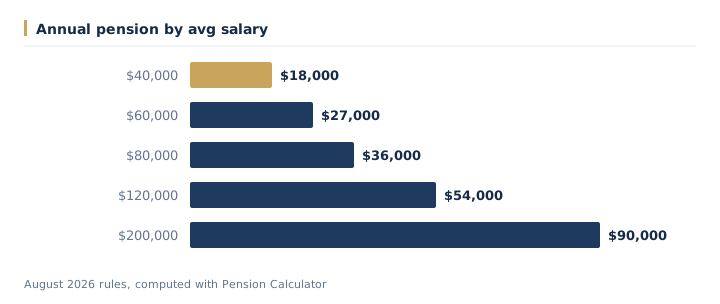
We ran 5 values of avg salary through the calculator and left every other input at its default. As of August 2026, the output was:
| Avg salary ($) | Annual pension ($) | Monthly pension ($) | Lifetime total ($) |
|---|---|---|---|
| 40,000 | 18,000 | 1,500 | 396,000 |
| 60,000 | 27,000 | 2,250 | 594,000 |
| 80,000 | 36,000 | 3,000 | 792,000 |
| 120,000 | 54,000 | 4,500 | 1,188,000 |
| 200,000 | 90,000 | 7,500 | 1,980,000 |
Running avg salary from $40,000 up to $200,000 moves annual pension from $18,000 to $90,000 — a spread of $72,000. That gap is the part a single headline rate never shows.
The same runs seen through monthly pension
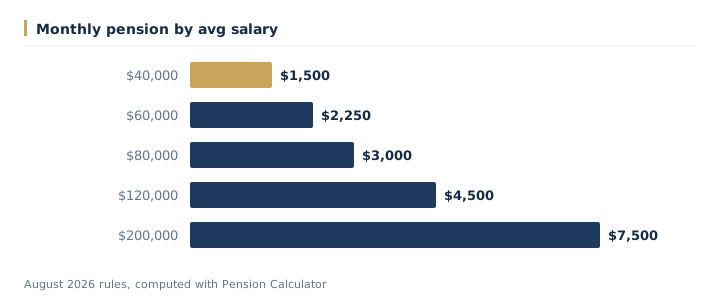
At $40,000, monthly pension works out to $1,500; at $200,000 it is $7,500. Looking only at annual pension tends to understate how much the outcome shifts across that range.
Assumptions behind these figures
| Input | Value |
|---|---|
| Avg salary | $80,000 |
| Years | 30 years |
| Multiplier | 1.5% |
| Retire age | 65 |
| Life exp | 87 |
| Discount | 5% |
| Lump offer | $0 |
| As of | August 2026 |
| Method | identical to /tools/pension-calculator |
Brackets, thresholds and rates change from year to year, so treat these as August 2026 figures for the 2026 tax year. For your own situation, open the Pension Calculator and enter your real numbers — the calculator runs the same code that produced every figure on this page.
Frequently Asked Questions
Is a pension better than a 401(k)?
Neither is universally better — they represent different answers to who bears the risk if retirement income falls short: a pension shifts investment, longevity, and market risk to the employer, while a 401(k) keeps that risk with the employee. A pension offers a predictable, often lifelong income stream, while a 401(k) offers more control and potential upside but no guarantee of a specific outcome. Which is preferable generally depends on how much financial risk you're able and willing to carry personally, and how much other guaranteed income you'll have.
How is a pension benefit calculated?
Most traditional pensions generally use a formula based on years of service multiplied by a percentage multiplier, often in a range of roughly 1% to 2.5%, multiplied by your final or highest-average salary over a defined period. This produces a monthly benefit that's typically paid for life, with the employer responsible for funding and managing the investment risk needed to meet that promise. Because formulas vary significantly between employers and plans, review your specific plan's formula rather than assuming a generic multiplier applies to your situation.
What happens to my pension if I leave a job before it vests?
If you leave before meeting your plan's vesting requirement, often a period of around five years though this varies by plan, you can generally lose the entire pension benefit, even after years of eligible service. This is a much harsher outcome than with a 401(k), where your own contributions are typically yours from day one regardless of when you leave, and only the employer match portion is subject to vesting. Because of this asymmetry, check your specific pension plan's vesting schedule carefully before making a job change near a vesting milestone.
What is the PBGC and how does it protect pensions?
The Pension Benefit Guaranty Corporation, or PBGC, is a federal agency that generally provides a safety net for certain private-sector defined-benefit pension plans if the sponsoring employer becomes insolvent and can't meet its pension obligations. Its protection typically comes with limits and doesn't cover every type of pension plan, so the benefit you'd actually receive if your employer's plan failed may be less than what was originally promised. Because coverage details and limits can be complex, check your specific plan's PBGC status if you're concerned about employer solvency.
Should I take my pension as a lump sum or monthly annuity?
This is a significant, largely irreversible decision that generally depends on factors like your health and expected longevity, other income sources, your comfort managing investments, and whether you have a spouse who'd need continued income. A monthly annuity option generally transfers investment and longevity risk to the pension plan and guarantees income for life, while a lump sum gives you control and flexibility but shifts all of that risk to you. Because of the complexity and stakes involved, discuss this decision with a fee-only financial advisor before deciding.