Guides
Long-Term Care Planning for Retirement
By Editorial Team · Published April 15, 2026 · Updated August 22, 2026 · 13 min read
Why Medicare won't cover custodial care, the Medicaid 5-year look-back, and how to fund long-term care: self-fund, traditional, or hybrid.
Most retirement plans are built around two fears: a market crash and living too long. Both get spreadsheets, calculators, and hours of attention. The expense that is statistically more likely to wreck the plan than either of them usually gets a sentence, if that. It's the cost of needing help with daily life — for years — late in retirement, and the reason it gets skipped is simple. The numbers are unpleasant, and there's no clean product that makes them go away.
This is the gap. A plan that funds 30 years of normal spending but has no answer for a four-year care event isn't a conservative plan; it's an incomplete one. So let's deal with the uncomfortable part directly: how likely the risk is, what it costs, why Medicare won't rescue you, and what the real funding choices actually are.
The distinction that decides who pays
Long-term care is help with the basic activities of daily life when age, illness, or cognitive decline makes doing them alone too hard. The standard yardstick is the Activities of Daily Living: bathing, dressing, eating, transferring in and out of a bed or chair, toileting, and continence. Most insurance benefits trigger when you can't do two or more ADLs without help, or when a severe cognitive impairment like dementia is present.
The single distinction that governs this entire topic is medical versus custodial. A hospital admission or a course of physical therapy is skilled medical care. Needing someone to help you bathe and dress every day for the next four years is custodial care. They feel similar to the person receiving them. They are worlds apart in who picks up the bill — and almost everyone assumes wrong about that, which is the costliest assumption in retirement planning.
Care also runs along an intensity spectrum: in-home aide visits, adult day care, assisted living, and skilled nursing facilities, roughly in ascending order of cost.
How probable is this, honestly?
The figure cited from federal sources is that roughly 70% of people turning 65 will need some form of long-term care during their remaining years. That headline is true but needs nuance, because the average hides the thing that matters.
A large share of people need only modest help for a short stretch — a few months, manageable. A smaller group needs years of intensive care, and that long tail is the financial catastrophe the plan has to survive. Women on average need care longer than men, partly because they live longer and more often outlive the spouse who would otherwise have been the unpaid caregiver.
You can't know in advance which group you'll be in. That uncertainty is precisely what makes this an insurable, plannable risk rather than a line item you can budget with confidence. Treat it the way you treat any catastrophic exposure: a low-to-moderate chance of a financially devastating outcome, which is the textbook profile for risk transfer or a deliberately funded reserve.
What it costs — and why a single year isn't the danger
Costs swing enormously by region and setting, and they've historically climbed faster than general inflation. The standard references are the Genworth Cost of Care Survey and federal HHS data; check the current year before relying on any number, including these. The approximate national ranges look roughly like this:
| Care setting | Approximate annual cost (illustrative — verify current data) |
|---|---|
| Home health aide (part- to full-time) | Tens of thousands up to ~$70,000+ |
| Assisted living facility | ~$50,000–$75,000+ |
| Nursing home, semi-private room | ~$90,000–$110,000+ |
| Nursing home, private room | Well over $100,000, often $115,000+ |
These are national midpoints. High-cost metros run far above them. But fixating on the per-year figure misses the actual hazard. One year of care is survivable for most funded retirements. The thing that breaks a plan is duration: four years in a private nursing room could exceed $450,000–$500,000 in today's dollars, and considerably more once inflation runs for 20 years before the care event. Always pull the latest Genworth or HHS data for your own state rather than planning around any single article's numbers.
Why Medicare is not the answer here
This deserves its own section because the misconception is nearly universal and it derails more plans than anything else: people assume Medicare pays for the nursing home. For ongoing custodial care, it does not.
Medicare covers skilled care for a limited window — for instance, up to 100 days in a skilled nursing facility after a qualifying hospital stay, with full coverage only for the first 20 days and a daily coinsurance after that. The moment the care is classified as custodial — the months and years of ADL help that make up the bulk of long-term care spending — Medicare stops paying. It was never designed to cover this, and no amount of supplemental Medigap coverage changes that.
That reality narrows you to four genuine funding paths, and the rest of this article is really about choosing among them: pay it yourself, insure it, blend the two, or fall back to Medicaid.
The Medicaid backstop — and the strings attached
Medicaid is the largest single payer of long-term care in the country, but it's a means-tested program for people with very limited assets and income. Leaning on it carries two heavy consequences.
The first is spend-down. You generally must exhaust most countable assets before Medicaid pays. The rules protect a primary residence up to limits, a vehicle, and — through spousal-impoverishment protections — a portion of assets and income for a spouse still living at home. But a single person typically has to spend down to a very low asset threshold first.
The second is the five-year look-back. When you apply, Medicaid reviews asset transfers made in roughly the prior five years. Gifts or below-market transfers inside that window trigger a penalty period of ineligibility. The popular idea of handing assets to the kids shortly before needing care simply doesn't work; the look-back is designed to catch exactly that.
Medicaid also constrains your choices — not every facility accepts it, and the room or facility options can be narrower. It is a real safety net, but planning to land on it generally means little is left for a spouse or heirs and you've given up a lot of control over care.
Lining up the four paths side by side
| Path | Best fit | Strengths | Weaknesses |
|---|---|---|---|
| Self-fund | High net worth (rough threshold often cited: ~$2M+ investable, varies) | Total control, no premiums, fully flexible | Open-ended exposure; a long stay can swallow much of the estate |
| Traditional LTC insurance | Middle-to-affluent who can pass underwriting | Premiums leverage into a large benefit pool; some tax advantages | Premiums can rise; benefits forfeited if care never needed; underwriting hurdles |
| Hybrid life/LTC | Those with a lump sum who dislike "use it or lose it" | Death benefit if LTC goes unused; premiums often guaranteed | Higher upfront cost; less LTC leverage per dollar; complexity |
| Annuity with LTC rider | Holders of non-qualified annuity assets, harder to underwrite | Enhanced withdrawals for care; lighter health underwriting on some | Lower leverage; product complexity; fees |
| Medicaid | Limited assets, or post spend-down | Genuine last-resort safety net | Spend-down, 5-year look-back, restricted choice |
A few of these need more than a table row.
Traditional LTC insurance buys a pool of benefits — a daily or monthly amount for a set number of years, ideally with an inflation rider — for an annual premium. The leverage can be excellent: modest premiums funding a large benefit pool. The well-known downsides are real, though. Insurers have repeatedly raised premiums on in-force older policies, benefits are typically forfeited entirely if you never need care, and health underwriting disqualifies a meaningful share of applicants. Given how fast care costs climb, an inflation-protection rider isn't optional padding; it's close to essential.
Hybrid life/LTC and annuity riders exist specifically to answer the "use it or lose it" objection. These pair permanent life insurance (or an annuity) with a long-term care rider: draw the benefit down for care if you need it, and if you never do, your heirs receive a death benefit. They've grown sharply in popularity. The trade is a larger upfront commitment and usually less LTC leverage per dollar than a traditional policy, in exchange for premiums that are more often guaranteed and money that isn't forfeited if care never happens.
Self-funding is rational if your assets are large enough to absorb the open-ended tail. The rough rule of thumb is that households with roughly $2 million or more in investable assets can reasonably self-insure, those with very little are likely headed to Medicaid anyway, and the broad middle is where insurance earns its keep. The genuine danger of self-funding is the tail itself: a multi-year care event hitting both spouses can consume far more than people anticipate, and the survivor is the one left depleted.
Sizing the number: a worked example
The most useful planning method isn't memorizing a cost table. It's estimating a realistic care scenario in today's dollars and then deciding how much of it to self-fund versus insure.
Linda is 60 and building her plan with deliberately conservative assumptions:
- Expected need: 3 years of care, sometime in her 80s
- Blended cost across in-home then assisted-living/nursing: assume $100,000 per year in today's dollars
- Total in today's dollars: $300,000
- Income that keeps flowing during care (Social Security and continuing portfolio income): roughly $40,000 per year, leaving about $60,000 per year of true gap — roughly $180,000 to fund from a dedicated source
From there her choices are concrete: earmark and invest a roughly $180,000-plus "LTC reserve" inside the portfolio and self-fund the gap; buy a traditional policy whose benefit pool plus an inflation rider covers it; or buy a hybrid policy so any unused benefit passes to her heirs. Because costs compound over the 20-plus years before care is likely, she inflates the figure and revisits it periodically rather than treating $180,000 as fixed. Model how a dedicated care reserve and the income that continues during a care event affect the broader plan with the Retirement Income Calculator, and stress-test how a multi-year care shock collides with portfolio longevity using the Money Longevity Calculator.
The takeaway from Linda's math is the part most people get wrong: the planning number is not the headline "$100,000-plus per year." It's the gap — care cost minus the income still flowing during care — times a realistic duration, then inflated forward.
The timing window you don't want to miss
Long-term care insurance is generally cheapest and easiest to qualify for from the mid-50s to mid-60s, before the health conditions arrive that lead to denials or steep premiums. Wait too long and the menu shrinks to self-funding or Medicaid by default — not by choice. And even a decision to self-fund only counts as a plan if it's explicit and funded with a designated reserve. The real failure mode here isn't picking the wrong option; it's reaching late retirement with no option chosen at all and discovering the default is spending down to Medicaid.
The errors that do the most damage
- Assuming Medicare covers it. It pays for limited skilled care, not ongoing custodial care, and this single belief wrecks more plans than anything else.
- Waiting too long to insure. Health changes in your 60s can make you uninsurable; pricing and eligibility are best from the mid-50s to mid-60s.
- Last-minute gifting to qualify for Medicaid. The 5-year look-back catches it and imposes a penalty period.
- Skipping inflation protection. A fixed benefit bought at 55 may cover only a fraction of the cost at 85.
- Forgetting the at-home spouse. A long care event for one spouse can impoverish the other; spousal protections help but don't erase the risk.
- Planning around one source's cost figures. They vary widely by state and year — verify current Genworth or HHS data for your area.
- Having no plan. "We'll figure it out" is the most expensive option, because it defaults to a Medicaid spend-down.
Questions worth answering before you decide
Does Medicare pay for a nursing home? Only briefly and only for skilled care — up to 100 days in a skilled nursing facility after a qualifying hospital stay, with coinsurance after day 20. It does not cover the ongoing custodial care that makes up most long-term care spending.
What does care cost per year? It depends heavily on setting and location, from tens of thousands a year for home-aide hours to well over $100,000 a year for a private nursing-home room. Pull the current Genworth Cost of Care Survey or HHS data for figures specific to your state.
What exactly is the Medicaid 5-year look-back? On application for Medicaid long-term care coverage, the program reviews asset transfers from roughly the prior five years. Gifts or below-market transfers in that window create a penalty period of ineligibility, which is why pre-need gifting is not a reliable strategy.
Is long-term care insurance worth it? It's most valuable for the broad middle — households with enough assets to lose but not enough to comfortably absorb a multi-year care event. Very high-net-worth households may self-insure; those with minimal assets will likely rely on Medicaid. The call depends on your assets, health, and risk tolerance.
What is a hybrid long-term care policy? Life insurance (or an annuity) combined with an LTC rider: draw the benefit for care if needed, and if you never need it, your heirs receive a death benefit — which removes the "use it or lose it" objection of traditional policies, usually at a higher upfront cost.
When should I start planning? In your 50s. Insurance is generally most affordable and easiest to qualify for between the mid-50s and mid-60s, and even a self-fund decision should be made explicitly with a dedicated reserve well before care is needed.
Sources
- Medicare — what is and isn't covered for skilled and long-term care
- Centers for Medicare & Medicaid Services — Medicaid long-term care and eligibility
- Social Security Administration — retirement income and benefits
- Consumer Financial Protection Bureau — planning for care costs in retirement
- U.S. Department of Labor — retirement and benefit plan resources
The plan in five lines
- About 70% of 65-year-olds will need some long-term care; the catastrophic multi-year tail is the part the plan must survive.
- Medicare does not cover ongoing custodial care, and Medicaid only helps after a spend-down subject to a roughly 5-year look-back on transfers.
- The four real funding paths are self-fund, traditional LTC insurance, hybrid life/LTC or annuity riders, and Medicaid — each with clear trade-offs.
- Plan around the funding gap — care cost minus the income that keeps flowing during care — times a realistic duration, then inflated; verify current Genworth/HHS data.
- Decide in your 50s to mid-60s while you can still qualify and choose; no plan defaults to a Medicaid spend-down.
This article is general educational information about long-term care and retirement planning, not personalized financial, tax, insurance, or legal advice. Care costs, insurance terms, and Medicaid rules vary by state and year — consult qualified professionals about your own situation before acting.
Run the numbers
Everything below came out of this site's own Retirement Income Calculator. The figures are not quoted from anywhere else: each row is one run of the same calculation the tool page performs, using August 2026 rules. Put the same inputs in and you will get the same output.
How the result moves with ss
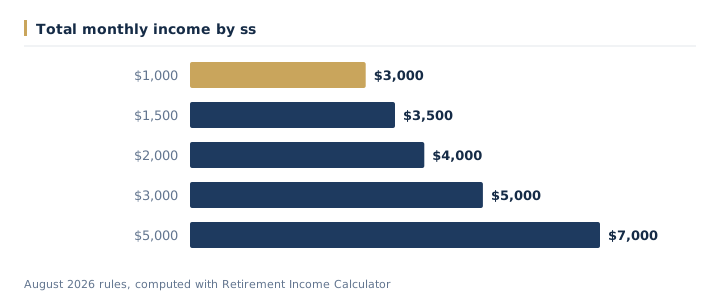
We ran 5 values of ss through the calculator and left every other input at its default. As of August 2026, the output was:
| Ss ($) | Total monthly income ($) | Monthly gap ($) | Coverage percent (%) |
|---|---|---|---|
| 1,000 | 3,000 | -1,500 | 66.67% |
| 1,500 | 3,500 | -1,000 | 77.78% |
| 2,000 | 4,000 | -500 | 88.89% |
| 3,000 | 5,000 | 500 | 111.11% |
| 5,000 | 7,000 | 2,500 | 150% |
Running ss from $1,000 up to $5,000 moves total monthly income from $3,000 to $7,000 — a spread of $4,000. That gap is the part a single headline rate never shows.
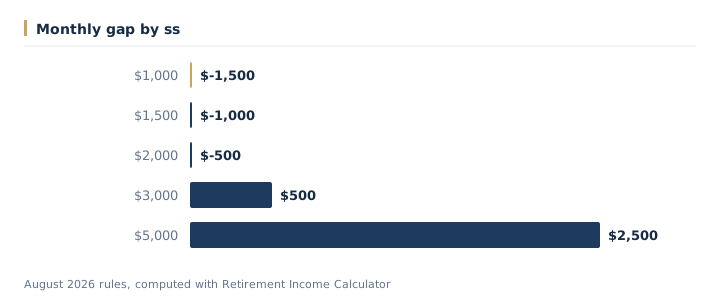
The same runs seen through monthly gap
At $1,000, monthly gap works out to $-1,500; at $5,000 it is $2,500. Looking only at total monthly income tends to understate how much the outcome shifts across that range.
Assumptions behind these figures
| Input | Value |
|---|---|
| Ss | $2,000 |
| Pension | $0 |
| Other | $0 |
| Balance | $600,000 |
| Wr | 4% |
| Expenses | $4,500 |
| As of | August 2026 |
| Method | identical to /tools/retirement-income-calculator |
Brackets, thresholds and rates change from year to year, so treat these as August 2026 figures for the 2026 tax year. For your own situation, open the Retirement Income Calculator and enter your real numbers — the calculator runs the same code that produced every figure on this page.
Frequently Asked Questions
Does Medicare cover long-term care?
No, Medicare generally does not cover ongoing custodial long-term care, such as help with daily activities like bathing and dressing. It does cover a limited period of skilled nursing care following a qualifying hospital stay, but once care shifts to custodial support, Medicare coverage generally stops. This is one of the most common and costly misconceptions in retirement planning, so it's important to have a separate funding plan for potential long-term care needs.
How likely am I to need long-term care?
Federal data often cited suggests a large majority of people turning 65 will need some form of long-term care during their remaining years, though the amount and duration varies enormously — many people need only modest, short-term help, while a smaller group needs years of intensive care that can be financially devastating. Because you can't know in advance which group you'll fall into, this is generally treated as an insurable, plannable risk rather than something to budget for with precision. Women, on average, tend to need care for longer.
How much does long-term care cost?
Costs vary significantly by region, care setting, and intensity — in-home aides, assisted living, and nursing homes each carry different price ranges, with semi-private or private nursing home rooms generally the most expensive. Costs have also historically risen faster than general inflation, so check current data, such as the Genworth Cost of Care Survey or federal HHS data, for your specific area rather than relying on a general estimate. What matters most for planning purposes isn't a single year's cost but the risk of a multi-year care need, which can add up substantially over time.
What is the Medicaid look-back period for long-term care?
Medicaid generally reviews asset transfers made in roughly the five years before you apply for long-term care benefits, and gifts or below-market transfers made within that window can trigger a penalty period of ineligibility. Medicaid is a means-tested program, so most applicants also need to spend down countable assets to a low threshold before qualifying, though certain protections exist for a primary residence, a vehicle, and a spouse still living at home. Because these rules are complex and state-specific, consult an elder law attorney before attempting any asset transfers.
What are the ways to pay for long-term care?
Generally, there are a few main paths: self-funding from savings, purchasing long-term care insurance, using a hybrid product that combines insurance with other benefits, or relying on Medicaid once assets are largely spent down. Each option carries different tradeoffs around cost, flexibility, and timing, and the right mix depends on your assets, health, and family situation. Because this is a significant and often underplanned financial risk, discuss options with a financial or elder care professional well before you need care.