Guides
The 4% Rule Explained: Is It Still Valid?
By Editorial Team · Published May 4, 2026 · Updated August 22, 2026 · 14 min read
What Bengen actually found vs. how the 4% rule gets misquoted, where it breaks down, and the dynamic alternatives, with a $1M example.
William Bengen never set out to write a rule. In 1994 he was a financial planner trying to answer a narrower, more honest question: across every bad starting point in modern US market history — including retiring straight into a crash — what was the highest inflation-adjusted withdrawal rate that never once ran a balanced portfolio to zero over 30 years? His answer was roughly 4%.
Notice what that finding is and isn't. It's a worst-case survival rate, derived by running history's ugliest sequences and asking what spending level still squeaked through. It is not an average, not a promise, and not a target you should expect to actually hit. Yet "the 4% rule" has been flattened in the retelling into something it never claimed to be: a guarantee that you can pull 4%, forget about it, and be fine. That gap — between what Bengen measured and what people think he said — is where retirements get into trouble. The rest of this article is mostly about closing it.
What the rule literally instructs you to do
The mechanics are specific, and the specificity is the whole point. The rule is not "withdraw 4% of your balance every year." It is a three-part procedure:
- In year one, withdraw 4% of the portfolio's starting value.
- Every year after, take last year's dollar amount and bump it by inflation — completely ignoring what the market did.
- Keep going for an assumed horizon of about 30 years.
A $1,000,000 portfolio funds a $40,000 first-year withdrawal. If inflation runs 3%, year two is $41,200 — and you take that $41,200 even if the portfolio fell 20% that year. The deliberate design goal is a stable, inflation-protected paycheck instead of an income that lurches around with markets. That stability is simultaneously why people love the rule and why it can quietly destroy a portfolio: it tells you to take a raise into a crash.
Why a fixed percentage can survive decades at all
It's worth pausing on the underlying arithmetic, because it explains both the rule's durability and its fragility. In a typical historical balanced portfolio, long-run real returns ran somewhat above 4%. When your portfolio earns more in real terms than you withdraw in real terms, the balance can sustain withdrawals more or less indefinitely. The 4% figure isn't the average sustainable rate — history would have comfortably supported much higher rates from good starting years. It's the rate low enough that even the worst historical starting points still finished with something left.
Reframe it that way and the rule looks different: 4% is a pessimistic floor wearing the costume of a tidy round number. That's precisely why, in average and good scenarios, it usually leaves a large unspent balance — and also why a future worse than anything in the historical record could still break it.
The savings target hiding inside the percentage
Invert 4% and you get the number most people actually plan around. If 4% of the portfolio funds one year of spending, then 25 × annual portfolio spending is the target. Want $60,000 a year from investments? Aim for roughly $1.5 million. This 25× shortcut is the engine of nearly all FIRE math; pressure-test your own figure with the FIRE Calculator.
The two most consequential words there are from investments. The 25× multiple applies only to the slice of spending the portfolio must cover — not your total spending — and missing that distinction sends people to wildly wrong conclusions.
A quick illustration of how wrong. Two retirees each spend $80,000 a year. The first has no other income; the portfolio must produce all $80,000, so the target is $2,000,000. The second expects $35,000 from Social Security and a small pension, so the portfolio only covers the remaining $45,000 — a target of $1,125,000. Identical lifestyle, identical rule, and a target that differs by nearly $900,000 purely because of guaranteed income. People who run 25× against gross spending routinely decide they can never afford to retire when, after layering in Social Security, they're far closer than they realize. Run the multiple on the gap, never the gross.
What it promises, and what it conspicuously doesn't
| The rule does | The rule does not |
|---|---|
| Give a defensible starting estimate | Guarantee the money lasts |
| Provide stable, inflation-adjusted income | React to a crash on its own |
| Translate cleanly into a 25× target | Account for taxes, fees, or your allocation |
| Reflect ~30 years of US history | Cover 40–50 year early-retirement horizons |
| Serve as useful shorthand | Substitute for an annual reality check |
The fixed, market-blind spending is the rule's defining feature and its defining flaw. It deliberately ignores what your portfolio is doing — reassuring when markets fall, genuinely dangerous when they fall early and hard.
The research lineage, briefly
Bengen's 1994 work backtested historical US data for the highest safe inflation-adjusted rate across every rolling 30-year window, including retirements that started just before the 20th century's worst downturns. The Trinity Study (three Trinity University finance professors, 1998) approached it from "success rates" across stock/bond mixes and withdrawal rates, and popularized the idea that a 50/50 to 75/25 portfolio had a high historical probability of lasting 30 years at a 4% inflation-adjusted draw.
Two things to keep front of mind about that pedigree. It rests on US historical returns over roughly 30 years — a backtest, not a law of physics. And "safe" only meant the portfolio didn't hit zero; plenty of "successful" historical paths put retirees through stomach-churning mid-retirement drawdowns they had to live through without blinking.
The five places it strains
Sequence-of-returns risk is the one that actually kills plans
Two retirees can earn the identical average return over 30 years and finish in completely different places depending only on the order of those returns. A bad opening stretch — poor returns in the first handful of years, while inflation-bumped withdrawals drain a shrinking balance — can be unrecoverable even if spectacular returns show up later. The rigid rule is uniquely exposed here because it keeps handing you a raise while the portfolio falls. Stress-testing how long money survives under different return orderings is exactly what the Money Longevity Calculator is built for.
Long horizons quietly invalidate the headline number
Bengen assumed about 30 years. Retire at 45 and you may need 45–55 years of withdrawals. Rates that are safe over 30 years are demonstrably less safe over 50 — sequence and inflation risk compound the longer the runway. Many early-retirement researchers land closer to a 3%–3.5% starting rate for very long horizons, which pushes the savings multiple from 25× toward 28×–33×.
Low yields and rich valuations
The historical record that produced "4%" includes long stretches of higher bond yields and cheaper equities than some later periods. When starting yields are low and valuations are high, forward returns have historically tended to be more muted, and that pressure lands squarely on the early years that matter most. Some researchers argue for lower safe rates in those environments; others counter that the rule already baked in history's worst entry points. Reasonable, informed people disagree here — that disagreement is itself a signal not to treat 4% as settled.
Fees and taxes are silent extra withdrawals
The original studies used index-like gross returns. A 1% advisory fee plus fund expenses can quietly turn a "safe" 4% into an unsafe one, because a fee behaves exactly like a permanent extra withdrawal that never takes a year off. Taxes compound the problem: spending $40,000 may require pulling well more than $40,000 from a traditional pre-tax account. The rule speaks gross and pre-tax; you live net and after-tax.
It pretends your spending is flat for 30 years
The rule mechanically raises your withdrawal by inflation every single year, implying perfectly constant real spending from 65 to 95. Almost nobody spends that way. Many retirees follow a go-go / slow-go / no-go arc: heavier discretionary spending in active early retirement, a natural taper through the middle years as travel and hobbies wind down, and a possible late-life rise driven by healthcare and long-term care. A rule that pumps spending up with inflation during the years you're actually spending less is over-conservative in the middle and potentially under-prepared for a late medical spike. Your real spending curve is an input the rule can't see — and modeling it can move both your number and your year-by-year withdrawals materially.
Working a real $1,000,000 case
A 65-year-old, $1,000,000 balanced portfolio, 30-year plan.
- Year 1: 4% = $40,000.
- Year 2 at 3% inflation: $40,000 × 1.03 = $41,200, taken even if the portfolio dropped.
- Year 10 at compounded ~3% inflation: roughly $52,000+ nominal, because the rule protects purchasing power, not the balance.
Now hold the long-run average return constant and change only the sequence:
| Sequence | First 3 years | Likely 30-year result |
|---|---|---|
| Good start, bad later | +15%, +12%, +9% | High odds it lasts and even grows |
| Bad start, good later | −18%, −10%, −6% | Materially higher depletion risk despite identical average |
Same arithmetic, same average, two very different retirements. The rule survives the historical worst cases by construction, but a future worse than historical is exactly the tail it cannot self-correct against. Stretch that same $40,000 inflation-adjusted draw over 50 years instead of 30 and the depletion risk climbs sharply; compare horizons with the FIRE Calculator.
What flexibility is worth, in dollars
Here's a way to price the value of being willing to adjust. Research on guardrail-style strategies repeatedly finds that a retiree who'll accept modest, rules-based cuts in bad years — say, trimming discretionary spending by around 10% after a sharp market drop — can often sustain a starting rate nearer 5% than 4% over 30 years at a comparable success probability. On $1,000,000 that's roughly $50,000 versus $40,000 of first-year income — about $10,000 a year, potentially well over $250,000 in nominal lifetime spending — bought purely with the option to flex during the rare bad-sequence years. The mirror image: a retiree whose budget genuinely can't bend, where every dollar is a fixed essential, should start below 4%, because there's no release valve when the sequence turns hostile. Spending flexibility is one of the highest-return assets in a withdrawal plan, and it costs nothing to hold.
The flexible version, played out
Same $1,000,000 retiree, but now on a guardrail plan: start at 5% ($50,000), with a rule to cut spending 10% if a market drop pushes the withdrawal rate above an upper guardrail. Markets fall 20% in year two. The rigid 4% retiree keeps drawing an inflation-bumped $41,200 from a portfolio now near $760,000 — a withdrawal rate that's jumped uncomfortably. The guardrail retiree, who started at $50,000, trims to about $45,000 for a year or two until the portfolio recovers, then resumes raises. The counterintuitive result: the flexible retiree often finishes wealthier and spends more in total than the rigid one, because a small, temporary cut early in a downturn protects the compounding base during exactly the years that decide everything. A strategy that bends a little rarely breaks; the one that never bends is the one most likely to.
The strategies that fix the blind spot
The rule's worst trait — it never reacts — is precisely what every serious alternative repairs. None of them require throwing the rule out; they make it adaptive.
Guardrails (Guyton-Klinger style). Pick an initial rate (often 4%–5%) plus rules: if the portfolio falls enough that your withdrawal rate climbs past an upper guardrail, cut spending modestly (e.g., 10%); if it rises past a lower guardrail, give yourself a raise. Small, rules-based moves sharply improve survivability and frequently support a higher starting rate than rigid 4%.
Variable percentage. Withdraw a fixed percentage of the current balance each year. The portfolio mathematically can't hit zero, but your income swings with markets — excellent for longevity, awkward for budgeting essentials.
Floor-and-upside. Cover essential expenses with guaranteed income (Social Security, possibly a pension or annuity) and apply flexible withdrawals only to discretionary spending. A crash then threatens the travel budget, not the mortgage. This pairs naturally with delaying Social Security to widen the guaranteed floor.
Ratcheting. Start conservatively (around 3.5%) and allow periodic raises only after the portfolio has grown substantially — locking in good fortune without overcommitting to it early.
The thread running through all four: flexibility beats precision. A retiree willing to trim discretionary spending in bad years can responsibly start higher than 4%. A retiree whose budget genuinely can't flex should start lower. Coordinating every income source so you know what the portfolio actually has to produce is what the Retirement Income Calculator is for.
Where people go wrong
The most common error is treating 4% as a guarantee rather than a historical success probability. Close behind: withdrawing 4% of the current balance every year while believing you're "following the rule" — that's a different strategy with very different income behavior. Then there's applying 25× to total spending instead of the post-Social-Security gap; ignoring fees that quietly convert a safe rate into an unsafe one; using a 30-year rule for a 50-year retirement; refusing to ever adjust, so you withdraw a raise into a crash; and forgetting that spending and gross pre-tax withdrawals are not the same number.
Questions worth answering directly
Is the 4% rule still valid? As a planning baseline, yes; as an autopilot, no. Critics cite low yields, high valuations, and long FIRE horizons as reasons to start lower (3%–3.5%) for long retirements; defenders note the rule already survived history's worst entry points. The workable middle ground: use ~4% to set a starting estimate, then add flexibility rules.
How much do I need? Roughly 25× the spending the portfolio must cover. Need $50,000/year from investments after Social Security? Target about $1.25 million. Longer retirements push that toward 28×–33×.
Does it include Social Security? No. The rule covers portfolio withdrawals only. Social Security and pensions reduce what the portfolio must produce, so apply 25× only to the remaining gap.
Safer rate for early retirement? For 40–50+ year horizons, many researchers favor a starting rate near 3%–3.5%, or a guardrails approach, because sequence and inflation risk compound over longer spans.
What exactly is sequence risk? The danger that poor returns early in retirement — while you're withdrawing from a shrinking balance — permanently damage the portfolio even if long-run average returns are fine. It's the single biggest threat the rigid rule won't self-correct for.
Does it account for taxes and fees? No. The original research used gross, index-like returns and spoke in pre-tax terms. A 1% all-in cost acts like a permanent extra withdrawal; pulling $40,000 of spending from a traditional account may require withdrawing meaningfully more. Translate the rule into your own after-fee, after-tax reality before trusting it.
Should I take the inflation raise during a bear market? That's the rule's exact weak spot. Mechanically it says yes — last year's dollars plus inflation, regardless. Practically, freezing (not cutting) the inflation adjustment for a year or two during a sharp early downturn is one of the lowest-effort, highest-impact ways to protect the portfolio, and it's the core idea behind guardrails. Tolerating a temporarily flat standard of living in a bad year dramatically improves the odds the money lasts.
Sources
- Consumer Financial Protection Bureau — retirement income planning and sustainable-spending guidance for consumers
- Social Security Administration — benefit estimates that determine how much of your spending the portfolio must actually cover
- Internal Revenue Service — RMD rules and pre-tax account taxation that turn gross withdrawals into after-tax spending
- U.S. Department of Labor — fee disclosure and fiduciary guidance relevant to the cost drag on safe withdrawal rates
Key takeaways
- The 4% rule is Bengen's worst-case survival rate, not a guarantee — withdraw 4% in year one, then inflation-adjust that dollar amount for ~30 years; it implies a 25× target on the portfolio's share of spending.
- Its rigidity is its flaw: it ignores markets, so it strains under poor early returns, long horizons, low yields, and fees, and informed researchers genuinely disagree about the right rate today.
- Sequence-of-returns risk, not average return, is what actually breaks plans.
- For 40–50+ year retirements, start lower (≈3%–3.5%) or adopt flexible rules.
- Guardrails, variable-percentage, floor-and-upside, and ratcheting all repair the blind spot — flexibility, priced in real dollars, beats chasing a perfect fixed number.
One caveat before you act on any of this: the article is general education about withdrawal strategy, not personalized financial or tax advice, and every figure here is rooted in historical US data that carries no obligation to repeat. Treat 4% as a conversation starter with a qualified advisor about your own horizon, taxes, and tolerance for a bad first decade — not as a decision already made.
Run the numbers
Everything below came out of this site's own FIRE Calculator. The figures are not quoted from anywhere else: each row is one run of the same calculation the tool page performs, using August 2026 rules. Put the same inputs in and you will get the same output.
How the result moves with assets
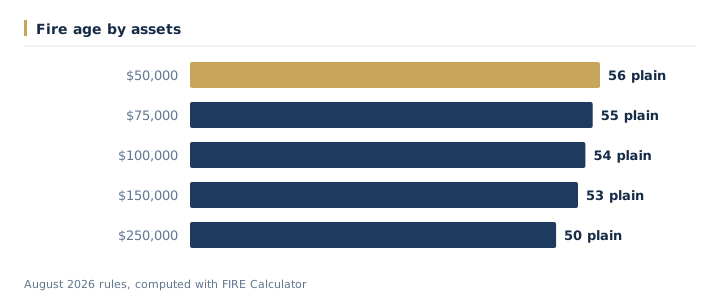
We ran 5 values of assets through the calculator and left every other input at its default. As of August 2026, the output was:
| Assets ($) | Fire age | Years to fire (years) |
|---|---|---|
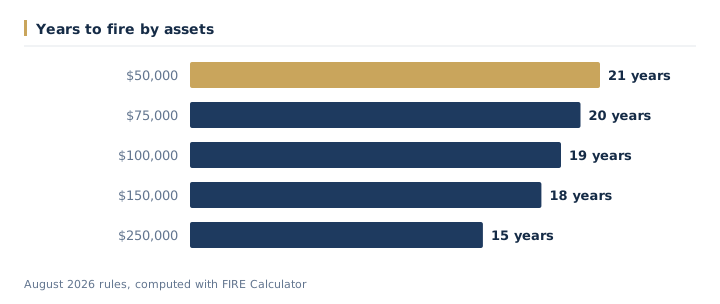
| 50,000 | 56 | 21 years |
| 75,000 | 55 | 20 years |
| 100,000 | 54 | 19 years |
| 150,000 | 53 | 18 years |
| 250,000 | 50 | 15 years |
Running assets from $50,000 up to $250,000 moves fire age from 56 to 50 — a spread of 6. That gap is the part a single headline rate never shows.
The same runs seen through years to fire
At $50,000, years to fire works out to 21 years; at $250,000 it is 15 years. Looking only at fire age tends to understate how much the outcome shifts across that range.
Assumptions behind these figures
| Input | Value |
|---|---|
| Age | 35 |
| Assets | $100,000 |
| Expenses | $50,000 |
| Savings | $25,000 |
| Ret | 7% |
| Swr | 4% |
| Coast target | 65 |
| As of | August 2026 |
| Method | identical to /tools/fire-calculator |
Brackets, thresholds and rates change from year to year, so treat these as August 2026 figures for the 2026 tax year. For your own situation, open the FIRE Calculator and enter your real numbers — the calculator runs the same code that produced every figure on this page.
Frequently Asked Questions
What is the 4% rule in retirement planning?
The 4% rule is a guideline suggesting a retiree withdraw 4% of their portfolio's starting value in year one, then increase that dollar amount each year by inflation, regardless of market performance. It was derived from historical U.S. market data by financial planner William Bengen as roughly the highest withdrawal rate that survived the worst historical 30-year retirement periods. It is a starting estimate, not a guarantee, and outcomes can vary with future market conditions.
Is the 4% rule still considered safe today?
The 4% rule is generally viewed as a reasonable starting point rather than a guaranteed safe rate, since it was based on about 30 years of historical U.S. returns and doesn't account for taxes, fees, or a much longer retirement horizon. It performed well in most historical scenarios and often left a surplus, but a future worse than anything in the historical record could still challenge it. Many planners treat it as a flexible framework with annual check-ins rather than a fixed formula, and a financial professional can help tailor it to your situation.
How much do I need saved to retire using the 4% rule?
Under the 4% rule, the rough target is 25 times the annual amount your portfolio needs to cover, since 4% is the inverse of 25. Importantly, this multiple should be applied only to the spending gap left after subtracting guaranteed income like Social Security or a pension, not your total annual spending. Two people with identical lifestyles can therefore need very different portfolio sizes depending on how much guaranteed income they have.
What is sequence-of-returns risk and why does it matter for the 4% rule?
Sequence-of-returns risk is the danger that poor investment returns early in retirement, combined with ongoing withdrawals, can permanently damage a portfolio even if the average return over the full retirement looks fine. Two retirees can earn the same average return over 30 years but end up in very different financial positions purely because of the order those returns occurred in. This is one of the main reasons a strict, unmodified 4% rule can fail in bad early markets, which is why some retirees use more flexible withdrawal strategies instead.
Who came up with the 4% rule?
The 4% rule originated with financial planner William Bengen's 1994 research, which tested historical U.S. market data to find the highest inflation-adjusted withdrawal rate that never exhausted a balanced portfolio over a 30-year retirement, even starting from the worst historical years. It was later reinforced by the Trinity Study, a 1998 analysis examining success rates across different stock and bond mixes. Both are backtests of U.S. historical data, not mathematical guarantees about the future.