Guides
Understanding Required Minimum Distributions (RMDs)
By Editorial Team · Published January 8, 2026 · Updated August 22, 2026 · 13 min read
When RMDs start (age 73, rising to 75), how the IRS Uniform Lifetime Table works, the steep penalty for missing one, and how QCDs help.
There is a line on Form 5329 that has cost retirees more money, per keystroke, than almost anything else in the tax code. It is the line where you report a required minimum distribution you were supposed to take and didn't. For decades the price of that mistake was a 50% excise tax on whatever you failed to withdraw. The SECURE Act 2.0 of 2022 softened it to 25%, and to 10% if you fix it fast enough. That is still a brutal toll on money you forgot to move from one account to another.
So start here, with the consequence, because the consequence is what makes the rest of this worth reading. If your required withdrawal for the year is $20,000 and you take nothing, the IRS wants $5,000 off the top as a penalty — and then you still owe ordinary income tax on the $20,000 once you finally pull it out. Two hits on the same dollars, one of them entirely avoidable by understanding a schedule.
That schedule is what this article walks through: when required minimum distributions switch on for you, what happens in that first strange year, and what each year after looks like. Treat the dates as hard. They are.
What this money actually is, and why the IRS wants it now
A required minimum distribution — everyone says "RMD" — is the smallest amount you're forced to pull each year from a tax-deferred retirement account once you hit a certain age. The reasoning isn't mysterious. Money that went into a traditional 401(k) or traditional IRA either went in pre-tax or grew without being taxed along the way. The government deferred that tax. It did not forgive it. RMDs are the mechanism that makes sure the deferred tax gets paid during your lifetime instead of being handed, untaxed, to the next generation forever.
The withdrawn amount is taxed as ordinary income in the year you take it. There's no separate "RMD tax rate." The dollars just land on your return next to your pension, your interest, your taxable Social Security, and get taxed at whatever marginal rate that stack reaches. This is the part people underestimate. A large RMD doesn't only cost you the tax on the withdrawal. It can push your bracket up, drag more of your Social Security into the taxable column, and two years later raise your Medicare premiums through the income surcharge known as IRMAA. The ripple is often bigger than the splash.
One reassurance and one warning. You can always take out more than the minimum; the RMD is a floor, not a ceiling. But you cannot skip it, and you cannot roll an RMD into another retirement account. An RMD is never rollover-eligible. Get that wrong and you can manufacture an excess contribution on top of the missed distribution.
Before the timeline: which accounts even count
Most tax-deferred employer and individual accounts are in scope. A few are not.
| Account type | RMDs for the original owner? |
|---|---|
| Traditional IRA | Yes |
| SEP and SIMPLE IRA | Yes |
| Traditional 401(k), 403(b), 457(b) | Yes |
| Roth IRA | Never |
| Roth 401(k)/403(b) | No, beginning tax year 2024 (SECURE 2.0) |
| Inherited IRA (any type) | Yes, under separate beneficiary rules |
That Roth 401(k) row is recent and worth a sentence. Before 2024, Roth 401(k)s required RMDs even though the money was already after-tax — an oddity savers routinely sidestepped by rolling the Roth 401(k) into a Roth IRA. SECURE 2.0 ended lifetime RMDs on Roth-designated employer accounts starting in 2024, finally lining them up with Roth IRAs. If your plan didn't get the memo, push on it.
Inherited accounts run on an entirely different rulebook. Most non-spouse beneficiaries who inherited after 2019 have to empty the account inside ten years, often with annual withdrawals along the way. That is its own article. For now, just hold the distinction: "my IRA" and "an IRA I inherited" are not the same animal.
Your RMD timeline
Think of RMDs less as a rule and more as a calendar that switches on at a fixed age and then repeats every December for the rest of your life. Here is that calendar, year by year.
The trigger year: age 73 (or 75)
SECURE 2.0 raised the starting age in two steps, and your birth year decides which one is yours.
| Birth year | RMD start age | First RMD year |
|---|---|---|
| 1950 or earlier | 72 (70½ under older rules) | Already in effect |
| 1951–1959 | 73 | The year you turn 73 |
| 1960 or later | 75 | The year you turn 75 |
Born in 1955? Your start age is 73. Born in 1962? You don't begin until 75. That staggered design quietly hands some savers extra runway, and the runway is worth real money. Every year before RMDs begin is a year you, not the IRS, decide how much taxable income you report — room for Roth conversions, for harvesting gains in a low bracket, or simply for staying put in a cheaper one. The RMD Calculator will show you how much delaying the start actually shrinks the early withdrawals, and the Retirement Income Calculator shows how it fits the whole picture.
These ages moved recently and could move again. Verify the current IRS start age for your exact birth year before you act on it — do not assume the number a friend two years older quoted you still applies.
The first year: the April 1 fork in the road
The first RMD comes with a one-time option that has trapped a lot of careful people.
Every normal RMD is due by December 31. The first one is different: you may delay it all the way to April 1 of the year after you reach your start age. That sounds like a free deferral. It usually isn't.
Here's the trap. Delaying the first RMD does nothing to the second. If you push RMD number one into the next calendar year, that year now contains two RMDs — the delayed first one due by April 1 and the regular second one due by December 31. Stacking two taxable distributions into a single tax year frequently bumps your bracket and, two years downstream, your IRMAA tier. For most retirees the cleaner move is to take the first RMD in the year you actually turn the start age and never use the April 1 extension at all. The extension exists for cash-flow emergencies, not as a default.
Every year after: divide, withdraw, repeat
From the second RMD onward the rhythm is monotonous, which is good — monotony is hard to forget.
The formula is one division:
RMD = (account balance on December 31 of the prior year) ÷ (your life-expectancy factor)
For nearly everyone the factor comes from the IRS Uniform Lifetime Table. Look up your age for the distribution year, find the published factor, divide. One exception matters: if your sole beneficiary is a spouse more than ten years younger than you, you use the Joint Life and Last Survivor Table instead, which produces a smaller required amount. Using the wrong table here means withdrawing — and taxing — more than you had to.
The factor gets smaller every year you age, so even if your balance never changes, the required percentage of the account climbs. It's roughly 3.8% at 73, crosses 5% in the early 80s, and keeps rising from there.
A worked example you can follow with your own numbers
Margaret turns 73 in 2025. Her traditional IRA was worth $500,000 on December 31, 2024. The Uniform Lifetime Table factor at age 73 is 26.5 — confirm the current published factor, because the IRS does revise these tables.
$500,000 ÷ 26.5 = $18,868 (rounded)
Margaret has to withdraw at least $18,868 during 2025 (or by April 1, 2026, if she uses the first-year extension, with all the bracket consequences discussed above). That $18,868 joins the rest of her 2025 taxable income.
Now move her forward to age 80. Say the account has grown and her prior-year balance is $520,000. The age-80 factor is about 20.2:
$520,000 ÷ 20.2 = $25,743
Roughly the same account, a withdrawal almost 37% larger. That is the rising-percentage effect doing exactly what it was designed to do — accelerate the drawdown as you age. Run your own balance through the RMD Calculator for several future ages at once; watching the required figure climb on a flat balance is the fastest way to understand why so many people front-load Roth conversions before the calendar turns 73.
A wrinkle in the schedule: which accounts you can combine
People assume one withdrawal covers everything. It depends entirely on the account type, and getting this wrong is a classic way to under-withdraw without realizing it.
- Traditional IRAs, including SEP and SIMPLE. Compute the RMD for each IRA separately, then total them and take the combined dollar amount from any one IRA or any mix of them. The IRS only cares that the aggregate comes out.
- 403(b) accounts. Similar aggregation is allowed among 403(b)s.
- 401(k) and other employer plans. No aggregation. Each 401(k) must satisfy its own RMD from that specific plan. An IRA withdrawal cannot cover a 401(k) RMD, and vice versa.
The practical takeaway: two old 401(k)s mean two separate RMDs from two separate plans. Orphaned former-employer 401(k)s are, in my experience reading these situations, the single most commonly missed RMD there is. Consolidating old employer plans into one IRA before age 73 both removes that risk and simplifies aggregation forever after.
When the penalty actually applies, and how to survive it
Back to where we started. Miss or short an RMD and the excise tax is:
- 25% of the shortfall, generally.
- 10% if you correct it within the SECURE 2.0 correction window — broadly, by the end of the second year after the missed RMD and before the IRS issues a deficiency notice — and file the right paperwork.
There is a relief valve. The IRS can waive the penalty entirely for reasonable cause if you take the missed distribution and file Form 5329 with an explanation. Waivers do get granted. But planning around an expected waiver is planning to lose; treat the deadline as immovable and the waiver as the thing you hope you never need.
Two ways out from under the tax
Qualified charitable distributions
If you give to charity anyway, the qualified charitable distribution is the most tax-efficient instrument available to an RMD-age IRA owner, full stop. From age 70½ you can send up to an annually indexed limit — roughly $108,000 in 2025, confirm the current IRS figure — directly from your IRA to a qualified charity.
What makes it powerful is the mechanics, not the sentiment. A QCD counts toward your RMD for the year, and it is excluded from taxable income entirely. That's better than taking the RMD and deducting a donation, because the exclusion lowers your adjusted gross income itself — which in turn can reduce how much of your Social Security is taxed, hold down your IRMAA tier, and protect other AGI-sensitive benefits. The money must go straight from the custodian to the charity, never through your hands; donor-advised funds generally don't qualify; and QCDs work for IRAs, not 401(k)s.
The still-working exception
This one applies to employer plans only — never to IRAs. If you're still employed by the company that sponsors your 401(k), 403(b), or 457(b), and you do not own more than 5% of that company, you may generally defer RMDs from that specific plan until April 1 of the year after you actually retire. The fences around it:
- It does nothing for IRAs. Those start on schedule no matter who you work for.
- It does nothing for 401(k)s left at former employers.
- It evaporates if you own more than 5% of the business.
A tempting and sometimes costly move is rolling an old 401(k) into your current employer's plan to shelter it under this exception. It can work — but only if the plan accepts incoming rollovers and you genuinely keep working there.
Mistakes I see again and again
- Forgetting the old 401(k) at the job you left in 2009. No aggregation across 401(k)s; that account owes its own RMD.
- Using the April 1 first-year extension without running the two-RMDs-in-one-year math.
- Assuming a Roth 401(k) still needs an RMD. Not since 2024 — but confirm your plan applied the change.
- Pulling from an IRA to "cover" a 401(k) RMD. Aggregation doesn't cross that line; the 401(k) is still short.
- Rolling over RMD dollars. They're not rollover-eligible, and doing it can spawn an excess contribution.
- Skipping the QCD while giving cash and itemizing — often the more expensive way to be charitable.
- Using the Uniform Lifetime Table when a much-younger spouse means the Joint Life table (and a smaller RMD) applies.
Questions people actually ask about RMDs
What age do RMDs start for me?
Birth year decides it. 1951–1959 means a start age of 73; 1960 or later means 75; 1950 or earlier means you're already subject to them. Because SECURE 2.0 changed these and could change them again, confirm the current IRS start age for your birth year rather than relying on an older relative's number.
Do Roth accounts have RMDs?
Roth IRAs never require RMDs during the original owner's lifetime. Roth 401(k)s joined them starting in 2024. Inherited Roth accounts, however, do carry distribution requirements for the beneficiary.
I missed a deadline — now what?
Take the missed amount immediately, file Form 5329, and pay the 25% excise tax (10% if you're inside the SECURE 2.0 correction window). Request a reasonable-cause waiver in the filing; it may be granted, but act as though it won't be.
Can I satisfy several accounts with one withdrawal?
Across traditional IRAs, yes — total the separate calculations and take the sum from any of them. The same pooling works among 403(b)s. It does not work across 401(k)s; each employer plan pays its own.
How is the dollar amount figured?
Prior-year December 31 balance divided by your age's factor from the IRS Uniform Lifetime Table — or the Joint Life table if your sole beneficiary is a spouse more than ten years younger. The RMD Calculator runs that division per account.
Can I keep contributing after RMDs begin?
Yes, with earned income. There's no age cap on IRA contributions while you (or a spouse) have qualifying earned income, and 401(k) contributions continue while you work. Doing both at once is allowed but rarely optimal unless an employer match or a Roth angle justifies it.
Sources
- Internal Revenue Service — retirement plan and RMD rules
- Social Security Administration — benefits and income coordination
- Medicare — Part B and Part D income-related premium surcharges
- Centers for Medicare & Medicaid Services — program administration
- Consumer Financial Protection Bureau — retirement money decisions
The short version
- The penalty for a missed RMD is 25% of the shortfall (10% if corrected promptly) on top of the income tax you still owe — the most avoidable cost in retirement.
- Your start age is 73 (born 1951–1959) or 75 (born 1960+); verify the current IRS age for your birth year.
- The first-year April 1 extension stacks two RMDs into one tax year — usually a bracket and IRMAA mistake.
- The amount is prior-year-end balance ÷ the Uniform Lifetime Table factor, and the required percentage climbs every year even on a flat balance.
- IRAs aggregate; 401(k)s do not — hunt down every old employer plan, and use QCDs if you give to charity.
The figures, ages, and tables in this article are general U.S. educational information current as of 2025, not personalized tax, legal, or financial advice. These rules are revised regularly — check the current numbers with the IRS or your own advisor before you act on anything here.
Run the numbers
Everything below came out of this site's own RMD Calculator. The figures are not quoted from anywhere else: each row is one run of the same calculation the tool page performs, using August 2026 rules. Put the same inputs in and you will get the same output.
How the result moves with balance
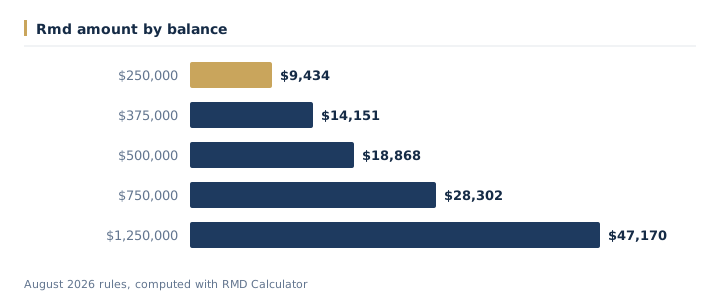
We ran 5 values of balance through the calculator and left every other input at its default. As of August 2026, the output was:
| Balance ($) | Rmd amount ($) | Penalty if missed ($) |
|---|---|---|
| 250,000 | 9,433.96 | 2,358.49 |
| 375,000 | 14,150.94 | 3,537.74 |
| 500,000 | 18,867.92 | 4,716.98 |
| 750,000 | 28,301.89 | 7,075.47 |
| 1,250,000 | 47,169.81 | 11,792.45 |
Running balance from $250,000 up to $1,250,000 moves rmd amount from $9,434 to $47,170 — a spread of $37,736. That gap is the part a single headline rate never shows.
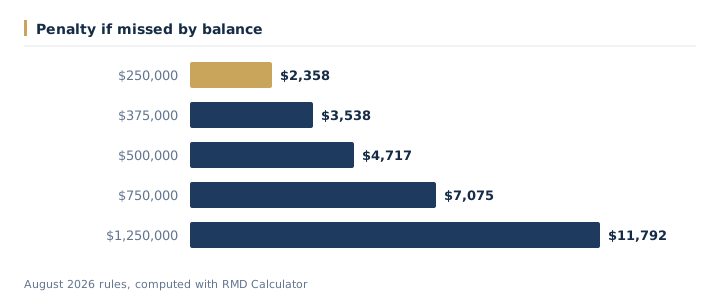
The same runs seen through penalty if missed
At $250,000, penalty if missed works out to $2,358; at $1,250,000 it is $11,792. Looking only at rmd amount tends to understate how much the outcome shifts across that range.
Assumptions behind these figures
| Input | Value |
|---|---|
| Age | 73 |
| Balance | $500,000 |
| As of | August 2026 |
| Method | identical to /tools/rmd-calculator |
Brackets, thresholds and rates change from year to year, so treat these as August 2026 figures for the 2026 tax year. For your own situation, open the RMD Calculator and enter your real numbers — the calculator runs the same code that produced every figure on this page.
Frequently Asked Questions
When do required minimum distributions start?
Required minimum distributions generally start at age 73 for most people currently approaching that age, with the starting age scheduled to rise to 75 for those born in 1960 or later, under SECURE Act 2.0 rules. Your exact starting age depends on your birth year, so confirm the current rule for your specific situation with the IRS rather than assuming a number a friend mentioned still applies. Roth IRAs are not subject to these lifetime distribution requirements for the original owner.
What happens if I miss an RMD?
Missing a required minimum distribution generally triggers an IRS excise tax on the shortfall, which was reduced from a historical 50% down to 25%, and further to 10% if corrected within a defined window. You would still also owe ordinary income tax on the distribution once you do take it, so a missed RMD can mean paying twice on the same dollars. If you discover a missed RMD, it's best to withdraw the missed amount and address the correction promptly, ideally with guidance from a tax professional.
Can I roll an RMD into another retirement account?
No — a required minimum distribution is never eligible for rollover into another retirement account. Attempting to roll it over can create an excess-contribution problem on top of the original missed-distribution issue. The RMD amount must be withdrawn and treated as taxable income for that year.
Do Roth accounts have RMDs?
Roth IRAs generally have no required minimum distributions for the original owner. Under recent SECURE Act 2.0 changes, Roth-designated employer accounts like Roth 401(k)s also no longer require lifetime RMDs, bringing them in line with Roth IRAs. This is one reason some retirees convert traditional balances to Roth accounts earlier in retirement, to reduce future forced distributions — though this decision should be weighed with a tax professional.
What is a qualified charitable distribution and how does it relate to RMDs?
A qualified charitable distribution, or QCD, generally lets an eligible IRA owner send money directly from their IRA to a qualifying charity, and that amount can typically count toward satisfying that year's required minimum distribution without being added to taxable income. This can be useful for retirees who are charitably inclined and don't need the RMD amount for living expenses. Specific eligibility rules and annual limits apply, so check current IRS guidance or consult a tax professional before using this strategy.