Guides
Understanding 401(k), IRA, and Other Retirement Accounts
By Editorial Team · Published December 10, 2025 · Updated August 22, 2026 · 12 min read
How 401(k), Roth and traditional IRA, HSA, and taxable accounts differ — plus the contribution priority order that actually maximizes your money.
Here is the question that comes up more than any other, in some form: "I have a 401(k) at work and I keep hearing I should also have a Roth IRA — aren't those the same thing? Which one do I actually use?" The confusion is completely reasonable, and clearing it up is the foundation for everything else, so let's resolve it before going anywhere near a priority list.
A 401(k) and an IRA are not competing products. They are containers. Both can hold the exact same index fund. What differs is two things: who sponsors the container (your employer sponsors a 401(k); you open an IRA yourself), and how the tax authorities treat the money going in and coming out. "Roth" and "traditional" aren't accounts at all — they're tax flavors that exist inside both containers. So a Roth IRA and a Roth 401(k) share a tax treatment but live in different containers; a Roth 401(k) and a traditional 401(k) share a container but have opposite tax treatments. Once that grid clicks, the alphabet soup stops being soup. Almost every account below is just one of those two tax flavors poured into one of a few containers.
A note on every number that follows: contribution limits and income phase-outs are set by the IRS and indexed, so they move each year. The figures here are labeled by year to show the shape of the rule. Confirm the live IRS amount before you contribute.
The two tax flavors, because everything reduces to these
- Traditional / pre-tax. The contribution goes in before income tax, grows untaxed, and is taxed as ordinary income when you withdraw it. Deduction now, tax bill later.
- Roth / after-tax. The contribution is money you've already paid tax on, it grows untaxed, and qualified withdrawals come out entirely tax-free. Tax now, never again on that money or its growth.
That's the whole engine. The traditional-vs-Roth decision is, stripped down, a bet on your own future tax rate: traditional wins if your rate is lower when you withdraw, Roth wins if it's the same or higher. Nobody knows future tax rates, which is the honest case for holding both — not as a hedge cliché, but because in retirement it lets you choose, year by year, which bucket to draw from based on the bracket you actually land in that year. That optionality is worth real money, and it's the single most under-appreciated reason to diversify across tax flavors.
The whole menu on one table
This is the spine of the article. Everything after it is commentary on a row.
| Container | Tax flavors available | Who opens it | 2025 limit (verify current IRS figure) | The one thing to know |
|---|---|---|---|---|
| 401(k) | Traditional and Roth | Employer | $23,500 employee deferral; +$7,500 at 50+; +$11,250 super catch-up at 60–63 | The employer match is the headline; capture all of it |
| Traditional IRA | Traditional (deduction may phase out) | You, at any brokerage | $7,000; +$1,000 at 50+ | Deduction phases out if you're covered by a workplace plan |
| Roth IRA | Roth | You, at any brokerage | $7,000; +$1,000 at 50+ | Direct contributions phase out at higher income; backdoor route exists |
| SEP IRA | Traditional | Self-employed / small business | Employer-side only, tied to net earnings | Simple to run; usually shelters less than a solo 401(k) |
| SIMPLE IRA | Traditional | Small businesses with staff | Lower than 401(k); mandatory employer contribution | Built for small employers, not true solo earners |
| Solo 401(k) | Traditional and Roth | Owner-only business | "Employee" + "employer" contributions combined | Often the largest total shelter for a profitable solo |
| HSA | Triple tax-free (medical) | You, if on a qualifying HDHP | $4,300 self / $8,550 family; +$1,000 at 55+ | Technically medical; functionally the best retirement account |
| Taxable brokerage | None — taxed normally | You, anytime | No cap | No limits, no penalties, no RMDs; the early-retirement bridge |
The rest of this piece walks the rows that need more than a sentence, then gives an opinionated order for filling them.
The 401(k): your workplace workhorse
The 401(k) carries most Americans' retirement savings, and its defining feature isn't the tax treatment — it's the match. Many employers add money based on what you contribute, a common shape being 100% of the first 3% of pay plus 50% of the next 2%. That is an immediate, contractual return no market investment can reliably touch. Contribute at least enough to collect every matched dollar; anything less is unclaimed compensation, full stop. And the match sits under a separate, much higher combined limit, so capturing it never eats into how much of your own money you can defer. The 401(k) Calculator will show what that match compounds into over a career, and the number tends to end most debates.
Most plans now offer traditional and Roth flavors within the same deferral limit. The rule of thumb I'd give: Roth when you're in a low bracket and expect a higher one later (often early career), traditional when you're in a high bracket now and expect a lower one in retirement. As of 2024, Roth 401(k)s no longer force lifetime RMDs on the original owner, which quietly removed their main historical drawback.
One detail trips up nearly everyone who goes "all Roth": the employer match has traditionally landed in a pre-tax sub-account even when your own contributions are Roth. SECURE Act 2.0 now permits Roth matching if a plan elects it, but plenty of plans still default to pre-tax. So a saver who believes they're 100% Roth may be quietly building a traditional balance through the match. That's fine — it actually helps tax diversification — but you should know it's there rather than discover a taxable bucket you didn't think you created.
The IRA: the account you control
You open an IRA yourself, independent of any employer, with a 2025 limit of $7,000 (plus $1,000 at 50+). Because you choose the brokerage, an IRA usually offers a far broader and cheaper investment menu than a workplace 401(k) — which is exactly why my priority order below sends you to max an IRA before returning to the 401(k) beyond the match.
The traditional IRA's contribution may be deductible, but the deduction phases out at higher incomes if you or a spouse are covered by a workplace plan. Even when it phases out fully, a nondeductible traditional contribution is still allowed, and that's the on-ramp to the backdoor Roth. Growth is tax-deferred; withdrawals are ordinary income; RMDs start at 73 (rising to 75 for those born in 1960 or later).
The Roth IRA is the one I'd fight hardest to fund: tax-free growth, tax-free qualified withdrawals, and no RMDs for the original owner, which makes it a standout for both flexibility and estate planning. A lesser-known feature adds a safety valve — your direct contributions (not earnings) can generally be pulled out anytime, tax- and penalty-free, so a Roth doubles as an emergency backstop of last resort, though raiding it sacrifices irreplaceable tax-free compounding. Direct contributions phase out above certain incomes; the "backdoor" route (nondeductible traditional contribution, then convert to Roth) keeps it reachable for higher earners. The Roth vs. Traditional IRA Calculator lets you compare the two under your own bracket assumptions.
If you're self-employed
Self-employment income unlocks containers with much higher ceilings than a standard IRA. For a profitable owner-only business, a solo 401(k) usually allows the largest tax-advantaged contribution, because you contribute as both the "employee" and the "employer." A SEP IRA is simpler to administer but only uses the employer side, so for the same income it typically shelters less. The SIMPLE IRA is really aimed at small businesses with staff, not solo earners. A freelancer netting $120,000 might combine the full employee deferral with an employer profit-sharing contribution figured from net earnings and land far above any IRA's limit. The right pick turns on whether you have employees, how much paperwork you'll tolerate, and how much you're trying to shelter — and switching plans later carries administrative friction, so it's worth modeling before you commit.
The HSA: the retirement account hiding in your health plan
If you're enrolled in a qualifying high-deductible health plan, the HSA is arguably the most tax-efficient retirement account in existence — contributions pre-tax, growth tax-free, and qualified medical withdrawals tax-free too. 2025 limits are $4,300 self-only and $8,550 family, plus $1,000 at 55+.
The strategy that turns it from a medical account into a retirement account: contribute the max, invest it instead of spending it, pay current medical bills out of pocket, and let it compound for decades. The mechanic that makes this almost unfair is that there's no deadline to reimburse a qualified expense. Pay a $2,000 bill today, keep the receipt, and you can reimburse yourself tax-free years later after the money has grown — documented medical spending becomes a tax-free withdrawal you can trigger on demand. In retirement, qualified medical withdrawals (which retirees have plenty of) stay tax-free, and after 65 non-medical withdrawals are simply taxed like a traditional account, no penalty. Worst case it's a traditional IRA; best case it beats a Roth. That asymmetry is why it ranks where it does below.
The taxable brokerage
No limits, no early-withdrawal penalty, no RMDs. You pay tax on dividends and on gains when you sell, but long-term gains get preferential rates, and the unrestricted access is the point. It's the natural home for money beyond the tax-advantaged caps and the essential bridge for anyone retiring before 59½. Two quiet advantages people miss: holding a position over a year qualifies the gain for the lower long-term rate, and assets held until death generally get a "step-up in basis" that can erase decades of unrealized gains for heirs. Used patiently, it's more tax-efficient than its reputation.
The order I'd actually fill these in
No single sequence fits everyone, but this one balances free money, tax efficiency, and access, and I'll defend it as a strong default:
- 401(k) up to the full match. Guaranteed return first. Nothing outranks it.
- HSA to the max, if eligible. The only triple-tax-free container; treat it as retirement money, not a medical checking account.
- IRA to the max, usually Roth. Broader, cheaper investments and tax diversification.
- Back to the 401(k) toward the deferral limit.
- Taxable brokerage for everything beyond, and for pre-59½ liquidity.
Now the opinionated part, because the order has real exceptions and pretending it doesn't is how generic advice fails people. If you carry high-interest debt, attack it after capturing the match but before maxing anything else — a 22% credit card balance beats almost any expected return. If you have no emergency cushion at all, build a starter one before step 2; an HSA does you no good if a car repair forces a 401(k) loan. And if you're aggressively chasing early retirement, deliberately overweight the taxable brokerage and Roth contributions, because both give you penalty-free access before 59½ that a traditional 401(k) does not. The principle underneath — free money, then the most tax-advantaged dollars, then flexibility — survives even when the exact steps get reordered.
A quick illustration of the order in motion, and of how it bends for a higher earner. Devon, 35, earns $95,000 with a 100%-of-first-4% match: contributing 4% ($3,800) pulls $3,800 of employer money instantly, then an HSA, then a Roth IRA, then more 401(k). Alia, 44, earns $210,000 and is over the direct Roth income limit: she captures her match, maxes a family HSA, and because direct Roth is off the table makes a $7,000 nondeductible traditional contribution and converts it — the backdoor Roth — then leans hard on pre-tax 401(k) deferrals to manage a steep current bracket. Same logic, different execution. (The backdoor Roth has a pro-rata-rule complication when other pre-tax IRA money exists; that one genuinely warrants professional input before you execute it.)
Questions that come up a lot
Max the 401(k) or the IRA first? Full match first, always — it's free money. After that, many savers max an IRA (often Roth) before returning to the 401(k), because IRAs usually have broader, cheaper investment menus, then go back to the 401(k) toward its higher limit.
Can I fund both a 401(k) and an IRA in the same year? Yes; the limits are separate. Your ability to deduct a traditional IRA contribution may phase out if you're covered by a workplace plan, and direct Roth contributions phase out at higher income, but you can generally still use both containers — and the backdoor keeps the Roth reachable above the income cap.
Is an HSA really a retirement account? Functionally yes, if you invest it rather than spend it. Triple-tax-free for medical costs, penalty-free (taxable) for anything after 65, plus the ability to reimburse old documented expenses years later — that combination makes it one of the most efficient long-term accounts available to eligible savers.
What happens to my 401(k) when I leave a job? Leave it, roll it to the new plan, or roll it to an IRA. Rolling preserves the tax treatment and cuts the number of accounts you have to watch. Cashing out is almost always the worst option because of taxes, penalty, and lost compounding.
Who actually needs the backdoor Roth? People whose income exceeds the direct Roth IRA limit. It restores tax-free Roth growth for higher earners via a nondeductible contribution then a conversion, but the pro-rata rule can create a tax bill if you hold other pre-tax IRA money, so confirm the mechanics first.
Key takeaways
- Every account is a container plus a tax flavor; "Roth" and "traditional" exist inside both 401(k)s and IRAs, which dissolves most of the confusion.
- Capture the full employer match before anything else — it's guaranteed return and sits under a separate limit, so it never reduces your own deferral room.
- An HSA on a qualifying health plan is the most tax-efficient container available; invest it and leave it alone.
- A defensible default order is match → HSA → IRA → rest of 401(k) → taxable, but high-interest debt, a missing emergency fund, and an early-retirement goal all legitimately reorder it.
- The 2025 figures ($23,500 401(k), $7,000 IRA, $4,300/$8,550 HSA) are indexed annually — confirm the current IRS numbers before contributing.
Sources
- Internal Revenue Service — retirement plans and contribution limits
- U.S. Department of Labor — employer-sponsored retirement plans
- Consumer Financial Protection Bureau — saving and retirement basics
- Social Security Administration — benefits and retirement
This is general educational material about how U.S. retirement accounts work, written for a wide readership and not tailored to anyone's individual finances; it isn't investment, tax, or legal advice. Limits, deductibility, and phase-outs reset every year, so verify the current IRS figures and consult a qualified professional about your own situation before acting.
Run the numbers
Everything below came out of this site's own 401(k) Calculator. The figures are not quoted from anywhere else: each row is one run of the same calculation the tool page performs, using August 2026 rules. Put the same inputs in and you will get the same output.
How the result moves with salary
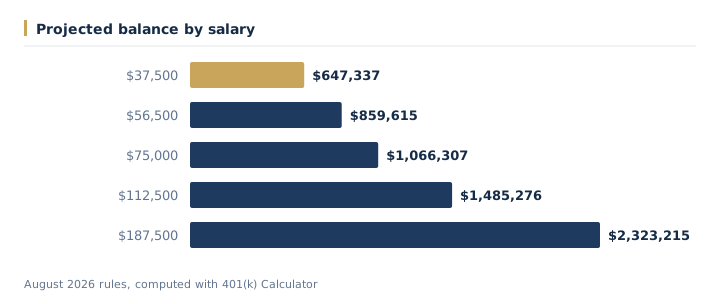
We ran 5 values of salary through the calculator and left every other input at its default. As of August 2026, the output was:
| Salary ($) | Projected balance ($) | Employee contributions ($) | Employer match ($) |
|---|---|---|---|
| 37,500 | 647,337.18 | 91,278.18 | 45,639.09 |
| 56,500 | 859,615.08 | 137,525.79 | 68,762.89 |
| 75,000 | 1,066,306.71 | 182,556.36 | 91,278.18 |
| 112,500 | 1,485,276.24 | 273,834.53 | 136,917.27 |
| 187,500 | 2,323,215.3 | 456,390.89 | 228,195.45 |
Running salary from $37,500 up to $187,500 moves projected balance from $647,337 to $2,323,215 — a spread of $1,675,878. That gap is the part a single headline rate never shows.
The same runs seen through employee contributions
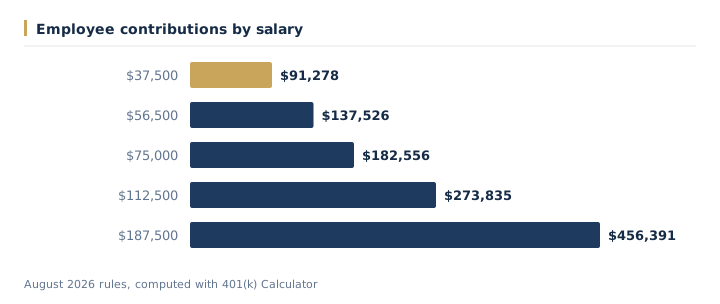
At $37,500, employee contributions works out to $91,278; at $187,500 it is $456,391. Looking only at projected balance tends to understate how much the outcome shifts across that range.
Assumptions behind these figures
| Input | Value |
|---|---|
| Current age | 35 |
| Retire age | 65 |
| Salary | $75,000 |
| Balance | $30,000 |
| Emp pct | 6% |
| Match pct | 50% |
| Match cap | $6 |
| Ret | 7% |
| Raise | 2% |
| As of | August 2026 |
| Method | identical to /tools/401k-calculator |
Brackets, thresholds and rates change from year to year, so treat these as August 2026 figures for the 2026 tax year. For your own situation, open the 401(k) Calculator and enter your real numbers — the calculator runs the same code that produced every figure on this page.
Frequently Asked Questions
What's the difference between a 401(k) and an IRA?
A 401(k) and an IRA are generally best understood as different containers rather than competing products — a 401(k) is sponsored by your employer, while an IRA is one you open yourself at a brokerage of your choosing. Both can hold similar underlying investments, and both are generally available in traditional and Roth tax-treatment versions. IRAs typically offer a broader investment menu since you choose the provider, while 401(k)s often come with valuable features like an employer match that IRAs don't have.
What's the difference between Roth and traditional accounts?
Traditional accounts generally let you contribute before tax, grow the balance tax-deferred, and pay ordinary income tax on withdrawals later, while Roth accounts are funded with after-tax money, grow tax-free, and generally allow qualified withdrawals to come out completely tax-free. This distinction — tax now versus tax later — applies within both 401(k)s and IRAs, since Roth and traditional are tax treatments rather than separate account types. Which is better for you generally depends on whether you expect your tax rate to be higher now or in retirement.
What order should I prioritize funding my retirement accounts?
A commonly suggested general order is to contribute enough to your 401(k) to capture the full employer match first, since that's typically an immediate, guaranteed return, then consider maxing out an HSA if you're eligible, given its unique triple tax advantage, then an IRA for its typically broader investment menu, and finally additional 401(k) contributions up to the full limit. This order isn't a strict rule for everyone, and personal circumstances like income limits or plan fees can change the optimal sequence, so adapt it to your own situation, ideally with a financial professional's input.
What is an HSA and how does it relate to retirement accounts?
A Health Savings Account is generally available to those covered by a qualifying high-deductible health plan and offers a rare triple tax advantage: tax-deductible contributions, tax-free growth, and tax-free withdrawals for qualified medical expenses. Because unused balances roll over indefinitely and can be invested for growth, many people treat it functionally as an additional retirement account rather than just a healthcare spending account. After age 65, non-medical withdrawals are generally taxed like a traditional IRA distribution without the earlier penalty, adding further retirement flexibility.