Guides
The Complete Guide to Retirement Planning in 2026
By Editorial Team · Published November 30, 2025 · Updated August 22, 2026 · 16 min read
A decade-by-decade retirement planning roadmap: setting your number, account choices, asset allocation, Social Security timing, and drawdown.
If I could give one piece of advice to someone who feels behind, it would be this: retirement is not a number you hit, it's a system you run for forty years. The number changes. Your income changes. The tax code changes roughly every time Congress is bored. What doesn't change is the handful of decisions that actually move the needle — how much you put away, which accounts you put it in, how it's invested, and the order in which you eventually spend it down. Get those right and the rest is housekeeping.
This guide is organized the way the work actually unfolds: roughly by decade, because the priorities in your 20s are not the priorities in your 60s, and pretending otherwise produces the kind of generic advice nobody can act on. After the decade roadmap there are a few cross-cutting topics — your target number, asset allocation, Social Security, healthcare, and the drawdown — that don't belong to any single age but matter throughout. Read the decade you're in first. Then read the one after it, because the most expensive mistakes are the ones you only see coming a decade too late.
One ground rule before we start. Every dollar figure here carries a year label because contribution limits and benefit thresholds are indexed and move annually. Treat them as the shape of the rule, not the current digit, and confirm the live IRS or SSA number before you act on it.
Your 20s and 30s: the cheap years
Nobody in their 20s feels rich, and almost everybody in their 20s is sitting on the single most valuable asset they will ever own: time. A dollar invested at 25 has about four decades to compound. The same dollar invested at 45 has roughly half that. Because compounding is exponential, not linear, the modest amounts you save early frequently end up contributing more to your final balance than the much larger amounts you save in your peak-earning years. That is not a motivational slogan; it's arithmetic, and it's the reason this is the cheapest decade to fund a retirement.
The part people get wrong here is treating the 401(k) match as optional. It is not an investment decision. It is a clause in your compensation that pays out only if you contribute enough to trigger it. Skipping it is a voluntary pay cut. So the first move, before anything clever, is contributing at least up to the full match.
After that, a short list:
- Build a starter emergency fund — three to six months of expenses — so a busted transmission doesn't become a 401(k) raid with taxes and a penalty attached.
- Lean Roth while your bracket is low. You are unlikely to ever pay a lower marginal rate than you do in your first jobs, and Roth locks that rate in.
- Automate the escalation. Bump your contribution rate one percentage point a year, or tie it to every raise, so the increase happens before the money ever feels like yours.
That last point carries more weight than its plainness suggests. A contribution you have to initiate by hand every month is competing against rent, a trip, a new phone, and your own willpower, and it loses that fight often enough to matter. A contribution that's pulled before the paycheck lands is one you never had to win. The Retirement Savings Calculator makes this concrete: run a small monthly amount starting at 25 against a larger one starting at 40, and the gap is usually wide enough to end the argument.
Your 40s: where good intentions meet the mortgage
This is the decade the plan gets tested, and not by the markets. By life. Income usually peaks here, but so do the claims on it — a mortgage, kids who are suddenly expensive, sometimes a parent who needs help. Plenty of disciplined savers quietly drift off track in their 40s without a single dramatic decision, just a slow accumulation of "we'll catch up next year."
So the 40s are about two things: pressing the savings rate higher, and finally running a real projection.
On the savings rate: if you started in your 20s and automated increases, you may already be where you need to be, and the job is mostly not sabotaging it. If you started late, this is where the rate has to climb toward 15% of gross and beyond, and where raises should be pointed at the future before lifestyle absorbs them. Lifestyle creep is not a moral failing, it's a default setting; the only reliable counter is diverting the raise before it arrives.
The projection matters more than people expect. By your mid-40s you finally have enough signal to produce a meaningful estimate — real balances, a stable income, a clear-eyed view of what you actually spend — and you still have two decades to respond to what it tells you. A shortfall discovered at 45 is a budgeting problem. The identical shortfall discovered at 63 is a lifestyle problem. The 40s are also the decade to deliberately diversify tax treatment, holding a mix of pre-tax, Roth, and taxable money so that future-you has levers to pull instead of a single locked bucket.
Your 50s: the catch-up decade
Two things change at 50. The IRS lets you contribute more, and the consequences of being wrong get a lot more concrete.
On the contributions: starting the year you turn 50, you get catch-up room on top of the standard limits. For 2025 that's an extra $7,500 on a 401(k) above the $23,500 employee deferral, plus a SECURE Act 2.0 "super catch-up" of $11,250 for ages 60 through 63, and an additional $1,000 on an IRA above the $7,000 base. Those figures are indexed and the super catch-up rules have phase-in wrinkles, so verify the current-year numbers before you build a plan around them. If you started late, this room is the lever; use it.
On the consequences: the 50s are when a projection stops being academic. You can now estimate your real spending, pull a personalized Social Security benefit estimate from SSA, and see honestly whether the trajectory supports the life you're picturing. If there's a gap, you still have time to close it through saving, working a little longer, or trimming the target — three real options, all of them quantifiable. This is also the decade to start mapping the mechanics of the exit: which accounts get drawn first, whether partial Roth conversions make sense in the low-income window between retiring and age 73, and how much stable money you want in place before the paychecks stop. The Roth vs. Traditional IRA Calculator is useful here for testing whether those conversions actually help in your bracket.
Your 60s: the decade the question changes
Everything up to here has been an accumulation question: how do I grow this? The 60s flip it. Now it's a conversion question: how do I turn this pile into a dependable paycheck without running out?
The decisions cluster: when to claim Social Security, when to enroll in Medicare, how to sequence withdrawals so the IRS doesn't take more than it has to, and how to keep a bad market in the first few years of retirement from doing permanent damage. What makes this decade unforgiving is the lack of runway. A mistake at 35 has thirty years to heal. A mistake at 64 has almost none, which is precisely why the decisions here should be modeled deliberately rather than improvised in the weeks around your last day of work. The Retirement Income Calculator is built for exactly this exercise — stacking Social Security, any pension, and portfolio withdrawals into a single monthly figure you can actually live on.
A specific friction point belongs here, because almost nobody plans for it until it's too late: Medicare enrollment is not automatic for everyone, and missing your enrollment window can attach a lifetime premium penalty. If you're still working past 65 with employer coverage, the rules differ again. This is one of those administrative details that has nothing to do with investing and yet quietly costs people money every month for the rest of their lives. Put the enrollment dates on a calendar the year you turn 64, not the month you turn 65.
There's also a planning opportunity hiding in your 60s that doesn't exist before or after: the low-income window. Between the day you stop earning and the year RMDs begin at 73, your taxable income may be unusually low — no salary yet, possibly no Social Security if you've delayed it. That trough is the cheapest time in your life to do partial Roth conversions, moving pre-tax money into Roth at a low bracket so it never gets taxed again and never triggers an RMD. Squander that window and the same dollars get forced out later, at a higher rate, often pushing you into IRMAA. People who model this in their early 60s frequently find it's the single highest-value move of the decade. Test the bracket impact with the Roth vs. Traditional IRA Calculator before you convert anything.
If you have a traditional pension or are considering an annuity to floor your essential spending, the 60s are also when those decisions get made — usually irreversibly. A pension's lump-sum-versus-lifetime-payment choice and an annuity's payout terms are exactly the kind of one-way doors worth modeling carefully with the Pension Calculator and Annuity Calculator rather than deciding under deadline pressure from an HR packet.
Your 70s and beyond: simplify, then protect
Once required minimum distributions begin — age 73 under current rules, moving to 75 for those born in 1960 or later — the job shifts from optimizing to protecting. The goals here are unglamorous and correct: consolidate scattered accounts so there's less to track, document where everything lives so a spouse or executor isn't running a treasure hunt, keep a cash buffer deep enough that a market drop never forces a panicked sale, and revisit beneficiary designations that may be a decade stale. Return is no longer the point. Resilience is, including resilience against the real possibility that your own capacity to manage money declines before your money runs out.
Setting your number
The decade roadmap tells you what to do at each age. It doesn't tell you how much is enough. For that, two estimates triangulate well.
The first works top-down from income. The reasoning is that retirement strips out some big costs — you stop saving for retirement, payroll taxes fall, the commute disappears — while others, healthcare especially, can rise. Many planners land on needing roughly 70–85% of pre-retirement income to hold your lifestyle steady. It's a fast sanity check, not a plan, and it badly misfires for anyone whose retirement spending will look nothing like their working spending.
The second works bottom-up from spending. It's the inverse of the 4% guideline: if a 4% initial withdrawal is roughly sustainable, then the portfolio you need is about 25 times the annual amount the portfolio itself must cover — after Social Security and any pension are subtracted. That subtraction is the step casual estimates skip, and skipping it can overstate the target by hundreds of thousands of dollars, because Social Security replaces a large slice of spending for many households. The 4% framework comes from William Bengen's 1994 research and the later Trinity Study; it's a durable heuristic with well-documented caveats, not a promise.
When the two methods disagree sharply, that disagreement is the useful part. It almost always means your retirement spending will diverge from your working spending, and the fix is to build an actual budget instead of trusting a ratio.
Here's the arithmetic on a real-ish household. Maria is 45, earns $90,000, wants to retire at 67. Eighty percent replacement puts her target income near $72,000. A personalized SSA estimate suggests roughly $30,000 a year at 67, leaving a $42,000 gap the portfolio has to fund. Twenty-five times $42,000 is about $1,050,000. With $250,000 already saved and $1,500 a month going in, a projection shows whether 22 years closes that gap — and if it doesn't, it shows exactly how much more saving or how many more working years it takes. That specificity, available at 45, is the entire argument for running the numbers early instead of discovering the shortfall at 64.
Asset allocation, in plain language
Your split among stocks, bonds, and cash drives portfolio behavior more than any individual fund pick. The trade-off is the whole story: stocks carry higher expected long-run growth and larger short-term swings; bonds soften the swings and grow slower. A reasonable default ties stock exposure loosely to time horizon — growth-heavy when retirement is decades out, gradually steadier as it approaches, but never so conservative that inflation quietly hollows out purchasing power across a 30-year retirement. Target-date funds automate that glide path and are a defensible choice for most people who don't want to manage it by hand.
The behavioral half matters as much as the math, and it gets discussed less. The right allocation is not the one that maximizes a spreadsheet; it's the one you can actually hold through a 30% drop without selling at the bottom. An aggressive portfolio you abandon in a panic is, in practice, worse than a slightly tamer one you can sit through. So the honest question when you choose an allocation isn't only "what's the expected return," it's "what will I actually do if this falls by a third next year." Answer the second one truthfully and let it constrain the first.
Social Security timing
This is the most valuable lever most people understand the least. For anyone born in 1960 or later, full retirement age is 67. Claim at the earliest possible age, 62, and you lock in a permanent reduction of roughly 30% versus the FRA benefit. Wait past FRA and you earn delayed retirement credits worth about 8% a year up to age 70 — an inflation-adjusted, government-backed raise that is genuinely hard to manufacture anywhere else.
There is no universally correct claiming age, and competent advisors disagree at the margins. Delaying tends to favor people with longevity in the family, enough other assets to bridge the gap, and a higher-earning spouse. Claiming early can be entirely rational with health concerns or no other income. The piece that gets overlooked is the survivor benefit: in a married couple, the larger of the two benefits continues for whoever lives longer. Delaying the higher earner's claim therefore buys longevity insurance for the surviving spouse, not just the earner — frequently the single most valuable decision a couple makes, and one almost nobody frames that way before they're forced to. Model your own version with the Social Security Calculator before you commit to anything irreversible.
Healthcare, the line item everyone lowballs
Medicare eligibility starts at 65. The standard Part B premium runs about $185 a month in 2025 (confirm the current figure), and higher-income retirees pay an income-related surcharge, IRMAA, calculated from a tax return filed two years earlier. Retire before 65 and you're bridging coverage through the marketplace, COBRA, or a spouse's plan, a gap that routinely runs into five figures a year.
The two-year IRMAA lookback creates a planning trap most people never see. A large one-time income event in your early 60s — a sizable Roth conversion, a property sale, a lumpy capital gain — can quietly inflate your Medicare premiums two years later. Coordinating the timing of taxable income against future IRMAA thresholds is advanced, but it's real money, and it's the kind of thing worth raising with a professional before you trigger the income, not after.
The drawdown
Accumulating is half the job. Turning the pile into income that lasts is the half where mistakes are least recoverable, and the half most people improvise after spending forty years optimizing the first half. Three ideas carry most of the weight.
Withdrawal rate. The 4% guideline is a starting point, not a contract. Retirees who flex — spending a little less after a bad market year, a little more after a good one — meaningfully improve how long the money lasts, and the research on variable-withdrawal strategies is consistent enough that rigid inflation-adjusted spending is hard to defend as the default.
Sequence-of-returns risk. A severe decline in the first few years of retirement does far more damage than the identical decline later, because you're selling assets while they're down and they never fully recover for you. A cash or bond buffer covering one to three years of spending is the cheapest insurance against being a forced seller at the worst moment.
Tax-efficient sequencing. Drawing from taxable, tax-deferred, and Roth money in a deliberate order — and using the low-income years between retirement and age 73 for partial Roth conversions — can shave real money off a lifetime tax bill. The Money Longevity Calculator is useful for pressure-testing how long a given balance survives under different spending and return assumptions, and if early retirement is the goal, the FIRE Calculator handles the aggressive-savings, short-runway version of the same math.
A few mistakes worth naming
These show up across nearly every plan I've seen go wrong, so they're worth stating plainly rather than burying:
- Treating the employer match as optional. It's compensation; declining it is a pay cut you chose.
- Cashing out a 401(k) at a job change. It triggers tax, often a penalty, and erases years of compounding. Roll it.
- Hiding in cash too early. It feels safe and loses to inflation over a multi-decade horizon.
- Holding only pre-tax money, which hands future-you a single locked lever and can inflate both taxes and Medicare premiums.
- Claiming Social Security at 62 reflexively, without modeling what delaying the higher earner's benefit does for the surviving spouse.
- Planning around an average lifespan. The failure mode that actually matters is being alive and broke at 90.
- Building the plan once and never looking again. Revisit it yearly and after any major life event; consistency beats intensity here.
Key takeaways
- The cheap years are your 20s and 30s; automation, not willpower, is what captures them.
- Run your first serious projection in your 40s, while a shortfall is still a budgeting problem and not a lifestyle one.
- Use 50s catch-up room aggressively if you started late, and start mapping the drawdown mechanics before you retire, not after.
- Delaying the higher earner's Social Security claim is often the most valuable single decision a married couple makes, because the survivor inherits it.
- Healthcare and the IRMAA two-year lookback are routinely underestimated; treat them as explicit line items, not rounding error.
Sources
- Internal Revenue Service — retirement plans, limits, and required distributions
- Social Security Administration — benefits and claiming-age rules
- Medicare — enrollment windows and Part B/IRMAA
- U.S. Department of Labor — employer retirement plans and your rights
- Consumer Financial Protection Bureau — planning and managing retirement
- Pension Benefit Guaranty Corporation — pension basics and protections
The material above is general education about U.S. retirement planning, written for a broad audience rather than for your specific finances, and it is not investment, tax, or legal advice. Because the tax and benefit numbers move every year, check the current IRS and SSA figures and talk to a qualified professional before acting on anything here.
Run the numbers
Everything below came out of this site's own Retirement Savings Calculator. The figures are not quoted from anywhere else: each row is one run of the same calculation the tool page performs, using August 2026 rules. Put the same inputs in and you will get the same output.
How the result moves with current savings
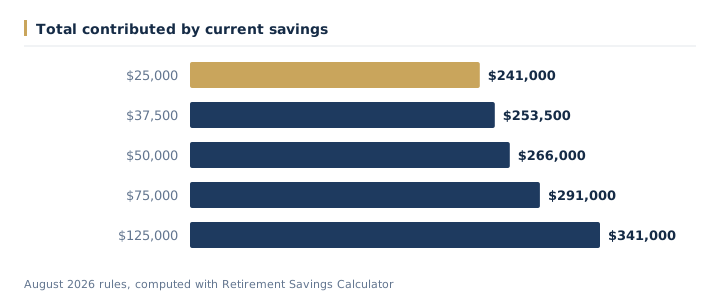
We ran 5 values of current savings through the calculator and left every other input at its default. As of August 2026, the output was:
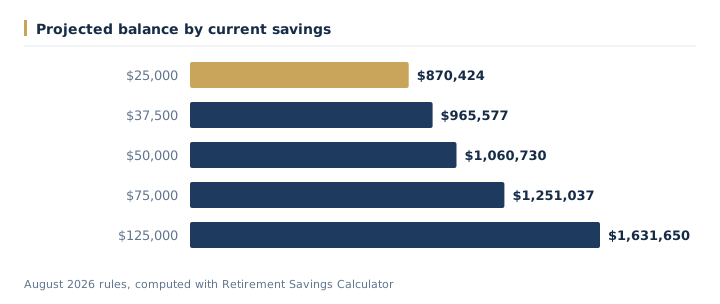
| Current savings ($) | Total contributed ($) | Projected balance ($) | Real balance today dollars ($) |
|---|---|---|---|
| 25,000 | 241,000 | 870,424.04 | 358,603.18 |
| 37,500 | 253,500 | 965,577.23 | 397,805.03 |
| 50,000 | 266,000 | 1,060,730.41 | 437,006.89 |
| 75,000 | 291,000 | 1,251,036.79 | 515,410.59 |
| 125,000 | 341,000 | 1,631,649.54 | 672,218.01 |
Running current savings from $25,000 up to $125,000 moves total contributed from $241,000 to $341,000 — a spread of $100,000. That gap is the part a single headline rate never shows.
The same runs seen through projected balance
At $25,000, projected balance works out to $870,424; at $125,000 it is $1,631,650. Looking only at total contributed tends to understate how much the outcome shifts across that range.
Assumptions behind these figures
| Input | Value |
|---|---|
| Current age | 35 |
| Retire age | 65 |
| Current savings | $50,000 |
| Monthly | $600 |
| Ret | 7% |
| Infl | 3% |
| As of | August 2026 |
| Method | identical to /tools/retirement-savings-calculator |
Brackets, thresholds and rates change from year to year, so treat these as August 2026 figures for the 2026 tax year. For your own situation, open the Retirement Savings Calculator and enter your real numbers — the calculator runs the same code that produced every figure on this page.
Frequently Asked Questions
How should retirement planning priorities change by decade?
Retirement planning priorities generally shift with each decade: in your 20s and 30s, the focus is capturing any employer match and letting time compound modest savings; in your 40s, it's raising your savings rate and running a real projection as income peaks alongside expenses; and in your 50s, it's using catch-up contribution opportunities while checking whether your trajectory supports your goals. The core message is that the same handful of decisions — how much you save, which accounts you use, how it's invested, and how you eventually spend it down — matter throughout, even as the emphasis changes.
Should I prioritize the 401(k) match over other savings goals?
Generally, yes — an employer 401(k) match is typically treated as part of your compensation that you only receive by contributing enough to trigger it, effectively an immediate, guaranteed return that is hard to match anywhere else. Skipping it to pursue other financial goals is usually considered one of the costliest ordering mistakes in retirement planning. Most guidance suggests contributing at least up to the full match before directing extra savings elsewhere, though a financial professional can help weigh this against your specific situation.
What extra retirement savings options are available after age 50?
Once you turn 50, the IRS generally allows catch-up contributions on top of standard limits for accounts like 401(k)s and IRAs, and a further enhanced catch-up typically applies for a narrow age band in the early 60s under SECURE Act 2.0 rules. These figures are adjusted periodically, so confirm the current-year limits with the IRS or your plan provider before relying on a specific number. If you started saving later in life, this expanded room is often the main lever available to help close a savings gap.
Why is saving early more valuable than saving more later?
Money saved earlier in life generally has more decades to compound, and because compounding grows exponentially rather than linearly, modest amounts saved in your 20s or 30s can end up contributing more to your final balance than larger amounts saved later in your career. This isn't a guarantee of specific returns, since markets vary, but it illustrates why starting early — even with small contributions — tends to have an outsized long-term effect. Automating contribution increases over time can help capture this advantage without requiring constant willpower.