Guides
Tax-Efficient Withdrawal Strategies in Retirement
By Editorial Team · Published January 18, 2026 · Updated August 22, 2026 · 13 min read
Conventional withdrawal order vs. proportional vs. bracket-filling — and how to manage IRMAA and Social Security taxation along the way.
Picture two retirees. Call them the Carters and the Delgados. Same $1.2 million in a traditional IRA. Same $90,000 a year in spending. Same Social Security, claimed at the same age. Same 30-year horizon. On paper they are interchangeable.
The Carters spent down their taxable brokerage account first, reported almost nothing on their tax return for a decade, felt clever about it, and then got hit at 73 with required withdrawals that landed squarely in a high bracket — and dragged 85% of their Social Security into taxable income while they were at it. The Delgados deliberately pulled a moderate amount out of the IRA every single year starting in their early sixties, kept their income parked near the top of a low bracket, and never once touched a high bracket.
Same assets. Same spending. The Delgados kept tens of thousands of dollars more, over their lifetime, than the Carters. The only difference was the order and timing of which account they drained. That is the entire subject of this article, and it is one of the few retirement decisions that is both completely free and routinely botched.
The thing that makes order matter: three kinds of dollars
A dollar in retirement is not just a dollar. Its tax character depends entirely on which account it comes out of.
- A dollar from a taxable account — brokerage, savings — has already been taxed as principal. Only the gain is taxed, and often at the favorable long-term capital-gains rate.
- A dollar from a tax-deferred account — traditional 401(k) or IRA — is fully ordinary income, taxed at your marginal rate.
- A dollar from a tax-free account — Roth IRA or Roth 401(k) — is, on a qualified withdrawal, not taxed at all, and a Roth IRA is never forced out by RMDs.
Because those three buckets are taxed so differently, the sequence in which you empty them changes how much money is left to fund the years you can't see yet. The objective is not a small tax bill this April. It is the smallest lifetime tax bill while keeping the portfolio alive as long as you are. A Retirement Income Calculator is the cleanest way to watch those trade-offs move.
What follows is three strategies, weakest to strongest, with the same family running each one so you can see exactly where the money goes.
Strategy one: the conventional order — taxable, then tax-deferred, then Roth
The textbook rule says spend the taxable account first, the tax-deferred account next, and leave the Roth for last.
The reasoning holds together. Spending taxable money first lets the tax-deferred and Roth accounts keep compounding under shelter longer. Saving the Roth for last preserves the most flexible, no-RMD, tax-free dollars for late life or heirs.
Followed as a default, this beats the genuinely naive approach of pulling proportionally from everything with no thought at all. For a lot of savers it's a perfectly acceptable starting point, and I won't pretend otherwise. But followed rigidly, it has one structural flaw that the Carters demonstrated above: it leaves a large traditional balance untouched until RMDs detonate it at 73 or 75, often in a higher bracket than the early retirement years, and usually pulling Social Security taxation and Medicare premiums up alongside. The RMD Calculator makes the size of that delayed bill uncomfortably concrete.
Strategy two: proportional withdrawals — smooth instead of lumpy
The next step up stops draining one bucket completely before touching the next. Instead you take a blend from taxable, tax-deferred, and Roth every year, in proportions chosen to keep taxable income roughly level and your bracket stable across decades.
It helps to understand why level beats lumpy, because the reason is the whole game. Federal income tax is progressive: the low brackets are cheap, the high brackets are expensive. Spread income evenly across many years and more of every dollar stays inside the cheap brackets. Compress it — by deferring everything until RMDs force it out in a rush — and you stack dollars into the expensive brackets in a handful of late years. Proportional withdrawals trade the conventional order's "low tax, then suddenly very high tax" whipsaw for a flat line. Over a long retirement the flat line almost always wins.
The exact mix is personal. It bends to account sizes, pension and Social Security timing, and legacy goals. But the principle doesn't bend: deliberate, smooth income beats forced, lumpy income.
Strategy three: bracket-filling — the one that actually optimizes
This is the strategy the Delgados ran, and it is the one worth the most money.
Each year, look at your taxable income before any discretionary withdrawals. If there's unused room in a low bracket — say you're comfortably under the top of the 12% bracket — deliberately create income up to that ceiling even when you don't need the cash, by taking extra traditional withdrawals or doing a Roth conversion. You are filling the bracket with cheaply taxed dollars now so you don't pay for those same dollars expensively later.
Bracket-filling and proportional withdrawals aren't rivals; the strongest plans run both. You smooth the blend across buckets and top off the cheap bracket each year. The combination is what separates the Delgados from the Carters.
The pre-RMD window is where this lives
The years between retiring and the onset of RMDs — especially if you've delayed Social Security to 70 for the larger benefit — are typically the lowest-income, lowest-bracket years you will ever have as an adult. Earned income has stopped. RMDs haven't started. Social Security may not have either. This is the Roth conversion window, and for many retirees it is the single most valuable tax opportunity left in their lives.
Convert traditional money to Roth during these years and you pay tax now at a low rate to accomplish three things at once: shrink the future traditional balance (and therefore the future RMDs), reduce the future income that would otherwise inflate Social Security taxation and IRMAA, and build a tax-free reserve for late-life flexibility and heirs.
The Carters and Delgados, with numbers
Tom and Linda, both 65, retiring this year, delaying Social Security to 70.
| Bucket | Balance |
|---|---|
| Taxable brokerage | $300,000 |
| Traditional IRA/401(k) | $900,000 |
| Roth IRA | $150,000 |
They need $70,000 a year. With no Social Security and no RMDs yet, their baseline taxable income is near zero. Assume the top of the 12% bracket for their filing status sits around $96,000 of taxable income — brackets move every year, so confirm the current figures.
Run it the rigid way and you get the Carters: spend the $300,000 taxable account first, report almost nothing for about four years, then start draining the IRA. Four years of empty low brackets, wasted.
Run it the bracket-filling way and you get the Delgados:
- Fund the $70,000 of spending mostly from the taxable brokerage (low tax — only realized gains count).
- On top of that, convert roughly $80,000–$90,000 of traditional IRA to Roth each year, deliberately filling up through the 12% bracket.
- Pay modest tax on those conversions now, while the bracket is cheap.
Across the five-year window before RMDs and Social Security, that's $400,000-plus moved into the Roth at low rates. The payoff: a far smaller traditional balance when RMDs hit at 73, materially lighter forced withdrawals, less taxable Social Security, a lower IRMAA tier — frequently five or six figures of lifetime tax saved. The precise optimum has to be modeled with your real brackets in a Retirement Income Calculator; the shape, though, is reliable.
To put a number on the shape: if those conversions cut each future RMD by, say, $30,000, and that $30,000 would otherwise have been taxed at 22% federal plus pulled more Social Security into tax plus nudged the couple over an IRMAA cliff, the effective annual saving runs well above the headline 22%. Compound that over a 20-year RMD period. Five disciplined early years quietly become one of the largest controllable tax savings a retiree can capture. The catch is precisely that discipline: the window is finite, it slams shut when RMDs and Social Security begin, and conversions are generally irreversible. Size it deliberately; do not improvise it.
One detail that decides whether a conversion pays off
Pay the conversion tax from outside money — taxable brokerage or cash — not by withholding from the converted amount. Convert $80,000 and use $18,000 of the IRA to cover the tax, and only $62,000 actually reaches the Roth, with the $18,000 potentially facing a penalty if you're under 59½. Pay from outside funds and the full $80,000 lands tax-free. This is exactly why retirees with a healthy taxable account can work the conversion window aggressively, and those without one should convert more cautiously. It is a planning constraint, not a footnote.
The two thresholds that quietly punish the careless
A good bracket-filling plan isn't just watching brackets. It's watching two other lines that don't appear on the tax tables.
The Social Security tax torpedo
Up to 85% of Social Security benefits can be taxable, but the trigger is "combined income" — your AGI plus nontaxable interest plus half your benefits. The thresholds where 50% and then 85% of benefits become taxable were never indexed for inflation, so a few more retirees cross them every single year.
This produces the torpedo. Add a dollar of ordinary income near a threshold — a traditional IRA withdrawal, for instance — and you don't just pay tax on that dollar. You also pull a previously untaxed chunk of Social Security into the taxable column, so the effective marginal rate on that one dollar can spike far above its stated bracket. A real strategy steers around this, favoring Roth dollars and return-of-basis taxable dollars in years you're near a threshold, because those don't inflate combined income the same way.
IRMAA, with its two-year memory
The Income-Related Monthly Adjustment Amount is a surcharge on Medicare Part B and Part D for higher-income retirees. Two features make it a planning problem rather than a footnote: it's based on your modified AGI from two years prior, and it works as a cliff.
| MAGI vs IRMAA tier | What happens |
|---|---|
| Just under a threshold | Standard premium (≈ $185/mo Part B in 2025) |
| One dollar over | The full higher surcharge, no phase-in |
Because of the two-year lookback, a large Roth conversion at 63 raises Medicare premiums at 65. The answer is not to abandon conversions. It is to size them so you fill the bracket without spilling over the cliff. Confirm the current IRMAA thresholds with Medicare and the SSA; they move annually.
The other tool that competes for the same room: the 0% capital-gains rate
One of the most underused levers is the 0% long-term capital-gains rate. Below an income threshold, long-term gains and qualified dividends are taxed at 0% federally. In a low-income early-retirement year you can deliberately sell appreciated holdings and rebuy them, stepping your cost basis up at zero tax cost.
Here is the friction nobody mentions: this pulls against Roth conversions. Conversions raise ordinary income, which crowds out the 0% gains space. The two share one bracket budget every year. The optimal use of a low-income year is usually a coordinated mix — some 0% harvesting, some bracket-filling conversion — sized together, not each maximized in isolation.
A year-end routine that ties it together
Every year, before December:
- Project taxable income before any discretionary moves.
- Measure the remaining room to the next bracket, to the IRMAA cliff, and to the Social Security taxation thresholds.
- Decide how to spend that room — Roth conversion, 0% gain harvesting, or deliberately nothing.
- Fund spending from the most tax-efficient source consistent with that decision.
- Re-check in December: RMDs, market swings, and one-off income can move the whole picture.
Where I see plans go wrong
- Running "taxable, then tax-deferred, then Roth" on autopilot — the Carter mistake, wasting low-bracket years and building an RMD bomb.
- Minimizing this April's tax instead of the next twenty years' tax. Paying $0 now can mean paying far more total.
- Forgetting the two-year IRMAA lookback, so conversions at 62–64 silently raise premiums at 65–66.
- Adding ordinary income near a Social Security threshold and detonating the torpedo.
- Doing conversions and 0% gain harvesting without one shared bracket budget — they compete, and uncoordinated you blow past your target.
- Spending the Roth first and surrendering the best instrument you have for managing future thresholds.
- Forgetting that RMDs reset everything at 73/75 — once forced withdrawals start, most of the discretion is gone, which is the entire reason the pre-RMD window is precious.
Questions retirees ask about withdrawal order
Is there a single best order to withdraw?
No, and anyone who gives you one without asking about your account sizes is guessing. The conventional taxable-then-deferred-then-Roth order is a floor, not the optimum. Blending the buckets to fill low brackets, working the pre-RMD conversion window, and dodging the Social Security and IRMAA thresholds usually beats it — by how much depends on your specifics.
When should I do Roth conversions?
Generally in the gap between retiring and the start of RMDs and Social Security — your lowest-bracket years. Converting then, up to the top of a cheap bracket and below the IRMAA cliff, can meaningfully cut lifetime tax.
Will an IRA withdrawal make my Social Security taxable?
It can. Traditional IRA withdrawals raise combined income, which determines how much of your benefit (up to 85%) is taxed. Near a threshold, one extra IRA dollar can pull more benefit into tax — the torpedo. Roth withdrawals don't do this.
What is the 0% capital-gains bracket?
Below an income threshold, long-term gains and qualified dividends are federally taxed at 0%. In low-income years you can sell and rebuy appreciated holdings to step up basis for free — but it competes with Roth conversions for the same bracket room, so coordinate them in one budget.
How does IRMAA constrain the plan?
It surcharges Medicare Part B and D based on income from two years earlier, with hard cliffs. Big withdrawals or conversions raise premiums later, so size income moves to fill a bracket without crossing the next IRMAA line.
Sources
- Internal Revenue Service — tax brackets, Roth conversions, and capital gains
- Social Security Administration — benefit taxation and claiming
- Medicare — IRMAA Part B and Part D surcharges
- Centers for Medicare & Medicaid Services — premium administration
- Consumer Financial Protection Bureau — retirement income guidance
The short version
- The goal is the smallest lifetime tax, not the smallest bill this April — that single reframing is the whole strategy.
- The rigid taxable-then-deferred-then-Roth order is a starting floor; proportional withdrawals plus bracket-filling almost always beat it.
- The pre-RMD, pre-Social Security window is prime time for Roth conversions and 0% gain harvesting — and it closes for good once RMDs begin.
- Watch three lines every year: your bracket, the Social Security taxation triggers, and the IRMAA cliff with its two-year lookback.
- Pay conversion tax from outside money, coordinate conversions and gain harvesting in one budget, and model it with a Retirement Income Calculator and RMD Calculator.
This is general U.S. educational information current as of 2025, not personalized financial or tax advice. Brackets, thresholds, and IRMAA tiers reset annually — verify the live numbers with the IRS, SSA, and Medicare, or with an advisor who knows your return, before acting.
Run the numbers
Everything below came out of this site's own Retirement Income Calculator. The figures are not quoted from anywhere else: each row is one run of the same calculation the tool page performs, using August 2026 rules. Put the same inputs in and you will get the same output.
How the result moves with ss
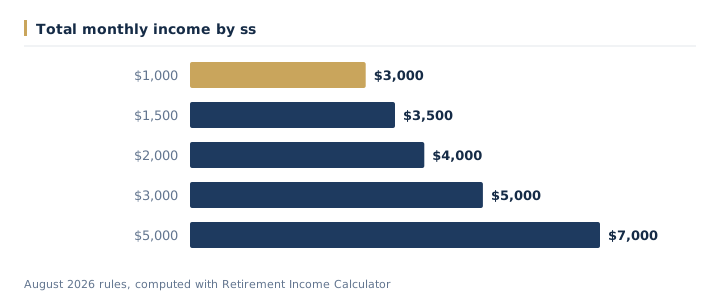
We ran 5 values of ss through the calculator and left every other input at its default. As of August 2026, the output was:
| Ss ($) | Total monthly income ($) | Monthly gap ($) | Coverage percent (%) |
|---|---|---|---|
| 1,000 | 3,000 | -1,500 | 66.67% |
| 1,500 | 3,500 | -1,000 | 77.78% |
| 2,000 | 4,000 | -500 | 88.89% |
| 3,000 | 5,000 | 500 | 111.11% |
| 5,000 | 7,000 | 2,500 | 150% |
Running ss from $1,000 up to $5,000 moves total monthly income from $3,000 to $7,000 — a spread of $4,000. That gap is the part a single headline rate never shows.
The same runs seen through monthly gap
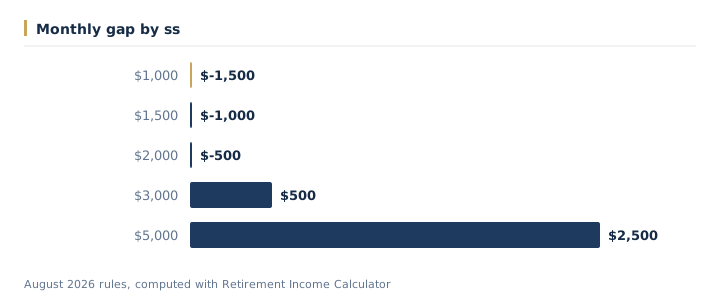
At $1,000, monthly gap works out to $-1,500; at $5,000 it is $2,500. Looking only at total monthly income tends to understate how much the outcome shifts across that range.
Assumptions behind these figures
| Input | Value |
|---|---|
| Ss | $2,000 |
| Pension | $0 |
| Other | $0 |
| Balance | $600,000 |
| Wr | 4% |
| Expenses | $4,500 |
| As of | August 2026 |
| Method | identical to /tools/retirement-income-calculator |
Brackets, thresholds and rates change from year to year, so treat these as August 2026 figures for the 2026 tax year. For your own situation, open the Retirement Income Calculator and enter your real numbers — the calculator runs the same code that produced every figure on this page.
Frequently Asked Questions
What order should I withdraw from retirement accounts?
There's no universal answer, but three approaches are commonly discussed: a conventional order spending taxable accounts first, then tax-deferred, then Roth last; a proportional approach that draws a blend from all account types each year to keep taxable income level; and bracket-filling, which deliberately generates income up to the top of a low tax bracket each year using tax-deferred withdrawals or conversions. Many planners combine proportional withdrawals with bracket-filling for a smoother, more tax-efficient lifetime outcome. Because this significantly affects lifetime taxes, work through it with a tax or financial professional.
What is bracket-filling in retirement withdrawals?
Bracket-filling means deliberately withdrawing or converting just enough from a tax-deferred account each year to use up the remaining room in your current tax bracket, even if you don't need the cash for spending. The goal is to pay tax on those dollars now at a lower rate rather than later, when required minimum distributions or other income sources might push you into a higher bracket. This strategy is often most valuable during low-income years between retirement and the start of Social Security or RMDs.
Why does withdrawal order matter for taxes?
Withdrawal order matters because each type of retirement account is taxed differently — taxable accounts are generally taxed only on gains, tax-deferred accounts are taxed as ordinary income on the full withdrawal, and Roth accounts are generally tax-free on qualified withdrawals. Two retirees with identical assets and spending can end up paying very different amounts of lifetime tax purely based on the sequence and timing of which accounts they draw from. Because the effect can be substantial over decades, this is one of the few retirement variables that's fully within your control.
What is the Roth conversion window?
The Roth conversion window generally refers to the years between when someone stops working and when required minimum distributions and Social Security begin, when taxable income can be unusually low. Converting traditional retirement funds to a Roth IRA during these years can lock in a lower tax rate on those dollars and shrink the balance that would otherwise generate larger, forced RMDs later. Because conversions are generally permanent and add to taxable income in the year they occur, model the tradeoff carefully or consult a tax professional.