Guides
Roth vs. Traditional IRA: Which Is Better?
By Editorial Team · Published March 17, 2026 · Updated August 22, 2026 · 11 min read
It comes down to one comparison: your tax rate now vs. later. The decision rule, a worked example, and Roth's non-tax advantages.
Most articles on this topic stall because they treat "Roth or traditional?" as a sprawling list of pros and cons. It isn't. It's one question wearing a disguise: is your tax rate higher now, or will it be higher when you take the money out? Answer that and almost everything else falls into place. The pros-and-cons lists exist because that one question is uncomfortable to answer honestly, not because the decision is genuinely complicated.
So let's answer the real question and dispatch the myths along the way. This is about the choice between the two accounts — which one to fund, and when. It is not about converting balances you already have or about backdoor contributions for high earners; those are separate decisions with their own articles.
The structural difference, stated once: a traditional IRA may deduct your contribution now, grows tax-deferred, taxes withdrawals as ordinary income later, and eventually forces money out through required minimum distributions. A Roth gives no deduction now, grows tax-free, pays out tax-free in retirement, and has no RMDs for the original owner. Traditional says "tax me later." Roth says "tax me now." Every other difference is downstream of that one. You can run both side by side with the Roth vs. Traditional IRA Calculator.
The rule, stated bluntly
Pay tax in the year your marginal rate is lower. That's it. Everything below is just applying that one sentence.
- Rate higher now than it will be in retirement → the traditional deduction is worth more. Defer.
- Rate lower now than it will be in retirement → tax-free Roth withdrawals win. Pay now.
- Rates roughly equal → the core math is close to a tie, and Roth's non-tax advantages (covered below) usually decide it.
Here's the part the simple version leaves out. Future tax rates are unknowable, but they don't drift randomly — several forces specifically push retirees' future rates up. RMDs stack on top of Social Security and pensions. The death of a spouse pushes the survivor into single brackets, with a smaller standard deduction, so the same income gets taxed harder. And statutory rates themselves can rise. That asymmetry is why "I'll be in a lower bracket in retirement" is true less often than people assume — which is the first myth worth retiring.
A worked example: same inputs, opposite right answers
Two savers. Each contributes $7,000 for the year. Each sits in a 24% bracket today. Watch how the answer flips on one variable.
Saver A — expects a 12% rate in retirement, chooses traditional.
- $7,000 deducted now saves $1,680 in tax this year (24% of $7,000).
- Say it grows to $30,000 over the decades.
- Withdrawn in a 12% bracket: about $3,600 in tax, leaving roughly $26,400, plus the $1,680 saved and itself invested along the way.
- Traditional wins: the deduction landed at 24%, the tax bill landed at 12%.
Saver B — expects a 32% rate in retirement, chooses Roth.
- $7,000 contributed after tax — no deduction, effectively giving up $1,680 of current tax savings.
- Same growth to $30,000.
- Withdrawn tax-free: the full $30,000 is spendable.
- Had this been traditional and pulled in a 32% bracket, tax would run about $9,600, leaving only ~$20,400.
- Roth wins decisively: tax was prepaid at 24% instead of paid later at 32%.
Identical contribution, identical growth, opposite correct choices — driven entirely by the now-versus-later rate. There's also a quieter point hiding in Saver B's numbers, and it's a myth-buster: $7,000 in a Roth is worth more than $7,000 in a traditional account, because the Roth dollars are already tax-paid. When you max a Roth, you're sheltering more real, after-tax money than the same nominal contribution to a traditional account. "They're equivalent if rates don't change" is only true before you account for the contribution cap.
Roth's advantages that have nothing to do with tax rates
Even when the rate math is a coin flip, the Roth carries structural advantages that often break the tie. These are the reasons many planners default to Roth when it's close.
No required minimum distributions for the original owner. Traditional IRAs force taxable withdrawals starting at age 73 — 75 for those born in 1960 or later, under SECURE Act 2.0. A Roth never forces the original owner's hand, so the money keeps compounding tax-free for as long as you leave it alone. That's not a minor footnote; for a long retirement it's a materially different outcome.
Control over your taxable income each year. Roth withdrawals don't add to taxable income, which means they don't push more of your Social Security into taxation, don't trip Medicare's IRMAA surcharges, and don't stack on top of capital gains. Having a tax-free bucket to draw from is, in practice, a lever for managing every other income-tested number in retirement.
Access to contributions. Direct Roth IRA contributions (not earnings, and conversions follow separate rules) can generally be withdrawn anytime without tax or penalty, because they were already taxed. That's a layer of liquidity a traditional IRA simply doesn't offer before 59½.
Estate efficiency. Roth assets pass to heirs income-tax-free. Most non-spouse heirs must still empty an inherited IRA within 10 years under current rules, but with a Roth those withdrawals are tax-free — and the account also softens the "widow's penalty," where a surviving spouse files single with compressed brackets.
Eligibility: the rules that can make the choice for you
The decision isn't always free. Income limits intrude.
The ability to contribute directly to a Roth IRA phases out at higher modified adjusted gross income. For a recent year (2025), that was roughly $150,000–$165,000 for single filers and roughly $236,000–$246,000 for married filing jointly. Treat those as approximate and confirm the current-year numbers with the IRS, since they reset annually. Above the top of the range, direct Roth contributions aren't allowed at all — though the backdoor Roth remains a route, which is its own separate topic.
A traditional IRA flips the constraint. Anyone with earned income can contribute, but the deduction may shrink or vanish if you (or your spouse) are covered by a workplace plan and income exceeds certain thresholds. No workplace plan, and the deduction is generally unrestricted. A nondeductible traditional contribution is allowed but forfeits the upfront benefit. For a recent year the IRA contribution limit was $7,000, plus a $1,000 catch-up at 50 or older — confirm the current IRS figure.
| Factor | Roth IRA | Traditional IRA |
|---|---|---|
| Upfront deduction | No | Yes, if eligible |
| Retirement withdrawals | Tax-free (qualified) | Taxed as ordinary income |
| Income limit to contribute | Yes (MAGI phase-out) | None to contribute; deduction may phase out |
| RMDs for original owner | None | Begin at 73 (75 if born 1960+) |
| Best when future rate is | Higher than today | Lower than today |
| Early access to contributions | Generally yes | No (penalty before 59½) |
| Inherited-account tax | Tax-free to heirs | Taxable to heirs |
Before any of this: the employer match
One myth deserves a blunt correction. The most common mistake people make in the Roth-versus-traditional debate is having it at all before capturing their employer 401(k) match. A match is an immediate, guaranteed return — frequently 50% or 100% on the first few percent of pay — and no IRA tax nuance comes close to beating a guaranteed 50%.
The sane priority order:
- 401(k) up to the full match. The unbeatable first dollar.
- Max an IRA, Roth or traditional. Wider investment menu; with Roth, tax-free flexibility.
- Back to the 401(k), toward the annual limit.
- Taxable brokerage for anything beyond that.
The identical now-versus-later logic applies inside the 401(k), where many plans now offer a Roth option. Model the 401(k), the match, and growth with the 401(k) Calculator, then compare IRA structures with the Roth vs. Traditional IRA Calculator.
When the honest answer is "both"
Here's the myth I'd most like to bury: that you have to pick one and commit. Because future tax law is genuinely unknowable, deliberately holding both pre-tax and Roth money — tax diversification — is often the most defensible choice, not a failure to decide. In retirement it lets you pull from traditional up to the top of a low bracket, then switch to tax-free Roth to avoid spilling into a higher one, tripping IRMAA, or taxing more Social Security.
The working heuristic most people land on: lean Roth in lower-income or early-career years, lean traditional during peak earnings, and aim to arrive at retirement with meaningful balances in both. You can't perfectly optimize against tax law you can't see. The hybrid stops pretending you can.
How the answer shifts across a career
The rule never changes; your inputs do. Your current bracket and your expected future bracket both move over a working life, so the same principle gives different answers at different ages.
In your twenties and early thirties, income — and therefore tax rate — is usually at a lifetime low, with decades of tax-free compounding ahead. Paying tax now at a low rate to lock in tax-free growth is a strong bet, which is why Roth is the common early-career default. A dollar taxed at 12% today and left alone for 35 years is hard to beat.
In your forties and fifties, the peak-earning stretch, you're often in the highest bracket of your life. The traditional deduction is most valuable here, and many high earners also breach the direct Roth income limits, pushing them toward deductible traditional contributions. Cutting taxable income now, when the marginal rate is steep, usually wins on the math.
In your late fifties and sixties, as earned income falls, the question changes shape entirely — from which IRA to fund to how to reposition what you've already accumulated. That's the conversion conversation, and it's a separate article. The throughline across all three stages: revisit the decision when your bracket moves. Many people correctly lean Roth early, traditional at the peak, then fine-tune later.
A decision framework
| Your situation | Lean toward |
|---|---|
| Early career, lower bracket now, income rising | Roth |
| Peak earnings, high bracket now, modest expected retirement income | Traditional |
| Expect higher tax rates in the future generally | Roth |
| Want to avoid future RMDs and keep compounding | Roth |
| Need maximum current-year tax reduction | Traditional (if deductible) |
| Over the Roth income limit but want Roth | Backdoor route (separate topic) |
| Genuinely unsure about future rates | Split — hybrid |
| Prioritizing tax-free assets for heirs | Roth |
Where people get it wrong
A short list of the recurring errors. Skipping the employer match while debating IRA types — the match outranks every IRA nuance. Choosing Roth purely because "tax-free sounds good" without checking whether today's rate is actually low. Forgetting RMDs in the comparison — traditional forces taxable income later, Roth doesn't. Assuming you can contribute directly to a Roth at any income, when the MAGI phase-out is real. Going 100% one direction when tax-rate uncertainty argues for diversifying. And ignoring the survivor/widow's-penalty effect, which can quietly lift a surviving spouse's future rate.
Questions people ask
Which is better for me? Whichever lets you pay tax at the lower rate — Roth if your retirement rate will be higher than now, traditional if lower. When it's close, Roth's lack of RMDs and tax-free flexibility make it the safer default.
Can I contribute to both in the same year? Yes, but combined contributions across all IRAs can't exceed the annual limit (a recent year: $7,000, plus $1,000 catch-up at 50+ — confirm current figures). Many people split deliberately for diversification.
What if my income is too high for a Roth? You can still contribute to a traditional IRA (deduction possibly limited) and use the backdoor route — a separate topic with its own pro-rata pitfalls.
Does a Roth have RMDs? Not for the original owner. That's a major edge over the traditional IRA, which forces distributions starting at 73 (or 75 if born in 1960 or later) under SECURE Act 2.0.
401(k) or IRA first? Enough 401(k) to capture the full match first — that's free money. After the match, an IRA usually offers more investment choice and, with Roth, tax-free flexibility; then back to the 401(k).
Is it really only about tax rates? Rate timing is the core driver, but RMD avoidance, withdrawal flexibility, estate treatment, and contribution access all tilt toward Roth and can decide a close call.
Sources
- IRS — current-year IRA contribution limits, Roth phase-outs, and RMD rules
- Social Security Administration — how withdrawals affect benefit taxation in retirement
- U.S. Department of Labor — 401(k) and employer-plan rules, including the employer match
- Consumer Financial Protection Bureau — choosing and managing retirement accounts
Key takeaways
- The whole decision is one question: is your tax rate higher now or higher in retirement? Pay tax in the lower-rate year.
- Same contribution and growth can produce opposite right answers — the rate comparison is what flips it.
- A maxed Roth shelters more real money than a maxed traditional account, because Roth dollars are already tax-paid.
- Roth's lack of RMDs, income-control flexibility, and estate efficiency routinely break a close tie.
- Capture the full employer 401(k) match before the Roth-versus-traditional debate even starts.
- Future tax law is unknowable, so holding both — a hybrid — is a defensible choice, not indecision; model it with the Roth vs. Traditional IRA Calculator and 401(k) Calculator.
Contribution limits and income phase-outs shown here are illustrative for a recent year and change every year; verify the current IRS figure before relying on them. This is general education comparing the two account types, not personalized tax or financial advice — confirm your own situation with a qualified professional.
Run the numbers
Everything below came out of this site's own Roth vs. Traditional IRA Calculator. The figures are not quoted from anywhere else: each row is one run of the same calculation the tool page performs, using August 2026 rules. Put the same inputs in and you will get the same output.
How the result moves with contribution
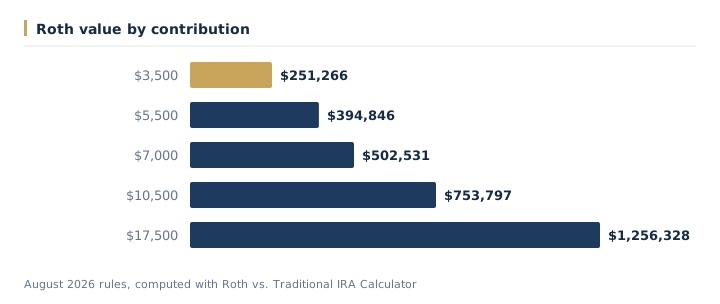
We ran 5 values of contribution through the calculator and left every other input at its default. As of August 2026, the output was:
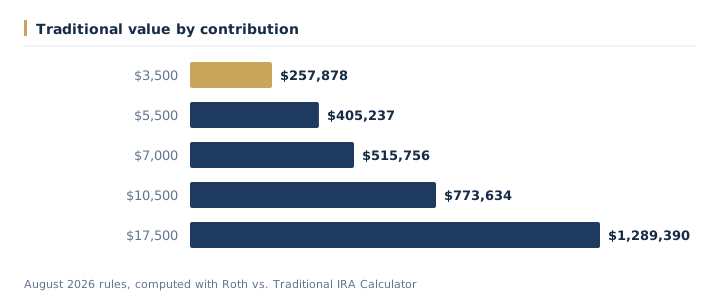
| Contribution ($) | Roth value ($) | Traditional value ($) | Difference ($) |
|---|---|---|---|
| 3,500 | 251,265.69 | 257,877.95 | 6,612.26 |
| 5,500 | 394,846.09 | 405,236.77 | 10,390.69 |
| 7,000 | 502,531.38 | 515,755.89 | 13,224.51 |
| 10,500 | 753,797.07 | 773,633.84 | 19,836.77 |
| 17,500 | 1,256,328.46 | 1,289,389.73 | 33,061.28 |
Running contribution from $3,500 up to $17,500 moves roth value from $251,266 to $1,256,328 — a spread of $1,005,063. That gap is the part a single headline rate never shows.
The same runs seen through traditional value
At $3,500, traditional value works out to $257,878; at $17,500 it is $1,289,390. Looking only at roth value tends to understate how much the outcome shifts across that range.
Assumptions behind these figures
| Input | Value |
|---|---|
| Current age | 35 |
| Retire age | 65 |
| Contribution | $7,000 |
| Tax now | 24% |
| Tax ret | 22% |
| Ret | 7% |
| As of | August 2026 |
| Method | identical to /tools/roth-vs-traditional-ira-calculator |
Brackets, thresholds and rates change from year to year, so treat these as August 2026 figures for the 2026 tax year. For your own situation, open the Roth vs. Traditional IRA Calculator and enter your real numbers — the calculator runs the same code that produced every figure on this page.
Frequently Asked Questions
Should I choose a Roth or traditional IRA?
The choice generally comes down to one comparison: whether your income tax rate is higher now or will be higher when you withdraw the money in retirement. If your rate today is higher, a traditional IRA's upfront deduction is typically worth more; if your rate will likely be higher later, paying tax now through a Roth usually wins. When the two rates look roughly similar, Roth's non-tax advantages, such as no required minimum distributions, often tip the decision, and a financial or tax professional can help apply this to your specific situation.
What's the main difference between a Roth and traditional IRA?
A traditional IRA may give you a tax deduction on contributions now, grows tax-deferred, and taxes withdrawals as ordinary income later. A Roth IRA offers no upfront deduction, grows tax-free, and generally lets you take qualified withdrawals in retirement completely tax-free. In short, traditional IRAs tax you later while Roth IRAs tax you now.
Does a Roth IRA have required minimum distributions?
No, a Roth IRA generally has no required minimum distributions for the original account owner, unlike a traditional IRA, which forces taxable withdrawals starting at a set age. This lets Roth funds keep growing tax-free for as long as the owner chooses not to touch them. Non-spouse heirs who inherit a Roth IRA typically still have to empty the account within a set number of years, though those withdrawals are generally tax-free.
Can I withdraw Roth IRA contributions before retirement without penalty?
Generally, yes — direct contributions (not earnings, and not converted amounts, which follow separate rules) to a Roth IRA can usually be withdrawn at any time without tax or penalty, since they were already taxed before being contributed. This gives a Roth IRA a layer of liquidity that a traditional IRA typically doesn't offer before age 59½. The rules around conversions and earnings are more complex, so it's worth confirming details with a tax professional before withdrawing.
Are there income limits for contributing to a Roth IRA?
Yes, the ability to make a direct Roth IRA contribution phases out above certain income levels, which differ for single and married filers and are adjusted periodically. Above the top of that range, direct contributions generally aren't allowed, though some high earners use other techniques to fund a Roth indirectly. Always check the current-year IRS income thresholds, since they change over time.