Guides
Roth Conversion: When It Makes Sense
By Editorial Team · Published February 25, 2026 · Updated August 22, 2026 · 12 min read
The low-income window before RMDs and Social Security, bracket-filling with a worked example, the 5-year rule, and when NOT to convert.
There's a window in a lot of retirement timelines that most people walk straight through without noticing. It opens the year you stop working and closes the year required minimum distributions and Social Security kick in. Inside that window, your taxable income can fall through the floor — sometimes to nearly nothing — while a large pre-tax IRA or 401(k) sits there waiting to be taxed at full freight later. A Roth conversion is the tool for that window. Used inside it, with discipline, it's one of the better tax moves available to a retiree. Used outside it, or carelessly, it's an expensive way to prepay tax you didn't owe yet.
This article is about converting balances you already have in pre-tax accounts — the timing decision, the conditions that have to be true, and the traps. It is deliberately not about the backdoor Roth, which is a contribution technique for high earners and a separate subject.
A quick anchor before the conditions: a conversion moves money from a traditional IRA or an old 401(k) into a Roth IRA, and the converted amount is added to your ordinary income for that year. There's no 10% early-withdrawal penalty on the conversion itself, even under 59½, as long as the money lands in the Roth. No income limit applies. After conversion, growth and qualified withdrawals are tax-free, and there are no lifetime RMDs for the original owner. The price of all that is a tax bill today, voluntarily accelerated. You can model the long-run trade-off with the Roth vs. Traditional IRA Calculator.
The one comparison that decides everything
Every conversion question collapses to a single comparison: the marginal rate you'd pay on the conversion this year versus the marginal rate those same dollars would face if you left them alone and pulled them out later — as a voluntary withdrawal, a forced RMD, or an inheritance to your heirs.
If your future rate is likely higher, converting now at the lower rate generally wins. If your future rate is likely lower, converting is usually a mistake — you'd be paying a high rate to dodge a low one. If the two rates look about equal, the income-tax math is roughly a wash, and the decision turns on secondary factors: no RMDs, cleaner estate treatment, more control over future taxable income.
The reason this conversation comes up so often for retirees is that several forces quietly push future rates up. RMDs stack on top of Social Security and pensions. When one spouse dies, the survivor often files single, with compressed brackets and a smaller standard deduction — the "widow's penalty" — so the same income is taxed harder. And statutory rates themselves can rise if temporary tax-law provisions expire. None of these are guaranteed, but they're the structural reason a conversion so often looks attractive when you actually run the projection.
The conditions that should be true before you convert
Treat the following as a checklist of conditions, not a recipe. A conversion makes sense when several of these hold together.
You're in a low-income gap year. This is the headline condition. After you stop working but before Social Security and RMDs begin, taxable income can drop into the 10%, 12%, or 22% brackets. Under SECURE Act 2.0, RMDs begin at age 73, or 75 for those born in 1960 or later, which often opens a multi-year runway between retirement and the first forced distribution. That runway is the prime conversion territory.
Your traditional balance is large enough that future RMDs will hurt. A modest pre-tax balance generates modest RMDs and may never push you into a higher bracket. A large one does the opposite — it inflates taxable income later, drags more of your Social Security into taxation, and can trigger Medicare surcharges. Converting in the quiet years before RMDs shrinks the future forced distribution and softens that spike.
The market just dropped. If your traditional IRA value is temporarily depressed, converting the same shares means you pay tax on a lower number. If the recovery happens inside the Roth, that rebound is tax-free. You've effectively bought the recovery at a discount on the tax.
You can pay the tax from outside the IRA. This one is closer to a requirement than a preference. If the only way to cover the conversion tax is to withhold it from the converted amount, the strategy loses much of its power, and under 59½ the withheld portion can itself be penalized. Conversions work best when taxable brokerage or cash funds the bill so the full balance lands in the Roth.
Estate or survivor planning is in the picture. Roth assets pass to heirs income-tax-free and carry no RMDs for the original owner. Heirs generally still must empty an inherited IRA within 10 years under current rules, but with a Roth those withdrawals are tax-free. Pre-emptively shrinking the pre-tax balance also softens the widow's-penalty problem before it arrives.
Filling a bracket: a worked example
The most disciplined version of this strategy is bracket-filling — converting just enough to reach the top of a chosen bracket and not a dollar more.
Robert and Susan are both 65, retired, not yet claiming Social Security. This year their only income is $30,000 from interest and dividends. Using round illustrative numbers and a married-filing-jointly standard deduction of roughly $30,000:
- Gross income: $30,000
- Standard deduction: about $30,000
- Taxable income before any conversion: roughly $0
Say they decide to fill up to the top of the 12% bracket, which for this illustration tops out near $96,000 of taxable income for a married couple. (Bracket thresholds are inflation-adjusted every year — confirm the current-year figure rather than trusting this one.)
- Room to the top of the 12% bracket: about $96,000 of taxable income
- They convert $96,000 from the traditional IRA
- Taxable income becomes roughly $96,000, taxed only at 10% and 12%
- Approximate federal tax on the conversion: about $10,000 to $11,000 — an effective rate near 11%
Now the comparison that justifies the whole exercise. Leave that same $96,000 in the pre-tax account, let it grow, and later distribute it as RMDs stacked on Social Security and pension income, and it could easily be taxed at 22%, 24%, or higher — north of $20,000 on the same dollars, plus the knock-on effects on Social Security taxation and Medicare premiums. Paying about 11% now to avoid 22%-plus later is the entire argument. Repeat it each gap year and you can move a large share of the pre-tax balance into the Roth at low double-digit rates.
| Approach | Taxable income created | Approx. effective rate | Result |
|---|---|---|---|
| Convert nothing | $0 now | 0% now, 22%+ later on RMDs | Bigger future tax, RMD spike |
| Fill the 12% bracket | ~$96,000 | ~11% | Low rate locked in, RMDs shrink |
| Overconvert into 24% | ~$200,000+ | 18%+ blended | Squanders the low-bracket advantage |
Two clocks and a torpedo: the traps
The conversion five-year rule. Separate from the five-year rule on Roth contributions, every conversion starts its own five-year clock. Withdraw converted principal before that clock runs out while you're under 59½, and a 10% penalty can hit that converted amount — even though the income tax was already paid at conversion. After 59½ this particular penalty rule generally stops applying to converted principal. For an early retiree building a conversion ladder, this is the central mechanic: each year's conversion becomes penalty-free to withdraw five years later, which is exactly what makes the ladder a usable income bridge. Don't assume converted money is immediately spendable penalty-free if you're under 59½.
IRMAA's two-year shadow. A conversion raises your modified adjusted gross income, and Medicare's income-related surcharges on Part B and Part D look back roughly two years. A conversion at 63 can raise your premiums at 65. This catches people who otherwise did everything right.
The Social Security tax torpedo. Conversion income can increase the share of your Social Security benefits that's taxable. In the torpedo zone, each extra dollar of conversion can effectively tax more than a dollar of income — a real reason to size conversions carefully rather than maximize them.
Two more to keep on the radar. A large conversion can knock pre-65 retirees off ACA premium subsidies, and extra ordinary income can push otherwise 0%-taxed long-term capital gains into taxable territory. The tax may also require quarterly estimated payments to avoid an underpayment penalty.
Turning it into a multi-year campaign
The big wins almost never come from one dramatic conversion. They come from a deliberate, several-year campaign that drains the pre-tax account at favorable rates before RMDs and Social Security raise the floor on taxable income.
A workable sequence:
- Map the gap years. List the calendar years between your final working year and the year RMDs begin. Each is a candidate.
- Project baseline income for each one — pensions, part-time work, dividends, any early Social Security or annuity income. The lower the baseline, the more low-bracket room you have.
- Pick a bracket ceiling. Many retirees fill the 12% or 22% bracket and stop deliberately short of the threshold that would trip IRMAA or push long-term gains into the taxable zone.
- Estimate the do-nothing rate. Project RMDs plus Social Security plus, eventually, the survivor's single-filer brackets if you never convert. If that clearly beats today's rate, conversions are favored.
- Convert the calculated amount, pay tax from outside funds, and re-run the projection annually as markets and tax law move.
Apply that to Robert and Susan. Suppose they hold a combined $900,000 in traditional IRAs and have an eight-year gap before RMDs. Do nothing and their projected RMDs plus Social Security land them around the 22%–24% brackets, worse after the first death. Convert roughly $96,000 a year for eight years at an effective rate near 11%, and they move about $768,000 out of the pre-tax bucket at low double-digit rates. By the time RMDs start, the remaining traditional balance — and the distribution it forces — is far smaller, the survivor's future single-filer shock is muted, and a large tax-free Roth is compounding with no RMDs. The lifetime tax savings can run well into six figures. The discipline lives in stopping at the bracket ceiling every single year, not in any one bold move.
| Path | Effective tax rate | Future RMD burden | Survivor exposure |
|---|---|---|---|
| No conversions | 0% now, 22%–24%+ later | Large | High (widow's penalty) |
| Eight-year laddered conversions | ~11% now | Much smaller | Substantially reduced |
When converting is the wrong call
Conversions are conditional, and the conditions sometimes point the other way. Don't convert, or reconsider, when:
- Your future rate is likely lower. Modest projected retirement income and a lower future bracket means a conversion prepays tax at a bad price.
- The only money to pay the tax is the IRA itself. That shrinks the tax-free base and, under 59½, can penalize the withheld portion.
- A small conversion trips an IRMAA or subsidy cliff that costs more than it saves. Sometimes the dollar that nudges you over a threshold is the most expensive dollar of the year.
- Your time horizon is short or you'll spend the money soon. Roth's advantage is decades of tax-free compounding; with little runway, the benefit is thin.
- You plan large charitable giving from the IRA. Qualified charitable distributions from a traditional IRA (available at 70½+) are already tax-efficient; converting first can undercut them.
Where conversions go wrong in practice
The recurring errors are worth stating plainly. Converting in a high-income year — most often while still working full time — instead of waiting for the low-income gap. Paying the tax with IRA money and eroding the benefit. Forgetting the two-year IRMAA lookback and inflating later Medicare premiums. Converting a tidy round number instead of the precise room to the bracket top, and spilling into the next bracket. Tripping the conversion five-year rule by tapping converted principal too early under 59½. And treating it as all-or-nothing when it works best as a patient, partial, multi-year strategy.
Questions that come up
Is there an income limit to convert? No. Direct Roth contributions phase out at higher incomes; conversions do not. Anyone with a pre-tax IRA or eligible 401(k) balance can convert.
How much tax will I owe? The converted amount joins your taxable income at ordinary rates for that year. The effective rate depends on how much you convert and which bracket it fills — which is exactly why bracket-filling and partial multi-year conversions are the preferred approach.
Which years are best? Generally the low-income stretch after you stop working but before Social Security and RMDs (age 73, or 75 if born 1960 or later). Market-downturn years are also attractive because you convert a depressed balance.
Does a conversion have its own five-year rule? Yes — each conversion carries its own five-year clock. Under 59½, withdrawing converted principal within five years can trigger a 10% penalty on that amount even though income tax was already paid. After 59½ this rule generally falls away.
Will it raise my Medicare premiums? It can. The conversion lifts MAGI, which can trigger IRMAA surcharges on Part B and Part D — based on income from roughly two years prior, so plan around that lookback.
Should I convert everything at once? Usually not. A single large conversion tends to push you into much higher brackets and can trip IRMAA and other thresholds. Spreading partial conversions across several low-income years generally produces a much lower blended rate.
Sources
- IRS — current-year tax brackets, conversion rules, and Form 8606 reporting
- Social Security Administration — how benefit taxation interacts with conversion income
- Consumer Financial Protection Bureau — retirement income and tax-planning basics
- U.S. Department of Labor — rules for 401(k) balances eligible to be converted after separation
Key takeaways
- A conversion is ordinary income in the year you do it, with no income limit to participate.
- The decision is always today's marginal rate versus your expected future rate — convert when today's is the lower of the two.
- The low-income gap years before Social Security and RMDs (age 73, or 75 for those born 1960+) are the prime window.
- Bracket-filling across multiple years is the disciplined version; one giant conversion usually isn't.
- Watch the conversion five-year clock, the two-year IRMAA lookback, Social Security's tax torpedo, and ACA subsidies before you commit.
- Run the long-run trade-off with the Roth vs. Traditional IRA Calculator, and confirm the current IRS bracket and threshold figures, which reset every year.
Brackets, IRMAA tiers, and IRS conversion rules change from year to year; the numbers above are illustrative for a recent year, so verify the current IRS figure before acting. Nothing here is personalized tax or financial advice — a qualified tax professional should review your own conversion before you execute it.
Run the numbers
Everything below came out of this site's own Roth vs. Traditional IRA Calculator. The figures are not quoted from anywhere else: each row is one run of the same calculation the tool page performs, using August 2026 rules. Put the same inputs in and you will get the same output.
How the result moves with contribution
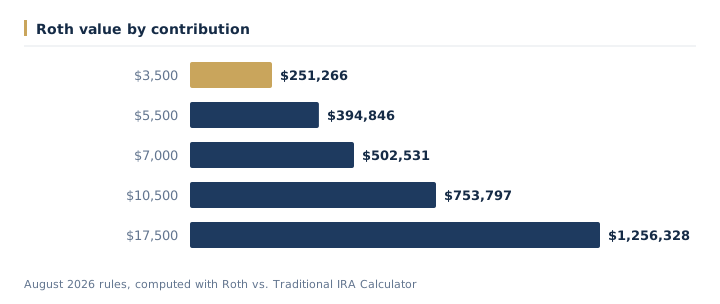
We ran 5 values of contribution through the calculator and left every other input at its default. As of August 2026, the output was:
| Contribution ($) | Roth value ($) | Traditional value ($) | Difference ($) |
|---|---|---|---|
| 3,500 | 251,265.69 | 257,877.95 | 6,612.26 |
| 5,500 | 394,846.09 | 405,236.77 | 10,390.69 |
| 7,000 | 502,531.38 | 515,755.89 | 13,224.51 |
| 10,500 | 753,797.07 | 773,633.84 | 19,836.77 |
| 17,500 | 1,256,328.46 | 1,289,389.73 | 33,061.28 |
Running contribution from $3,500 up to $17,500 moves roth value from $251,266 to $1,256,328 — a spread of $1,005,063. That gap is the part a single headline rate never shows.
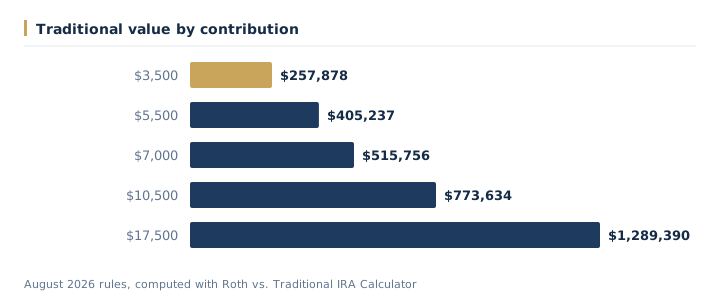
The same runs seen through traditional value
At $3,500, traditional value works out to $257,878; at $17,500 it is $1,289,390. Looking only at roth value tends to understate how much the outcome shifts across that range.
Assumptions behind these figures
| Input | Value |
|---|---|
| Current age | 35 |
| Retire age | 65 |
| Contribution | $7,000 |
| Tax now | 24% |
| Tax ret | 22% |
| Ret | 7% |
| As of | August 2026 |
| Method | identical to /tools/roth-vs-traditional-ira-calculator |
Brackets, thresholds and rates change from year to year, so treat these as August 2026 figures for the 2026 tax year. For your own situation, open the Roth vs. Traditional IRA Calculator and enter your real numbers — the calculator runs the same code that produced every figure on this page.
Frequently Asked Questions
When does a Roth conversion make sense?
A Roth conversion generally makes the most sense during a low-income gap year — after you stop working but before Social Security and required minimum distributions begin — when your taxable income is unusually low and you can convert at a lower tax rate than you'd likely face later. It also tends to be more favorable when you have a meaningfully large traditional balance that would otherwise generate large future RMDs, when the market has recently dropped, and when you can pay the resulting tax bill from funds outside the IRA. Because this involves permanent tax tradeoffs, model your specific numbers or consult a tax professional.
What is the best time to do a Roth conversion?
Generally, the years between retiring and when Social Security and required minimum distributions begin are considered the best window, since taxable income tends to be at its lowest during that stretch. A market downturn can also be an opportune time, since converting depressed asset values means paying tax on a lower amount before any recovery happens inside the tax-free Roth. There's no universal best year for everyone, though, since it depends heavily on your income sources and tax bracket each year.
Is there a penalty for doing a Roth conversion?
There's generally no 10% early-withdrawal penalty on the conversion itself, even if you're under 59½, as long as the full converted amount moves into the Roth IRA. However, if taxes are withheld from the converted amount rather than paid from outside funds, that withheld portion can potentially be treated as a distribution and penalized if you're under 59½. The conversion itself is treated as ordinary income for the year, so you will owe income tax on the converted amount.
What is bracket-filling with a Roth conversion?
Bracket-filling means converting just enough traditional retirement money to a Roth IRA to use up the remaining room in your current, lower tax bracket, without spilling into the next bracket. This lets you convert a meaningful amount at a controlled, relatively low tax cost rather than converting nothing and later facing potentially larger, forced distributions at a higher rate. Because tax brackets and thresholds are adjusted periodically, confirm the current-year figures before calculating exactly how much room you have.
When should I NOT do a Roth conversion?
A conversion generally makes less sense if you expect your tax rate to be lower in retirement than it is now, since you'd be paying a high rate today to avoid a lower rate later. It's also generally discouraged if you'd need to withhold the conversion tax from the converted funds themselves rather than paying it from outside savings, since that reduces the amount that actually lands in the tax-free Roth and can trigger penalties if you're under 59½. As with most retirement tax decisions, run the numbers for your specific situation or consult a tax professional before converting.