Guides
Medicare and Retirement: What You Need to Know
By Editorial Team · Published February 6, 2026 · Updated August 22, 2026 · 12 min read
Medicare Parts A–D and Medigap, the enrollment deadlines that trigger lifelong penalties, IRMAA surcharges, and bridging coverage before 65.
A lot of people assume Medicare just shows up at 65, the way a driver's license renewal notice does. For a sizable group of new retirees, it doesn't. If you are not already collecting Social Security when you turn 65, nobody enrolls you in Medicare. You enroll yourself, inside a specific window, and if you let that window close without other qualifying coverage, you can pay a late penalty on your premiums every month for the rest of your life. Not for a year. For life.
I lead with that because it is the single most expensive Medicare mistake, and it is entirely a calendar problem. The good news is that the calendar is knowable and the rules, once you see them laid out, are not that bad. Healthcare is the second-largest retirement expense after housing for most Americans, and the part most likely to wreck an otherwise solid plan — but it wrecks plans through missed dates and unbudgeted line items, both of which you can get ahead of. Let's do that.
First, the pieces — what Medicare actually is
Medicare is not one program. It's a few parts that snap together, plus an optional supplement. The whole rest of this article assumes you can read this table, so start here.
| Part | Covers | Typical 2025 cost (confirm current figures) |
|---|---|---|
| Part A | Hospital/inpatient, skilled nursing, hospice | Usually premium-free with 40 quarters (10 years) of covered work |
| Part B | Doctor visits, outpatient, preventive care | Standard premium ≈ $185/month; more with IRMAA |
| Part C (Medicare Advantage) | Private all-in-one plans bundling A, B, often D | Varies by plan; replaces Original Medicare |
| Part D | Prescription drugs | Varies by plan; IRMAA surcharge at higher incomes |
| Medigap (Supplement) | Pays Original Medicare's deductibles/coinsurance | Separate private premium; standardized lettered plans |
The first real decision is a fork in the road. You generally pick either Original Medicare — Parts A and B, usually plus a standalone Part D drug plan and a Medigap policy — or a Medicare Advantage (Part C) plan that bundles everything through a private insurer with its own network and rules. You cannot run a Medigap policy alongside Medicare Advantage. This choice shapes your costs and your provider freedom for the rest of your life, and it is harder to undo than to make, so it deserves more than a default. More on the reversibility trap below.
One quick clarification on that "premium-free" label. Part A is free only if you (or a spouse) have 40 quarters of Medicare-covered employment. Fewer quarters and you can still buy Part A, but it costs a monthly premium. Part B always has a premium.
The enrollment windows — where the permanent damage happens
This is the heart of it. Memorize this table; it is the part that costs people money for life.
| Window | When | Who it's for | If you miss it |
|---|---|---|---|
| Initial Enrollment Period (IEP) | 7 months: the 3 months before your 65th-birthday month, that month, and the 3 months after | Almost everyone turning 65 without qualifying employer coverage | Possible coverage gap and permanent late penalties |
| General Enrollment Period (GEP) | Jan 1 – Mar 31 each year | People who missed the IEP and had no qualifying coverage | Coverage starts later that year; penalties still apply |
| Special Enrollment Period (SEP) | Generally within 8 months of qualifying employer coverage ending | People who worked past 65 with qualifying group coverage | Lose the no-penalty path; fall back to the GEP |
A few things about that table that matter more than they look.
The IEP is seven months, but the halves are not equal. Enroll in the three months before your birthday month and coverage starts soonest; enroll after and it can be delayed. If you're already drawing Social Security before 65, you're typically auto-enrolled in Parts A and B and this whole worry goes away. If you are not yet collecting Social Security, enrollment is on you — and this is the oversight that catches the most people.
The penalties for blowing the IEP without valid coverage are not symbolic:
- Part B: roughly 10% added for each full 12-month period you were eligible but not enrolled, for as long as you have Part B.
- Part D: a smaller surcharge based on the months you went without creditable drug coverage, also generally for life.
Two years late with no valid exception is roughly a 20% higher Part B premium every month you're alive. That is why the enrollment calendar is not a formality, and it's the one thing in this article worth setting a reminder for the day you read it.
Working past 65: read the employer-size rule before you delay anything
More people work past 65 now, which raises the obvious question: enroll, or delay? The answer turns mostly on how big your employer is, and getting it backward is a quiet way to end up underinsured while holding a job and a health plan.
- Large employer (generally 20+ employees): the group plan is usually primary. You can often delay Part B penalty-free and pick it up later through a SEP. Many people still take premium-free Part A.
- Small employer (generally under 20): Medicare is typically primary. Delay Part B here and you can be effectively underinsured even though you have employer coverage. This is the one people misjudge.
There's also a Health Savings Account wrinkle that surprises people. The moment you enroll in any part of Medicare — including premium-free Part A — you can no longer contribute to an HSA. And because Part A enrollment can be backdated up to six months when you eventually claim Social Security, anyone working past 65 who wants to keep funding an HSA (2025 limits: $4,300 self / $8,550 family, plus $1,000 if 55+) has to time the moving parts deliberately. Confirm the current rules before you build a plan around this.
IRMAA: the high-income surcharge with a long memory
The Income-Related Monthly Adjustment Amount, IRMAA, is an extra charge stacked onto your Part B and Part D premiums when your income clears certain thresholds. Two design features make it a planning problem rather than a minor line.
First, the two-year lookback: your IRMAA tier comes from the modified adjusted gross income on your tax return two years prior. Your income at 63 sets your premium at 65. Second, the cliff: clear a threshold by a single dollar and you jump to the next surcharge tier for the entire year. There is no gentle phase-in.
Make that concrete. A couple lands just $500 over an IRMAA threshold two years before. That tiny overage can add a surcharge to each spouse's Part B and Part D premiums for twelve months — easily over a thousand dollars combined for being barely across a line. This is exactly why one-time income events — a Roth conversion, a large capital gain, a property sale — need to be sized with the IRMAA brackets in view. A Retirement Income Calculator is the place to see when a withdrawal or conversion would tip you over. Confirm the current IRMAA thresholds with Medicare and the SSA; they move every year.
If your income drops because of a genuine life-changing event — you retire, lose a pension, lose a spouse — you are not stuck with the two-year-old figure. File Form SSA-44 and ask Social Security to use more recent income. That form is the relief valve people don't know exists.
Original Medicare vs Medicare Advantage: the choice you can't easily walk back
Beyond monthly cost, this fork is a trade between flexibility and simplicity, and the trade is hard to reverse later — which is the part most people don't see coming.
Original Medicare plus a Medigap policy lets you see almost any provider nationwide that accepts Medicare, with predictable cost-sharing. That's valuable if you travel, split the year between two states, or want the freedom to chase specialized care wherever it is. Medicare Advantage often bundles drug coverage, adds extras like dental or vision, and can carry a low or zero monthly premium — but it runs on networks, may require referrals or prior authorization, and ties you largely to a local service area.
Here is the reversibility problem in plain terms. Getting into Medicare Advantage is easy. Switching back to Original Medicare later and buying a Medigap policy may require medical underwriting once you're outside your one-time guaranteed-issue window — meaning an insurer can decline you or charge more based on your health. The lowest-friction moment to make this decision well is at initial enrollment, when Medigap guaranteed-issue protections are strongest. Treat it as a long-horizon, one-time decision, not an annual coin flip.
What it actually costs — budget the whole thing, not just Part B
The most common budgeting error is penciling in the Part B premium and stopping. A realistic Medicare estimate includes:
- Part B premium (plus any IRMAA surcharge)
- Part D premium (plus IRMAA)
- A Medigap premium or Medicare Advantage costs
- Deductibles, copays, coinsurance
- Dental, vision, and hearing — largely not covered by Original Medicare
- Possible long-term care — which Medicare does not cover beyond limited short-term skilled care
A worked estimate for one couple
A 65-year-old couple chooses Original Medicare. Each pays the 2025 standard Part B premium of about $185/month, a Part D plan around $40/month, and a Medigap policy around $160/month. That's roughly $385/month per person, about $4,620/year each, close to $9,240/year for the couple — before any IRMAA, dental, vision, hearing, or out-of-pocket cost-sharing. Add a realistic $3,000–$5,000 for those uncovered and variable items and they're near $13,000–$14,000 in year one alone. Now inflate that at a healthcare-specific rate well above general inflation across 20–25 years and the cumulative number climbs steeply. That is precisely why a flat, single-rate budget line badly understates later-retirement reality. (All premiums here are 2025 illustrations; confirm current figures, since they change annually.)
Treat healthcare as a large, separately and faster-inflating line item in a Retirement Income Calculator rather than folding it into one general expense number. It's the more honest model, and it's the one that doesn't surprise you at 82.
Retiring before 65: building the bridge
Medicare generally starts at 65, so retiring at 60 leaves a multi-year gap you have to fill yourself. The realistic options:
| Bridge option | What to know |
|---|---|
| ACA Marketplace plan | Premium tax credits are income-based — managing taxable income can lower your cost |
| COBRA continuation | Keeps your employer plan temporarily, usually at full price; time-limited |
| Spouse's employer plan | If a working spouse has coverage you can join |
| Retiree health plan | Increasingly rare, but some employers still offer it |
One interaction is easy to walk into blind. ACA premium subsidies depend on your modified AGI, so an early retiree doing large Roth conversions to "fill brackets" before RMDs can shrink or zero out their health-insurance subsidy in the process. The pre-65 years mean coordinating two cliffs at once — the ACA subsidy cliff now and the future IRMAA cliff later. It's a balancing act, but it's a solvable one if you model it deliberately instead of discovering it after the fact.
Questions new retirees ask about Medicare
When do I sign up?
For most people, during the seven-month Initial Enrollment Period around 65 — three months before the birthday month through three months after — unless qualifying employer coverage lets you delay through a Special Enrollment Period. Miss the window without valid coverage and the penalties are permanent.
Is Medicare free?
No. Part A is usually premium-free with 40 quarters of covered work, but Part B has a standard premium (about $185/month in 2025, more with IRMAA), and Part D, Medigap, and Medicare Advantage all carry their own costs, plus deductibles and copays. Confirm current premiums each year.
Can I keep my HSA past 65?
You can keep and spend an existing HSA, but you can't contribute once you're enrolled in any part of Medicare, including premium-free Part A. Because Part A can apply retroactively when you claim Social Security, working past 65 and still funding an HSA takes careful timing.
What is IRMAA and can I dodge it?
It's an income-based surcharge on Part B and Part D, set from your income two years earlier, with hard cliffs. You can't always avoid it, but you can size Roth conversions, capital gains, and other income to stay under a threshold — and file Form SSA-44 after a qualifying life-changing event.
What do I do for insurance if I retire before 65?
Bridge with an ACA Marketplace plan, COBRA, a spouse's employer plan, or a retiree plan until Medicare begins. Because ACA subsidies are income-based, coordinate large pre-65 withdrawals or conversions against the subsidy cliff.
Does Medicare cover long-term care?
Generally no. It covers limited short-term skilled nursing or rehab after a qualifying hospital stay, not ongoing custodial care (help with daily living). That risk has to be planned for separately through savings, insurance, or other means.
Sources
- Medicare — official enrollment, parts, and cost information
- Social Security Administration — enrollment, IRMAA, and Form SSA-44
- Centers for Medicare & Medicaid Services — program rules and administration
- HealthCare.gov — ACA Marketplace coverage before 65
- Consumer Financial Protection Bureau — budgeting healthcare in retirement
The short version
- Medicare is not automatic if you're not yet collecting Social Security at 65 — you must enroll yourself, or risk lifelong Part B and Part D penalties.
- The Initial Enrollment Period is a seven-month window around 65; set a reminder the day you read this.
- Working past 65? Check employer size first — at small employers Medicare is usually primary, and delaying Part B can leave you exposed.
- IRMAA uses a two-year income lookback with cliff thresholds; income events at 63 raise premiums at 65, and Form SSA-44 can help after a life-changing event.
- Budget healthcare as a large, faster-inflating line item, plan separately for uncovered long-term care, and bridge the gap deliberately if you retire before 65.
This is general U.S. educational information about Medicare and retirement, current as of 2025, and not personalized financial, tax, insurance, or legal advice. Medicare rules, premiums, penalties, and IRMAA thresholds change every year — verify the current details with Medicare, the SSA, or a qualified advisor before acting.
Run the numbers
Everything below came out of this site's own Retirement Income Calculator. The figures are not quoted from anywhere else: each row is one run of the same calculation the tool page performs, using August 2026 rules. Put the same inputs in and you will get the same output.
How the result moves with ss
We ran 5 values of ss through the calculator and left every other input at its default. As of August 2026, the output was:
| Ss ($) | Total monthly income ($) | Monthly gap ($) | Coverage percent (%) |
|---|---|---|---|
| 1,000 | 3,000 | -1,500 | 66.67% |
| 1,500 | 3,500 | -1,000 | 77.78% |
| 2,000 | 4,000 | -500 | 88.89% |
| 3,000 | 5,000 | 500 | 111.11% |
| 5,000 | 7,000 | 2,500 | 150% |
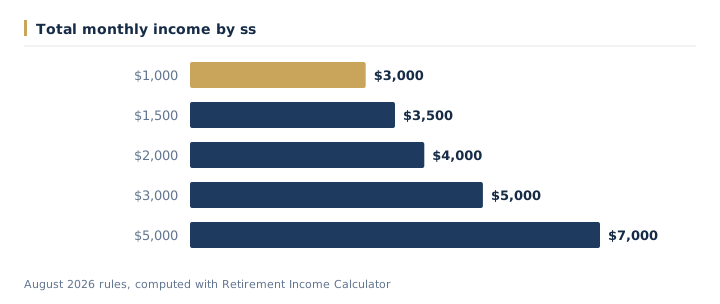
Running ss from $1,000 up to $5,000 moves total monthly income from $3,000 to $7,000 — a spread of $4,000. That gap is the part a single headline rate never shows.
The same runs seen through monthly gap
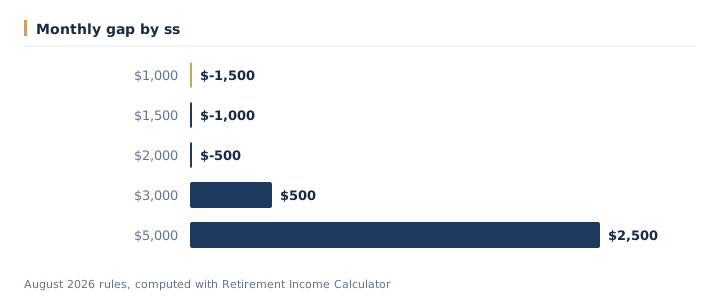
At $1,000, monthly gap works out to $-1,500; at $5,000 it is $2,500. Looking only at total monthly income tends to understate how much the outcome shifts across that range.
Assumptions behind these figures
| Input | Value |
|---|---|
| Ss | $2,000 |
| Pension | $0 |
| Other | $0 |
| Balance | $600,000 |
| Wr | 4% |
| Expenses | $4,500 |
| As of | August 2026 |
| Method | identical to /tools/retirement-income-calculator |
Brackets, thresholds and rates change from year to year, so treat these as August 2026 figures for the 2026 tax year. For your own situation, open the Retirement Income Calculator and enter your real numbers — the calculator runs the same code that produced every figure on this page.
Frequently Asked Questions
When should I enroll in Medicare?
If you're not already collecting Social Security when you turn 65, you generally need to actively enroll yourself in Medicare during your Initial Enrollment Period, a seven-month window spanning three months before your 65th birthday month, that month, and three months after. Enrolling in the three months before your birthday month generally starts coverage soonest. Missing this window without other qualifying coverage can lead to a coverage gap and permanent late penalties, so it's worth marking on your calendar well in advance.
What happens if I miss my Medicare enrollment window?
Missing your Initial Enrollment Period without qualifying coverage can generally trigger permanent late-enrollment penalties added to your monthly premiums — often described as roughly 10% more on Part B for each full year you were eligible but not enrolled, generally for as long as you have that coverage. You'd then need to wait for the General Enrollment Period, typically January through March each year, and coverage may not start right away. Because these penalties can last for life, confirm your specific enrollment timeline with Medicare or a benefits advisor well before turning 65.
What's the difference between Original Medicare and Medicare Advantage?
Original Medicare generally consists of Part A and Part B, usually paired with a standalone Part D drug plan and often a Medigap supplemental policy to help cover deductibles and coinsurance. Medicare Advantage (Part C) is a private-insurer alternative that bundles hospital, medical, and often drug coverage into one plan with its own network and rules. You generally cannot pair a Medigap policy with Medicare Advantage, and switching between the two paths later can be more difficult than choosing carefully at the start.
Do I need to enroll in Medicare if I'm still working past 65?
It depends largely on your employer's size. If you work for a large employer, generally 20 or more employees, your group coverage is usually primary, and you can often delay Part B without penalty until that coverage ends. If your employer is small, generally under 20 employees, Medicare is typically the primary payer, so delaying Part B in that situation can leave you effectively underinsured even with employer coverage. Because the rules are nuanced, confirm your specific situation with your HR department or Medicare directly before deciding to delay.
What is IRMAA?
IRMAA, the Income-Related Monthly Adjustment Amount, is a surcharge added to Medicare Part B and Part D premiums for beneficiaries above certain income thresholds. It's based on income from an earlier tax year, so a high-income year — such as one with a large Roth conversion or RMD — can raise your premiums a couple of years later. Because the income thresholds and surcharge amounts are adjusted periodically, check current Medicare or IRS figures when planning income-generating events near retirement.