Guides
Inflation Impact on Retirement Savings
By Editorial Team · Published January 27, 2026 · Updated August 22, 2026 · 12 min read
How inflation erodes purchasing power over a 25-year retirement, why real returns matter, and the hedges that actually help.
Here is a number to sit with. You retire at 65 with a plan to spend $60,000 a year, and that feels comfortable. Inflation averages a tame 3%. You don't change your lifestyle at all. By age 89 — and plenty of 65-year-olds will reach 89 — buying that exact same $60,000 lifestyle costs about $122,000 in actual dollars. Flip it around: if your income were frozen at $60,000 the whole way, by 89 it would buy less than half of what it bought on the day you retired.
Nothing dramatic happened in that story. No crash. No bad year that made the news. The market behaved. Inflation was low. And the retiree still lost more than half their purchasing power, quietly, while the spreadsheet kept saying everything was fine. That is the entire problem with inflation in retirement: it is the slow leak in the tire, never alarming in any one year, ruinous over twenty-five.
This article is about that leak — where it does the most damage, what actually slows it, and the mistakes that make it worse.
Why inflation hurts retirees specifically
While you're working, inflation is partly self-healing. Wages tend to drift up with prices over time, so your income keeps some pace with the cost of living without you doing anything.
Retire and that hedge mostly disappears. A lot of retirement income is fixed in nominal dollars and stays there: most pensions, fixed annuities, bond interest. The check is the same in year 20 as it was in year 1, but the grocery bill, the property tax, and the dental work are not.
The damage is easy to miss because it arrives one small step at a time. A retiree spending $60,000 isn't rattled when prices nudge up 3% — that's a rounding error in any given month. But compound that 3% over a long retirement and the $60,000 lifestyle quietly demands roughly $108,000 of nominal income twenty years later just to stand still. A Money Longevity Calculator that explicitly models rising prices tells you something true; one that assumes flat spending is telling you a comforting fiction.
The number that actually matters: real versus nominal
If you remember one distinction from this whole article, make it this one.
Nominal return is the headline. Your portfolio earned 6%.
Real return is what survives inflation. If inflation ran 3%, your real return was roughly 3%. The quick approximation: real ≈ nominal − inflation.
That reframing changes how every projection should be read. A "safe" portfolio of bonds yielding exactly 4% in a 4%-inflation world has a real return of about zero. You are not growing anything. Your money buys the same amount next year as this year, year after year, while you spend it down. Meanwhile a portfolio earning 7% nominal in a 3%-inflation world is growing purchasing power at about 4% a year — a completely different financial life.
So whenever you look at a retirement projection, the first question is blunt: are these numbers real or nominal? A plan that looks healthy in nominal terms can be quietly failing in real terms. Model retirement growth in real terms, or subtract expected inflation by hand, with something like the Retirement Savings Calculator.
A doubling rule, and 25 years of it in action
There's a mental shortcut worth carrying around: the rule of 72. Divide 72 by an annual rate to estimate how long something takes to double.
- At 3% inflation, prices double in about 72 ÷ 3 = 24 years.
- At 4%, about 18 years.
- At 2%, about 36 years.
Now watch the $60,000 retiree across 25 years at 3%:
| Year (age) | Nominal cost of the same lifestyle |
|---|---|
| Year 1 (65) | $60,000 |
| Year 10 (74) | ≈ $78,300 |
| Year 15 (79) | ≈ $90,800 |
| Year 25 (89) | ≈ $122,000 |
The lifestyle never changed. The same haircut, the same groceries, the same heating bill. Only the price tag moved, and it more than doubled. A flat-income plan doesn't just lag inflation; it slowly impoverishes a person who did nothing wrong. Stress-test your own number with the Money Longevity Calculator across a few inflation assumptions, not just one.
There's a second, less obvious way the same table bites. Most people don't spend a perfectly flat $60,000. Early retirement tends to be the expensive, active phase — travel, the deferred kitchen remodel, helping a grandchild with tuition. So the years when you withdraw the most in real terms are often the early ones, before inflation has done much, while the cheaper, slower years come later when inflation has compounded hardest. That timing partially offsets the picture, which is why a blanket "spending rises with inflation forever" assumption can be as wrong as a flat one. The honest move is to model your own spending shape, not borrow someone else's curve. A retirement income picture that ignores both the price-level climb and the way real spending changes with age is missing two things at once.
A real shield with real gaps: Social Security's COLA
Social Security is one of the rare income sources that fights back. Each year the Social Security Administration applies a cost-of-living adjustment — a COLA — tied to a consumer price index, so the benefit generally rises with measured inflation.
That makes Social Security an unusual real, inflation-protected income stream, which is one of the better arguments for delaying your claim: the delayed retirement credits add roughly 8% a year between full retirement age (currently 67 for those born 1960 or later) and 70, and that larger base then gets COLA'd for life. The Social Security Calculator is the place to see your own claiming trade-off.
But "shield" oversells it. Three gaps:
The index used to set the COLA may not track what retirees actually buy — particularly healthcare, where seniors spend a disproportionate share. COLAs are backward-looking, so when prices spike, the catch-up arrives late, after you've already absorbed the higher costs. And pensions and annuities mostly carry no COLA at all, so the more of your income that comes from those, the more of you is exposed.
Why a single "average" inflation rate lies to you
A tidy long-run number like "3%" is convenient and a little dishonest. Inflation doesn't show up at a polite 3% every December. It arrives in bursts — a couple of years at 6–8%, then quieter years that average back down to something that looks reasonable in hindsight. The retiree who was spending through the burst doesn't get to average it. Once prices ratchet up they almost never fall back; the higher base is locked in even after inflation cools. A plan that only ever tested itself against a flat average can look perfectly healthy while being fragile against the lumpy, front-loaded inflation that actually happens. Stress-testing a few bad years early matters far more than fine-tuning the long-run average.
When two risks compound: sequence plus inflation
You may already know sequence-of-returns risk: weak market returns early in retirement, while you're withdrawing, can permanently scar a portfolio in a way the same returns later would not. Inflation makes that worse, not additively but multiplicatively.
Hit a stretch of flat or falling markets and 5–6% inflation in the first few retirement years and you face a two-sided drain. The portfolio isn't growing. Meanwhile the dollar amount you must withdraw to maintain the same life is climbing fast. You are selling more shares, at bad prices, to fund a rising bill. That is among the most dangerous things that can happen to a 30-year retirement, and it's the strongest argument for holding a cushion of stable assets so you are not forced to sell into exactly that environment.
What actually blunts inflation
No single asset beats inflation cleanly. Several soften it, each with a catch.
| Hedge | How it helps | The catch |
|---|---|---|
| TIPS | Principal adjusts with CPI; explicit linkage | Modest real yields; taxable "phantom" income in taxable accounts |
| Series I savings bonds | Rate tracks inflation; tax-deferred | Annual purchase cap; one-year lockup, penalty before 5 years |
| Equities | Companies raise prices; long-run real growth beats inflation | Volatile; zero year-to-year protection; sequence risk |
| Real assets (real estate, some commodities) | Tend to rise with prices over long stretches | Lumpy, illiquid, not guaranteed |
| Delayed Social Security | COLA-protected lifetime income | Benefit is capped; index may lag retiree costs |
The unglamorous answer: enough stocks
The most powerful long-term inflation hedge for most retirees isn't a product with an acronym. It's a sufficient allocation to equities. Over multi-decade horizons stocks have historically delivered real growth comfortably above inflation, because businesses can raise prices and grow earnings. The price of that is volatility, which is why the common structure is a barbell: enough stable, inflation-aware assets — TIPS, I-bonds, a cash buffer — to fund near-term spending without forced selling, paired with an equity slice large enough to generate the real growth a 25-to-30-year horizon requires. Holding only "safe" fixed-rate assets is, against inflation, one of the riskiest things a retiree can do.
It's worth being honest that this is a point of genuine disagreement among sensible people. Some planners argue that a retiree who has already "won the game" should dial equity exposure down hard and accept low real growth in exchange for sleeping at night, leaning more on TIPS and an annuity floor for inflation-linked income. Others argue that a 30-year horizon is still a long-horizon investor and that under-allocating to stocks is the more dangerous error precisely because it's the invisible one. Both camps are reasoning from real risks; they just weight the visible risk of a downturn against the quiet risk of erosion differently. Where you land should depend on how much of your essential spending is already covered by COLA-protected income like Social Security — the more of your floor that's inflation-protected, the more freedom the rest of the portfolio has to chase real growth, and the less a bad market year actually threatens your groceries.
Inflation's sharpest edge: healthcare
General inflation is the part of the story everyone budgets. The part they underbudget is healthcare, which has historically risen faster than the broad rate and which is one of the largest and least optional expenses in late retirement. Medicare Part B premiums (roughly $185 a month in 2025 — confirm the current figure), Part D drugs, Medigap premiums, dental, hearing, vision, and above all long-term care all tend to climb at their own steeper pace.
That has two consequences worth saying plainly. Applying a single general 3% to your whole budget understates the path, because a growing share of late-life spending sits in the fastest-inflating category. And the late years — exactly when the portfolio may be smallest — tend to carry the highest real healthcare costs. Plans that assume flat or generally-inflating expenses are most wrong precisely about age 80-plus.
Two rates, no software required
You don't need a Monte Carlo engine to handle this honestly. Split the budget in two and inflate the halves separately. Take a retiree spending $60,000: say $48,000 on general living and $12,000 on healthcare. Inflate the general bucket at 3% and the healthcare bucket at 5%. After 20 years the general half has grown to roughly $86,700. The healthcare half — which started much smaller — has ballooned to about $31,800. Combined, the retiree now needs roughly $118,500, noticeably more than the ~$108,000 a single blended 3% would have predicted, and the gap widens every additional year. The exact figure isn't the point. The shape is: late-retirement spending bends upward faster than one rate suggests, right when the portfolio can least absorb it.
Why all-cash is its own kind of risk
The instinct as retirement nears is to move everything to cash and short-term CDs and be done with market risk. But cash carries a quiet risk of its own: after tax, it almost always loses to inflation. A "safe" 4% CD in a 3%-inflation world, taxed at 22%, nets roughly 3.1% — barely ahead in a good year, behind in a bad one. Run that for 30 years and an all-cash portfolio is one of the most reliable ways ever invented to guarantee a loss of purchasing power. Eliminating volatility is not eliminating risk. Inflation risk is just slower and less visible than a crash, which is exactly why it's so easy to walk into.
Questions retirees ask about inflation
How much does inflation really cut my savings?
At about 3% average, prices double in roughly 24 years (rule of 72), so frozen purchasing power loses about half its value across a typical retirement. A $60,000 lifestyle at 65 can need roughly $122,000 by 89 just to break even.
What inflation rate should I plan with?
A common long-run assumption is around 2.5–3%, but plan to stress-test higher and to inflate healthcare faster than the general budget. The aim isn't to predict — it's to confirm the plan survives a sustained run of elevated prices.
Does Social Security keep up with inflation?
Partly. The annual COLA makes it a rare inflation-protected stream, but the index may not match retirees' actual spending (healthcare especially), and the adjustment lags real-time price spikes.
What's the best inflation investment?
There isn't a single perfect one. TIPS and I-bonds give explicit linkage for near-term needs; a sufficient equity allocation supplies the long-run real growth that historically outpaces inflation. Most workable plans blend a stable inflation-aware reserve with growth assets.
Why is healthcare inflation a separate worry?
It has historically risen faster than general inflation and it's a growing share of spending in late retirement — exactly when portfolios are often smallest. One general rate applied to the whole budget tends to understate true late-life costs.
Sources
- Bureau of Labor Statistics — Consumer Price Index and inflation data
- Social Security Administration — annual cost-of-living adjustments
- TreasuryDirect — TIPS and Series I savings bonds
- Medicare — premiums and healthcare cost information
- Consumer Financial Protection Bureau — planning for inflation in retirement
The short version
- A frozen income loses about half its purchasing power over a typical retirement at 3% — the slowest, most predictable threat there is.
- Read every projection in real terms; a plan that looks fine nominally can be failing in real terms.
- Social Security's COLA is a genuine but imperfect shield; most pensions and fixed annuities have none.
- The practical defense is a barbell: inflation-aware reserves (TIPS, I-bonds, cash buffer) plus enough equities for real growth — all-cash quietly guarantees a loss.
- Inflate healthcare faster than the general budget, and stress-test high inflation paired with weak early returns using a Money Longevity Calculator.
This is general U.S. educational information current as of 2025, not personalized financial or tax advice. Inflation rates, Social Security COLAs, and Medicare premiums reset every year — check the current figures with the SSA, Medicare, the BLS, or a qualified advisor before you rely on anything here.
Run the numbers
Everything below came out of this site's own Money Longevity Calculator. The figures are not quoted from anywhere else: each row is one run of the same calculation the tool page performs, using August 2026 rules. Put the same inputs in and you will get the same output.
How the result moves with assets
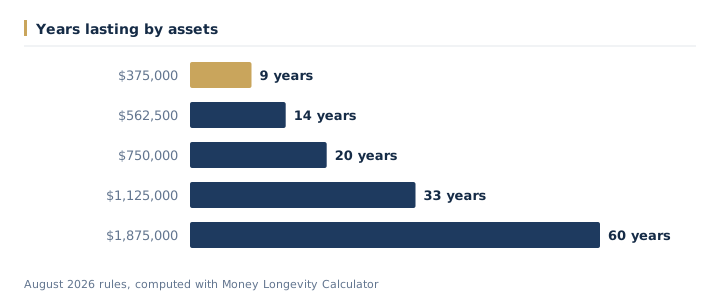
We ran 5 values of assets through the calculator and left every other input at its default. As of August 2026, the output was:
| Assets ($) | Years lasting (years) | Depletion age | Sustainable monthly spend ($) |
|---|---|---|---|
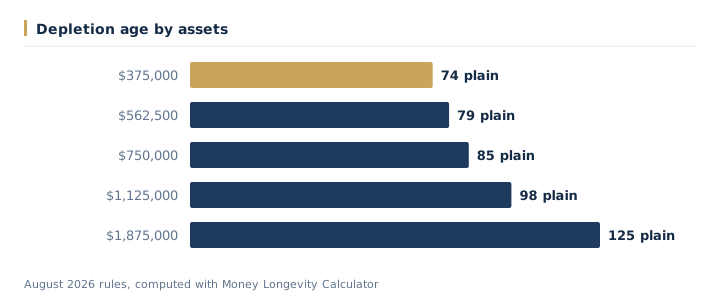
| 375,000 | 9 years | 74 | 606.8 |
| 562,500 | 14 years | 79 | 910.19 |
| 750,000 | 20 years | 85 | 1,213.59 |
| 1,125,000 | 33 years | 98 | 1,820.39 |
| 1,875,000 | 60 years | 125 | 3,033.98 |
Running assets from $375,000 up to $1,875,000 moves years lasting from 9 years to 60 years — a spread of 51 years. That gap is the part a single headline rate never shows.
The same runs seen through depletion age
At $375,000, depletion age works out to 74; at $1,875,000 it is 125. Looking only at years lasting tends to understate how much the outcome shifts across that range.
Assumptions behind these figures
| Input | Value |
|---|---|
| Assets | $750,000 |
| Age | 65 |
| Monthly | $4,000 |
| Ret | 5% |
| Infl | 3% |
| As of | August 2026 |
| Method | identical to /tools/money-longevity-calculator |
Brackets, thresholds and rates change from year to year, so treat these as August 2026 figures for the 2026 tax year. For your own situation, open the Money Longevity Calculator and enter your real numbers — the calculator runs the same code that produced every figure on this page.
Frequently Asked Questions
How does inflation affect retirement savings?
Inflation gradually erodes the purchasing power of fixed retirement income, meaning the same dollar amount buys less over time even without any dramatic market event. Because retirees generally don't receive automatic wage increases the way workers do, income sources that stay flat in nominal dollars — like many pensions, fixed annuities, or bond interest — can quietly lose a large share of real value over a long retirement. This makes inflation one of the more underappreciated risks in retirement planning, since the damage is gradual and easy to overlook year to year.
What's the difference between real and nominal returns?
Nominal return is the return your portfolio actually earned before adjusting for inflation, while real return is what's left after subtracting inflation's effect, roughly calculated as nominal return minus the inflation rate. A portfolio earning a return that just matches inflation has a real return near zero, meaning it isn't actually growing your purchasing power even though the account balance may be rising. When reviewing any retirement projection, check whether the figures are stated in real or nominal terms, since a plan that looks healthy in nominal dollars can be losing ground in real terms.
How much does inflation erode purchasing power over a 25-year retirement?
Even at a modest, historically typical inflation rate, the cost of maintaining an identical lifestyle can more than double over roughly two to three decades of retirement, since prices compound similarly to investment returns. This means a retiree with flat, non-inflation-adjusted income can effectively lose more than half their purchasing power over a long retirement without any single dramatic year standing out. This is why many retirement income plans build in an inflation adjustment rather than assuming spending needs stay flat.
Does Social Security protect against inflation?
Yes, to a meaningful degree — Social Security benefits generally receive an annual cost-of-living adjustment tied to a measure of consumer prices, making it one of the few inflation-protected income sources retirees have. However, this protection isn't perfect: the index used may not fully reflect costs retirees actually face, especially healthcare, and adjustments are generally backward-looking, so they can lag behind a sudden price spike. Most private pensions and annuities, by contrast, typically carry no similar built-in inflation adjustment.