Guides
HSA: The Triple Tax-Advantaged Retirement Account
By Editorial Team · Published March 26, 2026 · Updated August 22, 2026 · 13 min read
Why the HSA may be the most underrated retirement account: triple tax-free, the invest-and-save-receipts strategy, and the stealth IRA after 65.
If I could only keep one account for retirement and someone forced me to give up either my Roth IRA or my health savings account, I would think harder about that choice than most people expect. That sounds absurd. An HSA is supposed to be the thing you use to pay for contact lenses and the occasional urgent-care copay. But the tax code accidentally built the best retirement account in America and then hid it inside a health plan, and most people never find it.
Here is the case I want to make: for a household that can afford to pay routine medical bills from a regular checking account, the HSA is not a healthcare account at all. It is a retirement account with a better tax structure than the 401(k) and the Roth IRA, and it is being wasted by tens of millions of people who swipe the debit card at the pharmacy every month.
Why I'll defend the "most underrated account" claim
Run the comparison on the only thing that matters long term, which is how many times your dollar gets taxed.
A traditional 401(k) gets taxed once, on the way out. A Roth IRA gets taxed once, on the way in. The HSA, used for qualified medical expenses, gets taxed zero times. Money goes in deductible, grows with no tax drag, and comes out free. There is no other account in the U.S. system that does this. Not one.
And there's a kicker most articles bury. If you contribute through your employer's payroll, HSA money also escapes the 7.65% FICA payroll tax on Social Security and Medicare. Your 401(k) deferral does not get that. Your IRA contribution does not get that. So the HSA isn't just triple tax-advantaged in the brochure sense — for payroll contributors it's arguably quadruple advantaged.
The catch, and the reason almost nobody captures this, is behavioral, not legal. The strategy only works if you stop treating the account like a wallet. That single habit is the whole game, and I'll come back to it.
What you're actually opening
An HSA is a personal, portable account that you can only fund while you're covered by a qualifying high-deductible health plan, or HDHP. The "you own it" part deserves emphasis: it is yours the way an IRA is yours. Change jobs, retire, fire your employer in your head every Monday — the account and every dollar in it follow you. There is no forfeiture, no "use it or lose it," no employer claw-back. Balances roll forever.
Mechanically there are two buckets inside the account. One is a cash sweep that behaves like a checking account with a debit card. The other is an investment platform, usually unlocked once you hold some minimum in cash (often $1,000–$2,000, set by the custodian, not the IRS). The investment bucket is where the retirement money actually lives. An HSA left entirely in the cash sweep is a savings account having an identity crisis.
The triple advantage, mechanism by mechanism
Let me take the three legs one at a time, because the why matters more than the slogan.
Leg one, the deduction. Contributions reduce taxable income in the year you make them. Through payroll they also dodge FICA, as noted. This is the same front-end benefit a traditional 401(k) gives you, plus the payroll-tax piece a 401(k) doesn't.
Leg two, the growth. Dividends, interest, and capital gains inside the account are never taxed while they stay there. No annual 1099, no drag, no rebalancing tax. This is Roth-like behavior on assets that already got a deduction going in — a combination a Roth and a traditional account each only get to do half of.
Leg three, the withdrawal. Spend it on an IRS-qualified medical expense at any age and the withdrawal is tax-free. Qualified expenses are broad: deductibles, copays, dental, vision, prescriptions, and in retirement, Medicare premiums for Part B, Part D, and Medicare Advantage.
Here's the same idea as a table, because the asymmetry is the entire argument:
| Account | Deductible going in? | Tax-free growth? | Tax-free coming out? | Skips payroll tax? |
|---|---|---|---|---|
| Traditional 401(k)/IRA | Yes | Yes | No — taxed as income | No |
| Roth IRA | No | Yes | Yes | No |
| HSA (qualified medical) | Yes | Yes | Yes | Yes, via payroll |
Read across that bottom row twice. Nothing else in the table can claim it.
The stealth-IRA trick after age 65
This is the part that converts the HSA from a healthcare account into a genuine retirement account, and it's the feature critics conveniently skip.
Before 65, a non-medical withdrawal is brutal: ordinary income tax plus a 20% penalty. That penalty is what scares people off treating it as retirement money. But the 20% penalty disappears at 65. After that age, a non-medical HSA withdrawal is taxed exactly like a traditional IRA distribution — ordinary income, no penalty.
Sit with what that means. The worst-case outcome for an HSA after 65 is that it performs identically to a traditional IRA. The best case — using it for the medical and Medicare costs essentially every retiree incurs — is fully tax-free. A floor of "as good as a traditional IRA" and a ceiling of "completely tax-free" is not a risk profile you turn down. Planners who call it the "stealth IRA" or "secret Roth" aren't being cute; the math earns the nickname.
The gatekeeper: HSA-eligible HDHP coverage
You can't fund an HSA on goodwill. You need coverage under a specifically HSA-eligible HDHP, and you need to be free of disqualifying coverage. This trips people up because not every plan that markets itself as "high deductible" is HSA-eligible — the IRS sets minimum-deductible and maximum-out-of-pocket bands each year that define the qualifying plans. Confirm with HR or the plan documents; the marketing name is not proof.
Things that disqualify new contributions: being claimed as someone's tax dependent, carrying other non-HDHP coverage (a spouse's plan, a general-purpose FSA), or being enrolled in any part of Medicare. Disqualification only stops new contributions. Existing money keeps its tax-free powers for qualified expenses regardless.
Contribution limits (2025 figures — confirm the current year)
For the 2025 tax year:
- Self-only HDHP coverage: $4,300
- Family HDHP coverage: $8,550
- Age 55-or-older catch-up: an extra $1,000
These are inflation-indexed and move every year, so verify the current figure before you fund — overcontributing draws an excise tax until you fix it. One detail people miss: each spouse's $1,000 catch-up must go into an HSA in that spouse's own name. You cannot stack both catch-ups into one account.
And don't forget employer money counts against the same ceiling. If your employer seeds $1,000 into a self-only HSA in 2025, your personal room is $3,300, not $4,300. That seed is still triple-advantaged for you and is effectively free — capture at least the match — but treat it as part of the cap, not a bonus on top.
The one habit the whole strategy depends on
I promised to return to the behavioral piece. Here it is, blunt: the HSA only becomes a retirement account if you stop spending it.
Three concrete moves.
First, pay current medical bills from ordinary cash or savings if your budget can stand it. Every dollar you leave inside keeps compounding tax-free, and the opportunity cost of pulling $400 out at 40 instead of letting it ride to 70 is enormous.
Second, invest the balance above the custodian's cash minimum. A 0.4% cash sweep versus a diversified portfolio over three decades is not a rounding error; it's the difference between a nice cushion and a six-figure account.
Third — and this is the move almost nobody makes — keep every medical receipt. There is no deadline to reimburse yourself for a qualified expense, as long as the expense came after you opened the HSA and wasn't already reimbursed or deducted elsewhere. Pay a $600 bill out of pocket in 2026, file the receipt, let the HSA compound for 22 years, then withdraw $600 tax-free in 2048 against that ancient receipt. You've effectively built a tax-free emergency fund you can crack open at any age, with paperwork. Store receipts as scans in a dedicated folder or your custodian's receipt vault; the IRS can ask you to substantiate a tax-free withdrawal long after the fact.
What three decades of this actually builds
Numbers make the case better than adjectives. Take Maria, 35, with family HDHP coverage, who decides to fund the family limit and invest it.
To keep the arithmetic clean, assume she puts in a level $8,550 a year for 30 years (the real limit rises with inflation, so this understates the result) and earns an average 7% inside the account.
- Annual contribution: $8,550
- Horizon: 30 years, to age 65
- Assumed return: 7%
A $8,550 annual contribution compounding at 7% for 30 years lands near $808,000. If Maria paid routine care out of pocket and saved her receipts along the way, a large share of that balance can leave the account entirely tax-free against retirement medical and Medicare costs, and whatever remains behaves like a traditional IRA after 65.
Then layer the front-end savings. Funding through payroll in a 24% federal bracket, with state tax and FICA on top, the combined upfront tax she avoids on $8,550 could clear $3,000 a year — money a 401(k) deferral wouldn't have shielded from FICA. To see how this account stacks against your 401(k) and IRA in your own situation, run the combined picture through the Retirement Savings Calculator and check how the tax-free leg changes your trajectory with the Retirement Income Calculator.
Don't confuse this with an FSA
People treat the HSA and the health FSA as interchangeable because both pay medical costs with pretax dollars. For retirement they are nothing alike.
| HSA | Health FSA | |
|---|---|---|
| Who owns it | You, portable | Tied to the employer |
| Rollover | Unlimited, indefinitely | Use-it-or-lose-it, minor carryover at best |
| HDHP required | Yes | No |
| Can be invested | Yes | No |
| Survives a job change | Yes | Generally no |
| Retirement value | High | None |
An FSA is a one-year spending tool. An HSA is a multi-decade wealth tool. A limited-purpose FSA (dental and vision only) can sometimes coexist with an HSA, but a general-purpose FSA will block your HSA contributions outright.
The Medicare timing trap that costs people real money
If there's one place where smart people still get burned, it's the collision between HSAs and Medicare. Enroll in any part of Medicare and you can no longer contribute to an HSA. Part A enrollment is automatic for most people who claim Social Security at or after 65, and — this is the sharp edge — Part A can be backdated up to six months.
That retroactivity is the trap. Work past 65, delay Social Security, then claim it at 67, and your Part A is treated as effective up to six months before you applied. Any HSA contributions made during those retroactive months retroactively become excess contributions with a penalty attached.
The practical rule if you intend to keep funding an HSA past 65: do not enroll in any part of Medicare, do not claim Social Security, and stop HSA contributions at least six months before you eventually do either. You can still spend the existing balance tax-free on Medicare Part B, Part D, and Advantage premiums plus deductibles and copays — Medigap premiums are the notable exception and don't qualify — you just can't add new money.
Where people leave money on the table
- Parking the whole balance in the cash sweep and forfeiting decades of compounding.
- Reflexively swiping the HSA card for every $30 prescription instead of paying out of pocket and letting it grow.
- Tossing receipts, which destroys the ability to reimburse yourself tax-free later.
- Contributing while enrolled in Medicare — even Part A alone — and ignoring the six-month backdating rule.
- Forgetting that employer contributions eat into the same annual cap, triggering an excess-contribution excise tax.
- Assuming any "high-deductible" plan is HSA-eligible without checking.
- Leaving the default beneficiary unreviewed: a spouse can treat an inherited HSA as their own, but a non-spouse beneficiary must report the full value as taxable income in the year of death.
Questions I get asked the most
Is the HSA genuinely better than a 401(k) for retirement? For dollars you can leave invested, yes — the triple advantage beats a traditional 401(k)'s single-taxed structure, and payroll contributions skip FICA on top. A defensible priority order: grab the full 401(k) employer match first, then max the HSA, then circle back to the 401(k) or an IRA. Your numbers may reorder that; model it.
What if I sail through retirement with almost no medical bills? Statistically unlikely — healthcare is among the largest retiree expense categories — but even then, after 65 you withdraw for anything at ordinary income rates, identical to a traditional IRA. There is no scenario where the HSA loses to a traditional account.
Can the HSA pay my Medicare premiums? Yes, tax-free, for Part B, Part D, and Medicare Advantage, plus deductibles and copays. Medigap supplemental premiums are the exception and are not qualified.
Do I forfeit the money if I move off an HDHP? No. You keep the account and every dollar permanently. You simply can't add new contributions for any month you lack HSA-eligible HDHP coverage. Old funds still spend tax-free on qualified expenses.
Can spouses share one HSA? No. HSAs are individual; there is no joint HSA. A family HDHP allows a combined family limit, but each spouse's catch-up must sit in an account in that spouse's own name.
Is there a deadline to reimburse an old expense? None — provided the expense occurred after the HSA was established, was qualified, and wasn't already reimbursed or deducted. Keep the receipt and you can reimburse yourself decades later, tax-free.
Sources
- IRS — Health Savings Accounts and high-deductible plan rules
- Medicare — enrollment and premium information
- Centers for Medicare & Medicaid Services — program guidance
- Consumer Financial Protection Bureau — saving and planning resources
- U.S. Department of Labor — employer health and benefit plan rules
What to take away
- The HSA is the only U.S. account taxed zero times when used for qualified medical costs — deductible in, growth untaxed, withdrawals free — and payroll contributions also dodge FICA.
- The strategy is behavioral: pay current bills out of pocket, invest the balance, and archive receipts for tax-free reimbursement years later.
- After 65 the floor is "as good as a traditional IRA" and the ceiling is "completely tax-free," so there is no losing scenario versus a traditional account.
- 2025 limits are $4,300 self-only and $8,550 family, plus $1,000 catch-up at 55+ — these index annually, so verify the current figure before funding.
- Stop contributing at least six months before enrolling in Medicare or claiming Social Security, or the Part A backdating rule turns those contributions into penalized excess.
The above is educational background on HSAs and retirement strategy, not individualized tax, financial, or insurance advice. Limits and rules change yearly; check the current IRS figures and talk to a qualified professional about your own circumstances before acting.
Run the numbers
Everything below came out of this site's own Retirement Savings Calculator. The figures are not quoted from anywhere else: each row is one run of the same calculation the tool page performs, using August 2026 rules. Put the same inputs in and you will get the same output.
How the result moves with current savings
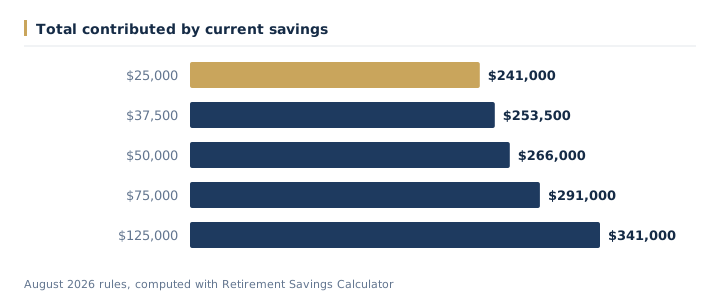
We ran 5 values of current savings through the calculator and left every other input at its default. As of August 2026, the output was:
| Current savings ($) | Total contributed ($) | Projected balance ($) | Real balance today dollars ($) |
|---|---|---|---|
| 25,000 | 241,000 | 870,424.04 | 358,603.18 |
| 37,500 | 253,500 | 965,577.23 | 397,805.03 |
| 50,000 | 266,000 | 1,060,730.41 | 437,006.89 |
| 75,000 | 291,000 | 1,251,036.79 | 515,410.59 |
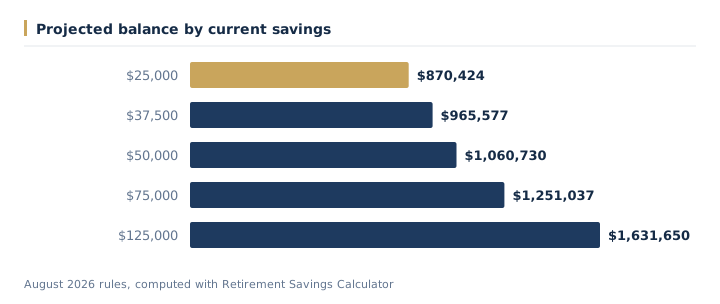
| 125,000 | 341,000 | 1,631,649.54 | 672,218.01 |
Running current savings from $25,000 up to $125,000 moves total contributed from $241,000 to $341,000 — a spread of $100,000. That gap is the part a single headline rate never shows.
The same runs seen through projected balance
At $25,000, projected balance works out to $870,424; at $125,000 it is $1,631,650. Looking only at total contributed tends to understate how much the outcome shifts across that range.
Assumptions behind these figures
| Input | Value |
|---|---|
| Current age | 35 |
| Retire age | 65 |
| Current savings | $50,000 |
| Monthly | $600 |
| Ret | 7% |
| Infl | 3% |
| As of | August 2026 |
| Method | identical to /tools/retirement-savings-calculator |
Brackets, thresholds and rates change from year to year, so treat these as August 2026 figures for the 2026 tax year. For your own situation, open the Retirement Savings Calculator and enter your real numbers — the calculator runs the same code that produced every figure on this page.
Frequently Asked Questions
Why is an HSA considered a good retirement account?
A Health Savings Account is often considered attractive for retirement because it offers a rare triple tax advantage: contributions are generally tax-deductible, growth inside the account is untaxed, and withdrawals for qualified medical expenses come out tax-free at any age. For funds contributed through payroll, HSA contributions also typically avoid FICA payroll taxes, which most other retirement accounts don't offer. This benefit applies specifically to those who can afford to pay routine medical costs out of pocket and let the HSA balance grow long-term.
What happens to HSA funds after age 65?
After age 65, a non-medical withdrawal from an HSA generally loses its 20% early-withdrawal penalty and is instead taxed as ordinary income, similar to a traditional IRA distribution. Withdrawals used for qualified medical expenses, including many Medicare premiums, generally remain entirely tax-free at any age. This combination — behaving at worst like a traditional IRA and at best being fully tax-free — is why some planners call it a stealth IRA.
What is the triple tax advantage of an HSA?
The three legs are generally a tax deduction on contributions going in, tax-free growth on investments held inside the account, and tax-free withdrawals when the money is used for qualified medical expenses. No other widely available U.S. retirement account combines all three benefits — a traditional 401(k) is only taxed once, on the way out, and a Roth IRA is only taxed once, on the way in, while a qualified HSA withdrawal is generally taxed zero times. Contributions made through payroll can add a further payroll-tax savings on top.
Do HSA funds expire if I don't use them?
No, HSA balances generally roll over indefinitely with no use-it-or-lose-it rule, unlike a general-purpose flexible spending account. The account is portable and stays with you through job changes and retirement, and unused funds can continue growing, potentially invested, for decades. This makes it functionally similar to an IRA in terms of ownership and continuity.
Who is eligible to contribute to an HSA?
You generally need to be covered by a specifically HSA-eligible high-deductible health plan and free of disqualifying coverage, such as being claimed as a dependent, having other non-HDHP coverage, or being enrolled in any part of Medicare. Not every plan marketed as high deductible actually qualifies, since the IRS sets specific minimum-deductible and maximum-out-of-pocket thresholds each year that define eligibility. It's best to confirm with your HR department or plan documents rather than relying on a plan's marketing name.