Tutorials
How to Withdraw From Retirement Accounts Tax-Efficiently
By Editorial Team · Published March 3, 2026 · Updated August 22, 2026 · 13 min read
A withdrawal-order procedure: conventional vs proportional vs bracket-filling, coordinated with RMDs, Social Security, and IRMAA, over a multi-year example.
Picture two retirees, same $1.5 million, same $70,000-a-year spending, same investments. One pays roughly $4,000 a year in federal tax across a thirty-year retirement. The other pays multiples of that, drifts into a higher bracket in their seventies, and watches a Medicare surcharge appear out of nowhere at 74. The only difference between them is the order in which they emptied their accounts and how they sequenced it around Social Security. Sequencing is not a footnote to a withdrawal plan. For two otherwise identical retirees it can be the single largest swing in lifetime tax — and unlike markets, it's a variable you fully control.
There is already a companion piece on this site explaining why the strategies work. This one is the procedure: the actual decision steps, in order, for deciding which account to tap in a given year and how much.
First, sort your money into its three tax buckets
Every dollar you'll spend in retirement lives in one of three buckets, and each is taxed on withdrawal in a fundamentally different way. You can't sequence what you haven't sorted, so this is step zero.
| Bucket | Examples | How a withdrawal is taxed |
|---|---|---|
| Taxable | Brokerage, bank, individual stocks | Only the gain is taxed, generally at lower long-term capital-gains rates; principal comes out tax-free |
| Tax-deferred | Traditional 401(k), traditional IRA, 403(b) | The entire withdrawal is ordinary income, taxed like a paycheck |
| Tax-free | Roth IRA, Roth 401(k) | Qualified withdrawals are not taxed at all |
The reason order matters at all flows directly from this table. A dollar from the taxable bucket might cost you fifteen cents of tax; the same dollar from the tax-deferred bucket might cost twenty-two cents or more and also raise other income-tested costs; the Roth dollar costs nothing today. Withdrawing in the wrong order means voluntarily paying the expensive dollars when cheap ones were available — or, just as costly, leaving so much in the tax-deferred bucket that it detonates as oversized RMDs and surcharges later. Map your three buckets and their balances first; everything below operates on that map.
The three sequencing methods, and when each wins
There is no universal "correct" order. There are three named approaches, each optimal in different situations. Knowing which problem you have tells you which method to run.
Method 1: The conventional order (taxable → tax-deferred → Roth)
The classic rule of thumb: spend the taxable bucket first, then tax-deferred, and save Roth for last.
The logic is sound and worth stating precisely: spending taxable money first lets the tax-deferred and Roth accounts keep compounding sheltered for longer, and it defers the ordinary-income hit. Roth goes last because it grows tax-free and (for your own Roth IRA) has no lifetime RMDs, so it's the most valuable space to preserve and the best thing to leave heirs.
Its weakness is just as precise. Spending taxable first means your early-retirement taxable income can be very low — which sounds good but often wastes years when you could have pulled tax-deferred money out cheaply in a low bracket. Then at 73 the still-large tax-deferred bucket produces RMDs so big they spike you into a higher bracket. The conventional order can be the right answer; it's also the one most likely to leave a tax bomb ticking in the tax-deferred bucket. Use it as a starting point, not a verdict.
Method 2: Proportional withdrawals
Instead of draining one bucket dry before touching the next, you pull a proportional slice from all three every year, roughly preserving the relative size of each bucket.
This smooths taxable income across the whole retirement. It tends to avoid both the very-low-income early years and the very-high-income RMD years that the conventional order creates. For many retirees with a meaningful balance in all three buckets, proportional drawdown produces a flatter, more predictable lifetime tax bill than draining sequentially. The trade-off: it gives up some of the extra tax-deferred compounding the conventional order buys, and it requires recalculating the split each year.
Method 3: Bracket-filling (the one that usually wins on the margin)
This is the active version, and for many retirees it's where the real money is. The procedure:
- Estimate the ordinary income you already expect this year from all sources (pension, any Social Security, interest).
- Identify the top of your current federal tax bracket.
- Deliberately pull additional tax-deferred money — or do a Roth conversion — up to, but not past, the top of that bracket.
- Cover any remaining spending need from the taxable bucket so you don't push into the next bracket.
The insight: tax brackets are use-it-or-lose-it each year. If you're in a low bracket in your sixties, the room at the top of that bracket is empty space you can fill with cheaply-taxed tax-deferred withdrawals or conversions now, shrinking the balance that would otherwise come out as expensive RMDs at 73+. Bracket-filling is less an alternative to the other two than a discipline layered on top of either — it's the part that converts a passive plan into an actively tax-managed one. Modeling the bracket headroom year by year is exactly what the Retirement Income Calculator is built to do.
The three things that warp every plan: RMDs, Social Security, IRMAA
A withdrawal plan that ignores these three isn't tax-efficient — it just hasn't met the bill yet.
RMDs remove your choice. Starting at age 73 (rising to 75 for those born 1960 or later), the IRS forces a minimum withdrawal from tax-deferred accounts whether you want the money or not, taxed as ordinary income. Every year before 73 that you didn't draw down or convert the tax-deferred bucket is a year that bucket grew larger — and a larger bucket means a larger forced, taxable distribution later. The pre-73 years are the only window you control; that's why bracket-filling early is so often the difference-maker. Project your future required amounts now with the RMD Calculator so you can see how big the forced distributions become if you do nothing.
Social Security taxation is a hidden cliff. The share of your Social Security benefit that's taxable rises with your other income, up to a maximum portion of the benefit. A poorly timed tax-deferred withdrawal can simultaneously be taxed itself and drag more of your Social Security into taxable income — a double effect that makes a withdrawal more expensive than its own bracket suggests. This is a strong argument for doing larger tax-deferred withdrawals and conversions in the years before Social Security starts, when there's no benefit to drag into tax.
IRMAA is a surcharge with a two-year memory. Higher-income retirees pay income-related surcharges on Medicare Part B and Part D premiums. The mechanism that catches people: the surcharge for a given year is based on your tax return from two years prior. A big one-time tax-deferred withdrawal or Roth conversion at 67 can trigger a higher Medicare premium at 69 — long after you've forgotten the withdrawal. The thresholds adjust over time, so confirm the current figures with Medicare and the SSA rather than memorizing a number; the rule to internalize is the two-year lookback, because it means tax-efficient withdrawal is a multi-year game, not a one-year one.
A multi-year worked example
A couple retires at 62 with: $300,000 taxable, $900,000 tax-deferred, $200,000 Roth. They'll delay Social Security to 70. They spend about $70,000 a year. Watch how the years are used.
Ages 62–69 (the low-income window). No Social Security yet, no RMDs yet — their natural taxable income is near zero. A purely conventional plan would spend down the $300,000 taxable bucket here and report almost no income. Instead they bracket-fill: each year they take roughly the taxable-bucket money they need for spending plus an additional chunk of tax-deferred money or Roth conversion sized to reach — not exceed — the top of a low federal bracket. Over these eight years they deliberately move a large slice of the $900,000 out at low rates. The tax-deferred bucket shrinks on purpose.
- Spending need: ~$70,000/year, largely from the taxable bucket
- Extra tax-deferred withdrawal / Roth conversion: filled up to the low-bracket ceiling each year
- Effect: eight years of cheap drawdown that would otherwise never have happened
Age 70. Social Security begins. Because the tax-deferred bucket is now meaningfully smaller, the eventual RMDs (at 73) will be smaller too — so less of the Social Security benefit gets dragged into taxable income, and they're less likely to cross an IRMAA threshold.
Ages 73+. RMDs begin, but on a deliberately reduced tax-deferred balance. The required amounts are modest. Spending is topped up from the Roth bucket, which is tax-free and doesn't raise AGI, so it doesn't worsen Social Security taxation or trip IRMAA.
The contrast with the naive plan is the whole point. The naive couple spends taxable first, reports near-zero income for eight years (wasting eight years of empty low-bracket room), then hits 73 with the full $900,000-plus still in the tax-deferred bucket — producing large RMDs that tax their Social Security harder and push them over an IRMAA threshold, with the surcharge arriving two years after the spike. Same accounts, same spending, same market: the only difference was using the empty bracket-years on purpose. Sequence is a lever you already hold.
Two refinements that sharpen the procedure
The buckets, methods, and three warping forces are the spine of the plan. Two further moves separate a decent plan from a tightly run one.
Match the asset to the bucket, not just the withdrawal to the year. Tax efficiency isn't only about which account you pull from — it's partly decided years earlier by what you hold in each. Assets that throw off heavily taxed income are generally better sheltered inside tax-deferred or Roth space, while investments that mostly grow and pay favorably taxed dividends fit naturally in the taxable bucket, where you also get the long-term capital-gains rate and the ability to harvest losses. This is location, and it interacts with sequencing: a taxable bucket built mostly of low-basis, highly appreciated holdings is more expensive to spend down than one with a higher cost basis, because more of each withdrawal is taxable gain. Knowing the composition of each bucket, not just its balance, changes which bucket is actually the cheap one in a given year.
Use capital losses and the basis step-up deliberately. Two features of the taxable bucket have no equivalent in the other two. First, realized capital losses can offset realized gains and a limited amount of ordinary income, which can make a taxable withdrawal effectively free of tax in a year you also harvest losses — a reason the taxable bucket is sometimes the smart pull even when a simple ordering rule says otherwise. Second, appreciated assets held until death generally receive a step-up in cost basis for heirs, which is why deeply appreciated taxable holdings are often the worst thing to spend and the best thing to leave — the mirror image of the Roth, which is the best thing to leave for a different reason (tax-free, no lifetime RMDs). A plan that ignores what happens to each bucket at the end isn't fully optimized; it's optimized only for the years you're spending.
A short numeric illustration ties these together. Suppose in a given year you need $30,000 of spending money and you also hold a taxable position sitting on a $12,000 unrealized loss. Harvesting that loss lets you sell $30,000 of appreciated taxable holdings, offset $12,000 of the gain with the loss, and report a much smaller taxable gain than the conventional "spend taxable last" instinct would ever produce. The same $30,000 pulled from the tax-deferred bucket would have been fully ordinary income. Same spending need, materially different tax — decided entirely by reading the buckets' internals before choosing where to pull. Pair this with a forward look at your required distributions using the RMD Calculator, because a loss-harvesting year is also often a good year to do an extra conversion while the bracket has room.
The annual decision procedure
Run this every year; the answer changes as brackets, balances, and your age move:
- Total your committed income for the year: pension, Social Security (if started), interest, any RMD you're forced to take.
- Find your bracket headroom — the gap between that income and the top of your current federal bracket.
- If you're under RMD age and in a low bracket, fill the headroom with tax-deferred withdrawals or Roth conversions; this is the scarce resource.
- Cover remaining spending from the taxable bucket (capital-gains-favored) to avoid pushing into the next bracket.
- Touch Roth last and on purpose — to top up spending without raising AGI in any year where another dollar of ordinary income would tax Social Security harder or cross an IRMAA line.
- Re-check the IRMAA two-year lookback before any large one-time withdrawal or conversion, because the cost shows up in your Medicare premium two years out.
Sorting buckets is step zero. Choosing among conventional, proportional, and bracket-filling is the strategy. But the part that compounds into the biggest lifetime difference is simply using the low-bracket years before RMDs and Social Security start — the empty space no one bills you for keeping, and no one refunds once it's gone.
Sources
- Internal Revenue Service — ordinary-income vs. capital-gains treatment, Roth qualified distributions, Roth conversion mechanics, and RMD timing
- Social Security Administration — how other income raises the taxable portion of Social Security benefits and how claiming age interacts with withdrawals
- Medicare — income-related monthly adjustment amounts on Part B and Part D and the two-year income lookback that triggers them
- Consumer Financial Protection Bureau — consumer guidance on coordinating withdrawals across account types and managing taxable income in retirement
Key takeaways
- Sort every dollar into taxable, tax-deferred, and tax-free buckets first — sequencing is impossible without that map, and each bucket is taxed on a different basis.
- Three methods exist: conventional order (simple, but can leave a tax-deferred bomb), proportional (smooths lifetime tax), and bracket-filling (usually wins on the margin); bracket-filling is best run as a discipline on top of either of the others.
- RMDs at 73+ remove your choice, so the pre-73, pre-Social-Security years are the controllable window where deliberate low-bracket withdrawals and conversions pay off most.
- A tax-deferred withdrawal can be doubly expensive by also dragging more Social Security into taxable income; favor large withdrawals before benefits start.
- IRMAA Medicare surcharges run on a two-year income lookback, so a one-time spike today raises premiums two years later — tax-efficient withdrawal is a multi-year decision, not an annual one.
This article describes general procedures for sequencing retirement withdrawals and is not individualized tax or investment advice; bracket thresholds, IRMAA tiers, and Social Security taxation figures change and depend on your full return, so model your own numbers and confirm them with a tax professional before acting.
Run the numbers
Everything below came out of this site's own Retirement Income Calculator. The figures are not quoted from anywhere else: each row is one run of the same calculation the tool page performs, using August 2026 rules. Put the same inputs in and you will get the same output.
How the result moves with ss
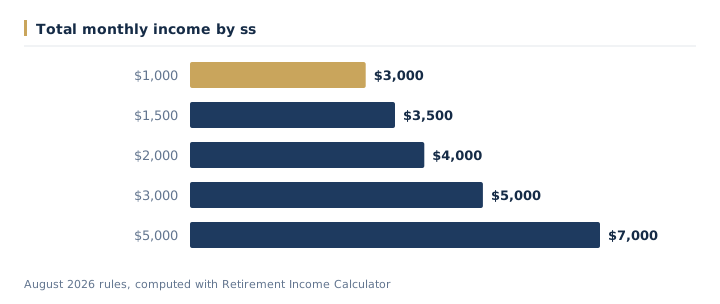
We ran 5 values of ss through the calculator and left every other input at its default. As of August 2026, the output was:
| Ss ($) | Total monthly income ($) | Monthly gap ($) | Coverage percent (%) |
|---|---|---|---|
| 1,000 | 3,000 | -1,500 | 66.67% |
| 1,500 | 3,500 | -1,000 | 77.78% |
| 2,000 | 4,000 | -500 | 88.89% |
| 3,000 | 5,000 | 500 | 111.11% |
| 5,000 | 7,000 | 2,500 | 150% |
Running ss from $1,000 up to $5,000 moves total monthly income from $3,000 to $7,000 — a spread of $4,000. That gap is the part a single headline rate never shows.
The same runs seen through monthly gap
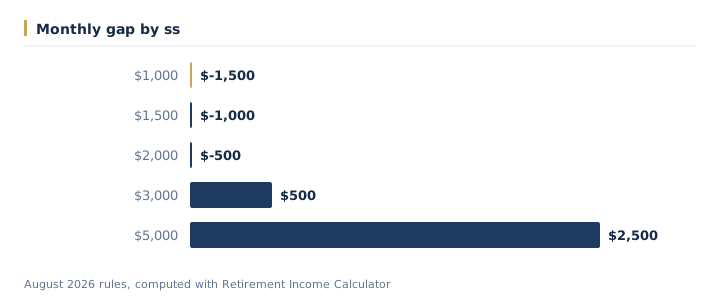
At $1,000, monthly gap works out to $-1,500; at $5,000 it is $2,500. Looking only at total monthly income tends to understate how much the outcome shifts across that range.
Assumptions behind these figures
| Input | Value |
|---|---|
| Ss | $2,000 |
| Pension | $0 |
| Other | $0 |
| Balance | $600,000 |
| Wr | 4% |
| Expenses | $4,500 |
| As of | August 2026 |
| Method | identical to /tools/retirement-income-calculator |
Brackets, thresholds and rates change from year to year, so treat these as August 2026 figures for the 2026 tax year. For your own situation, open the Retirement Income Calculator and enter your real numbers — the calculator runs the same code that produced every figure on this page.
Frequently Asked Questions
What is the best order to withdraw from retirement accounts?
There's no single order that's best for everyone, but three general approaches are used: a conventional order spending taxable accounts first, then tax-deferred, then Roth last; proportional withdrawals that pull a blend from all three every year; and bracket-filling, an active strategy of deliberately generating income up to the top of a chosen tax bracket. The right approach, or combination of approaches, depends on your account balances, other income sources, and long-term tax goals. Because the difference between strategies can represent a very large amount of lifetime tax, work through it with a financial or tax professional.
What are the three tax buckets in retirement accounts?
The three buckets are generally taxable accounts, like a brokerage account, where only gains are taxed, often at lower capital-gains rates; tax-deferred accounts, like a traditional 401(k) or IRA, where the entire withdrawal is taxed as ordinary income; and tax-free accounts, like a Roth IRA or Roth 401(k), where qualified withdrawals aren't taxed at all. Understanding which of your dollars sit in which bucket is generally the first step before deciding a withdrawal sequence, since each bucket carries a very different tax cost per dollar withdrawn.
What is proportional withdrawal strategy?
A proportional withdrawal strategy generally means taking a blended slice from your taxable, tax-deferred, and Roth accounts every year, roughly in proportion to their relative sizes, rather than draining one bucket completely before moving to the next. This tends to smooth out taxable income across retirement, avoiding both very low-income early years and a spike in income later from large required distributions. The tradeoff is that it gives up some of the extra tax-deferred compounding that a strict taxable-first approach can provide, and it requires recalculating the mix each year.
How do RMDs, Social Security, and IRMAA interact with withdrawal planning?
These three factors generally interact closely: required minimum distributions force taxable income out of tax-deferred accounts starting at a set age, that added income can push more of your Social Security benefit into taxable status, and the combined higher income can trigger IRMAA surcharges on Medicare premiums a couple of years later. Because of this ripple effect, a withdrawal plan that ignores one of these factors can end up costing more than expected even if it looks fine on paper otherwise. Modeling these together, ideally with a financial or tax professional, generally produces a more tax-efficient outcome than optimizing each one separately.