Tutorials
How to Calculate RMDs in Retirement
By Editorial Team · Published February 16, 2026 · Updated August 22, 2026 · 12 min read
An RMD is one division problem — prior-year balance over an IRS table factor. The real risk is the inputs, the aggregation asymmetry, the deadline, and QCDs.
Strip away the acronym and a required minimum distribution is one short division problem. One number on top, one number on the bottom, divide, and you have the dollar amount the IRS requires you to pull out of your tax-deferred accounts this year. People treat RMDs as something arcane and frightening; the math fits on an index card. What's actually worth your attention isn't the formula — it's the four places people get the inputs wrong, miss the deadline, or fail to coordinate the withdrawal with everything else happening in their tax return. So this walks the calculation first, in full, and then takes apart each place it goes sideways.
The formula, stated once and exactly
For most account owners, the required minimum distribution for a year is:
(Account balance on December 31 of the prior year) ÷ (the IRS Uniform Lifetime Table factor for your age this year)
That's it. Two inputs, one division. The reason it isn't quite trivial is entirely in the inputs:
- The balance is the prior year's December 31 value, not today's, not the average, not the year-end value of the year you're withdrawing for. The market can have moved 20% since then; you still use the old number.
- The factor comes from the IRS Uniform Lifetime Table, which gives a divisor that gets smaller as you age — which is the mechanism that forces a rising percentage out of the account over time. (A different table, the Joint Life and Last Survivor Table, applies if your sole beneficiary is a spouse more than ten years younger than you. Most owners use the Uniform Lifetime Table.)
Because the factor shrinks each year, dividing by a smaller number produces a larger result, so the fraction of the account the RMD represents climbs steadily as you get older. That's the table doing exactly what it's designed to do: drain tax-deferred money over your life expectancy.
A full worked example
A retiree turns 73 this year. Their traditional IRA was worth $500,000 on December 31 of last year. Suppose the Uniform Lifetime Table factor for age 73 is roughly 26.5 (always pull the current factor from the IRS table for the exact figure for your age — the structure is fixed but you confirm the divisor against the source).
- RMD = $500,000 ÷ 26.5 = $18,868 (rounded)
That $18,868 must come out of the account this year, and it is taxed as ordinary income. Now move one year forward. The IRA was worth, say, $520,000 the following December 31, and the factor for age 74 is smaller — roughly 25.5.
- RMD = $520,000 ÷ 25.5 = $20,392
Notice two forces pushing the dollar figure up: the balance grew and the divisor shrank. Even if the balance had been flat at $500,000, the smaller factor alone (500,000 ÷ 25.5 = $19,608) would have raised the required amount. This is why RMDs tend to escalate through retirement and why they can quietly push people into higher tax brackets in their late seventies and eighties — the table is structurally designed to accelerate. Project several years of this stacked on top of Social Security and any pension with the Retirement Income Calculator, because the year an RMD tips you into a higher bracket is rarely the year you first notice it.
When the clock starts: age 73, rising to 75
Under current law the required beginning age is 73. It is scheduled to rise to 75 for people born in 1960 or later. (The starting age has moved more than once in recent years — it was 70½, then 72, now 73 — which is precisely why you should confirm your personal start age against the IRS rather than relying on what a relative's start age was.) Roth IRAs have no RMDs during the original owner's lifetime, which is one reason Roth conversions earlier in retirement are such a common tool for shrinking future required distributions.
The first-year delay, and the trap inside it
The first RMD has a special timing rule, and it contains a tax trap that catches people every year.
For your first RMD year, you're allowed to delay that initial distribution until April 1 of the following year — this is the "required beginning date." Every subsequent year's RMD must be taken by December 31 of that year.
Here's the trap. If you defer the first RMD into the next calendar year, that next year also has its own RMD due by its December 31. So you'd take two taxable distributions in the same calendar year — last year's delayed one in, say, March, and this year's by December 31. Two RMDs landing in one tax year can spike your taxable income, push you into a higher bracket, and raise other income-tested costs. Many retirees deliberately take the first RMD in the first year (by that December 31) rather than using the April 1 delay, specifically to avoid the doubling. The delay is an option, not free money — treat it as a tax decision, not a default.
The penalty, and how it shrank
Missing an RMD used to carry one of the harshest penalties in the tax code: an additional tax of 50% of the amount you should have withdrawn but didn't. Recent law reduced that to 25%, and further to 10% if the shortfall is corrected within a defined correction window. The IRS can also waive the penalty entirely if the miss was due to reasonable error and you take steps to fix it.
The procedure if you do miss one is mechanical:
- Withdraw the missed amount as soon as you discover the error.
- File the relevant IRS form reporting the shortfall and the corrected distribution.
- Attach a brief statement of the reasonable cause and the corrective action.
The penalty got smaller, but the correct response didn't change: fix it fast and document it. Don't let an automatic-deposit gap or a forgotten account turn into an avoidable 25% surcharge.
The aggregation rules — where most mistakes actually happen
This is the part the formula doesn't tell you, and the part that produces the most genuine errors. The RMD is calculated per account, but the rules about which account you actually take it from differ by account type, and they are not symmetrical.
| Account type | Calculate RMD how | Withdraw from where |
|---|---|---|
| Multiple traditional IRAs | Separately for each IRA | Total them up; you may take the combined total from any one or any combination of your IRAs |
| 403(b) accounts | Separately for each | May aggregate the total across your 403(b)s (similar to the IRA rule, but kept in their own group) |
| Multiple 401(k) accounts | Separately for each plan | Must take each plan's RMD from that specific plan — no aggregating across 401(k)s |
The two failure modes follow directly from the table. People with several 401(k)s wrongly aggregate them the way IRAs work and end up short on one plan — triggering the penalty on the shortfall. People with several IRAs sometimes overcomplicate it, taking a separate withdrawal from each when they were allowed to satisfy the entire IRA total from a single account. And IRA and 401(k) RMDs can never be crossed to satisfy each other — an IRA distribution does not cover a 401(k) RMD, or vice versa. Also note inherited accounts run on their own separate RMD regime and are not aggregated with your own. If you hold more than two tax-deferred accounts, write out which bucket each one is in before you calculate, not after.
The QCD offset — satisfying the RMD without the tax
There's one widely underused move that changes the after-tax math of an RMD entirely: the qualified charitable distribution.
If you're at least 70½, you can direct money straight from your IRA to a qualified charity as a QCD. The transferred amount can count toward satisfying your RMD for the year, and — this is the entire point — it is excluded from your taxable income rather than deducted from it. Exclusion is more powerful than a deduction here, because a lower adjusted gross income can ripple outward: it can reduce the taxable share of Social Security, lower income-tested Medicare premium surcharges, and keep you under thresholds you'd otherwise breach.
A quick example. The age-73 retiree above owes an $18,868 RMD. They were going to give $10,000 to charity anyway. If they make that $10,000 as a QCD directly from the IRA, only the remaining $8,868 of the RMD shows up in taxable income; the $10,000 never enters AGI at all. Same charitable gift, same RMD satisfied, materially lower taxable income — and potentially lower Medicare and Social Security taxation downstream. There's an annual dollar cap on QCDs that's indexed over time, so confirm the current limit against the IRS, and make sure the money goes directly from the IRA custodian to the charity — a check routed through you first generally breaks the exclusion. For charitably inclined retirees this is one of the cleanest ways to lower the lifetime tax cost of mandatory withdrawals; size it against your full income picture with the RMD Calculator so the QCD lands where it does the most good.
Two more places the calculation quietly goes wrong
Beyond aggregation, there are two input errors that look harmless and aren't.
The first is using the wrong balance after a rollover or transfer. The required distribution is anchored to the prior December 31 value of each account. If you rolled a 401(k) into an IRA in, say, October, the IRS still expects that money to be accounted for. A balance that was sitting in the 401(k) on the prior year-end generally still drives a 401(k) RMD for the year of the rollover even though the money has since moved — and you can't roll over an amount that represents that year's RMD in the first place; the RMD must come out before or as part of the rollover, not get swept into the IRA. People who move money mid-year and then look only at the receiving account's prior-year balance routinely under-withdraw. When accounts move, reconstruct what each account held on the prior December 31, not what it holds now.
The second is forgetting an account entirely. Old 403(b)s from a job two employers ago, a small IRA at a credit union, an inherited IRA opened years back — each carries its own RMD obligation, and the penalty attaches per account that fell short. The fix is unglamorous and effective: keep a single written list of every tax-deferred account, its custodian, and its prior-year-end value, and update it each December. The formula can't divide a balance it never saw.
How RMDs compound with everything else on the return
It helps to see the RMD not as an isolated withdrawal but as an income event that lands on top of a return already in motion. The same $20,000 RMD that's nearly painless at 73 — when other income is modest — can be expensive at 80, after Social Security, a pension, and a larger required amount have stacked underneath it. Because the Uniform Lifetime Table forces a rising percentage out every year, the RMD tends to grow at exactly the time other fixed income is also peaking. That interaction is why retirees who model only a single year are routinely surprised by their late-seventies tax bills: the RMD didn't change unexpectedly, but the bracket it landed in did. Running a multi-year projection that stacks the rising RMD on Social Security and any pension with the Retirement Income Calculator turns that surprise into a plan, and often makes the case for shrinking the tax-deferred bucket earlier through conversions or QCDs before the table's acceleration takes over.
A clean order of operations
To compute and satisfy RMDs without tripping any of the four wires above, run it in this sequence every year:
- Inventory the accounts. List every tax-deferred account and tag each as traditional IRA, 403(b), 401(k), or inherited. Roths (your own, during your lifetime) drop off the list.
- Pull the prior-year 12/31 balance for each account.
- Find this year's Uniform Lifetime Table factor for your age (or the spousal table if it applies).
- Divide each balance by its factor to get each account's RMD.
- Apply the aggregation rules: combine IRA RMDs and take the total from any IRA(s); take each 401(k)'s RMD from that 401(k) specifically.
- Decide on QCDs before withdrawing, since a QCD only counts if it's done as a direct transfer and within the year.
- Withdraw by the deadline — December 31, except a first RMD you may (carefully) defer to April 1 of the next year.
The formula is one line. The discipline is in steps 1, 5, and 6 — the inputs, the aggregation, and the QCD timing — which is where the dollars and the penalties actually live.
Sources
- Internal Revenue Service — the Uniform Lifetime Table, required beginning age, the reduced missed-RMD penalty, aggregation rules, and QCD requirements
- U.S. Department of Labor — guidance on employer 401(k) and 403(b) plan distributions, including how plan rules govern in-plan withdrawals
- Social Security Administration — how additional ordinary income from RMDs can change the taxable portion of Social Security benefits
- Consumer Financial Protection Bureau — consumer guidance on retirement account withdrawals and managing taxable income across multiple accounts
Key takeaways
- An RMD is just prior-year December 31 balance ÷ the IRS Uniform Lifetime Table factor for your age; the factor shrinks each year, which is the mechanism that forces a rising share out over time.
- The required beginning age is 73 (scheduled to rise to 75 for those born 1960 or later); confirm your personal start age and the exact factor against the IRS.
- The first RMD can be deferred to April 1 of the following year, but doing so stacks two RMDs into one tax year — often a worse outcome than just taking the first one on time.
- Aggregation is asymmetric: IRA RMDs can be combined and taken from any IRA, but each 401(k)'s RMD must come from that 401(k); IRA and 401(k) RMDs never cover each other.
- A qualified charitable distribution can satisfy the RMD while being excluded from income — a stronger tax effect than a deduction — for retirees 70½ and older giving to charity anyway.
This is educational information about how required minimum distributions are computed and not personalized tax advice; the dollar limits, exact table factors, and penalty-correction windows have specific conditions, so verify the current figures with the IRS or a tax professional before relying on any calculation here for your own filing.
Run the numbers
Everything below came out of this site's own RMD Calculator. The figures are not quoted from anywhere else: each row is one run of the same calculation the tool page performs, using August 2026 rules. Put the same inputs in and you will get the same output.
How the result moves with balance
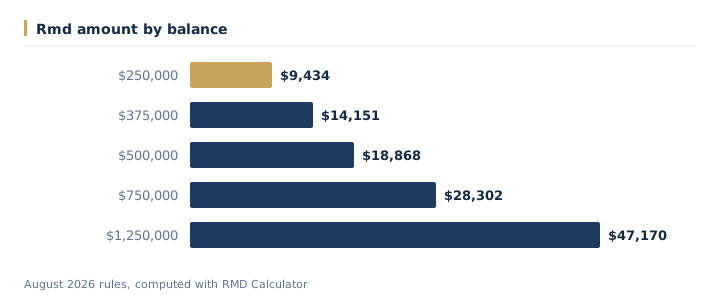
We ran 5 values of balance through the calculator and left every other input at its default. As of August 2026, the output was:
| Balance ($) | Rmd amount ($) | Penalty if missed ($) |
|---|---|---|
| 250,000 | 9,433.96 | 2,358.49 |
| 375,000 | 14,150.94 | 3,537.74 |
| 500,000 | 18,867.92 | 4,716.98 |
| 750,000 | 28,301.89 | 7,075.47 |
| 1,250,000 | 47,169.81 | 11,792.45 |
Running balance from $250,000 up to $1,250,000 moves rmd amount from $9,434 to $47,170 — a spread of $37,736. That gap is the part a single headline rate never shows.
The same runs seen through penalty if missed
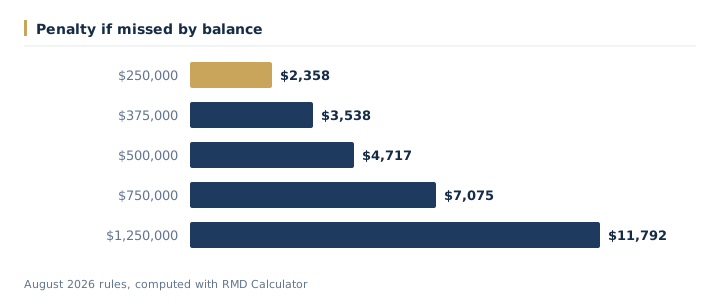
At $250,000, penalty if missed works out to $2,358; at $1,250,000 it is $11,792. Looking only at rmd amount tends to understate how much the outcome shifts across that range.
Assumptions behind these figures
| Input | Value |
|---|---|
| Age | 73 |
| Balance | $500,000 |
| As of | August 2026 |
| Method | identical to /tools/rmd-calculator |
Brackets, thresholds and rates change from year to year, so treat these as August 2026 figures for the 2026 tax year. For your own situation, open the RMD Calculator and enter your real numbers — the calculator runs the same code that produced every figure on this page.
Frequently Asked Questions
How do I calculate my RMD?
Your required minimum distribution is generally calculated by dividing your retirement account's balance as of December 31 of the prior year by a life-expectancy factor from the IRS Uniform Lifetime Table that corresponds to your age that year. The factor generally shrinks as you get older, which causes the required percentage withdrawn to rise over time even if your balance stays flat. Because the specific table factors are set by the IRS, pull the current figure for your exact age rather than relying on an old or approximated number.
What table is used to calculate RMDs?
Most account owners use the IRS Uniform Lifetime Table to determine their RMD divisor. A different table, the Joint Life and Last Survivor Table, generally applies only if your sole beneficiary is a spouse more than ten years younger than you. In either case, confirm the current-year table and your exact factor directly from the IRS rather than assuming last year's figure still applies.
What happens if I take my first RMD late?
The IRS generally allows you to delay your very first RMD until April 1 of the year after you reach your required beginning age, but that delay doesn't push back your second RMD, which is still due by December 31 of that same year. That means delaying can result in two taxable distributions landing in the same calendar year, which can push you into a higher tax bracket or trigger other income-related costs. For this reason, many retirees choose to take their first RMD in the actual year they become required to, rather than using the delay.
What is the penalty for missing an RMD?
Missing a required minimum distribution generally triggers an IRS excise tax on the shortfall, which was reduced under recent law to 25%, and further to 10% if corrected within a defined window. The IRS can also waive the penalty in cases of reasonable error if you take prompt corrective action. If you discover a missed RMD, the general approach is to withdraw the missed amount as soon as possible and file the appropriate correction paperwork, ideally with help from a tax professional.
Are RMDs calculated per account or combined?
RMDs are generally calculated separately for each account, but the rules about which accounts can be aggregated for withdrawal purposes differ by account type — for example, multiple traditional IRAs can often have their combined RMD taken from just one of them, while 401(k) accounts generally each require their own separate withdrawal. Because these aggregation rules are easy to get wrong and vary by account type, confirm the specific rules for your account types with a tax professional or the IRS before assuming you can combine withdrawals.