Tutorials
How to Plan for Early Retirement (FIRE)
By Editorial Team · Published December 31, 2025 · Updated August 22, 2026 · 12 min read
An early-retirement action plan: the savings-rate timeline, the pre-59.5 access toolkit, the pre-65 health-insurance gap, and first-decade sequence risk.
Most retirement advice quietly assumes you'll work until your sixties, then live off the money for twenty or thirty years. Early retirement breaks that assumption in two places at once, and that's the part nobody tells you up front. You're not just trying to save more, faster. You're trying to fund a payout period that might run forty or fifty years instead of thirty — and you're trying to reach a pile of money before the tax code thinks you're allowed to touch it without a penalty. Plenty of would-be early retirees nail the first problem, hit their number at 47, and then discover the second one waiting for them like an unmarked step at the bottom of a staircase.
This is a how-to, so it's organized as the order of operations you'd actually work through: figure out the timeline, build the number, solve the pre-59½ access problem, plug the health-insurance gap, and pressure-test the first decade. Each step depends on the one before it. Skip the access step and your perfectly sized portfolio is locked in a box.
Step 1: Turn your savings rate into a timeline
The single number that decides when you can retire early is not your income. It's your savings rate — the share of take-home pay you don't spend. The reason is mechanical: a high savings rate simultaneously shrinks the lifestyle you have to fund and grows the pile that funds it. Those two effects multiply, which is why the timeline collapses so fast as the rate climbs.
Here's the arithmetic in plain terms. If you spend everything you make, your portfolio target is infinite and you never retire. If you save 50% of take-home pay, you're banking one year of expenses for roughly every year you work, and compounding does the rest. Researchers who've run this with conventional return and withdrawal assumptions land on a rough ladder that's worth memorizing because it reframes the whole project:
| Savings rate (of take-home) | Approx. years to financial independence |
|---|---|
| 10% | ~50+ |
| 25% | ~32 |
| 50% | ~17 |
| 65% | ~10–11 |
| 75% | ~7 |
Those figures assume you invest the savings, earn a reasonable long-run real return, and stop working once the portfolio can cover your spending at a sustainable withdrawal rate. They're approximations, not promises — but the shape of the curve is the lesson. Going from 10% to 25% saved chops decades off. Going from 50% to 65% chops roughly six more years. The rate, not the raise, is the lever.
A worked example
Take someone with $70,000 of take-home pay who has decided their genuine annual spending is $42,000. That's a 40% savings rate — they're banking $28,000 a year.
- Annual spending to fund: $42,000
- Target portfolio at a 4% starting withdrawal rate (25× spending): $1,050,000
- Annual amount invested: $28,000
Starting from roughly zero, with a reasonable long-run real return on a stock-heavy portfolio, $28,000 a year compounds to a bit over a million in the high-teens-to-low-twenties range of years — call it around 19–21 years depending on the return you assume. If that same person trims spending to $36,000 (raising the savings rate to about 49%), two things happen at once: the target drops to roughly $900,000 and the annual contribution rises to $34,000. The timeline doesn't shrink a little. It shrinks by years. This is the dual effect in numbers, and it's why early retirees obsess over recurring expenses rather than one-time splurges. Model your own rate, return, and target together with the FIRE Calculator before you trust any single year-count — small changes in the assumed real return move the answer more than people expect.
One caution on the 25× shortcut. It comes from a 4% starting withdrawal rate built on roughly 30-year horizons. A retirement that might run 45–55 years carries more sequence and inflation risk over the longer runway, and many long-horizon researchers favor a starting rate closer to 3%–3.5%, which pushes the multiple toward 28×–33×. For the $42,000 spender, 30× is $1,260,000 rather than $1,050,000 — not a rounding error. Decide which multiple you're using before you set the finish line, and check how long the money plausibly lasts at your real horizon with the Money Longevity Calculator.
Step 2: Separate the number you save from the number you can reach
Here's the trap. You can do everything in Step 1 correctly, accumulate $1.1 million by 47, and still not be able to retire — because most of that money is sitting in a 401(k) and a traditional IRA, and the standard penalty-free age for those is 59½. Withdraw early and you generally owe ordinary income tax plus a 10% additional tax on the amount. For someone retiring at 47, that's potentially a twelve-and-a-half-year wall.
So early retirement is really two accumulation problems wearing one disguise:
- Saving enough total.
- Making sure enough of it is reachable before 59½ without the penalty.
The toolkit for the second problem has three main instruments. You usually use more than one.
Instrument A: The taxable brokerage bridge
A regular (taxable) brokerage account has no age rule at all. You can sell and spend from it at 40, 47, or any age. The cost is that you pay tax along the way — dividends and realized capital gains each year — but you trade that drag for total access. Many early retirees deliberately overfund a taxable account specifically to build a bridge: enough money outside retirement accounts to cover spending from their retirement date until the tax-advantaged money becomes reachable without a penalty. The bridge is the most flexible tool and the one most under your control, so it tends to be the foundation the other two instruments are layered on top of.
Instrument B: The Roth conversion ladder
This one exploits a specific rule: money you convert from a traditional IRA to a Roth IRA can generally be withdrawn without the 10% additional tax after it has sat in the Roth for five years (each conversion has its own five-year clock). The procedure:
- After you stop working, your taxable income is low, so each year you convert a chosen slice of traditional IRA money to a Roth and pay ordinary income tax on that slice at your now-lower rate.
- You wait five years.
- In year six you withdraw the amount that was converted in year one, free of the 10% additional tax.
- You keep climbing the ladder — converting each year, withdrawing the conversion from five years earlier.
The catch is structural and unavoidable: the ladder has a built-in five-year startup gap. Conversions you make after retiring aren't reachable for half a decade, which is exactly why the taxable bridge has to cover those first roughly five years. The ladder doesn't replace the bridge; it relays from it.
Instrument C: 72(t) / SEPP — substantially equal periodic payments
The tax code has its own escape hatch built directly into the early-withdrawal rule. Under Section 72(t), you can take substantially equal periodic payments (SEPP) from an IRA before 59½ without the 10% additional tax, using one of three IRS-sanctioned calculation methods that fix your annual withdrawal based on your balance, an interest rate, and life expectancy.
It works, but it is rigid by design, and the rigidity is the whole risk. Once you start a SEPP, you generally must continue the substantially-equal payments for the longer of five years or until you reach 59½ — and modifying or stopping early can trigger retroactive penalties back to the first payment. You don't get to dial the amount up in a good year or down in a bad one. Most early retirees treat 72(t) as a backstop for a defined chunk of an IRA, not as the primary plan, precisely because a flexible bridge plus a ladder leaves your options open while a SEPP locks them.
A combined picture: a 47-year-old retiree might fund years 1–5 from the taxable bridge, start a Roth conversion ladder in year one so it begins paying out in year six, and keep 72(t) in reserve in case the bridge runs thin. The point isn't to use all three. It's to enter early retirement knowing which dollars are reachable in which years.
Step 3: Price the pre-65 health-insurance gap before you quit
Medicare eligibility generally starts at 65. Retire at 47 and you have an roughly eighteen-year stretch with no employer plan and no Medicare — a gap that, left unbudgeted, is the single most common reason an otherwise sound early-retirement plan unravels in year two.
The mechanism worth understanding is the one that makes this manageable: marketplace health coverage under the Affordable Care Act offers premium tax credits that scale with your modified adjusted gross income, not your net worth. An early retiree with a $1.2 million portfolio but a deliberately low taxable income can qualify for substantial premium assistance, because the subsidy formula looks at income, not assets. This creates a genuine planning tension you should see clearly: every dollar of Roth conversion you do in Step 2 raises your MAGI, which can shrink your health-insurance subsidy. The conversion ladder and the ACA subsidy pull in opposite directions, and the right balance between them is a personal optimization, not a fixed answer.
The exact subsidy amounts, income thresholds, and the cost-sharing rules change year to year and by state, so the move here is not to memorize a number — it's to (a) get a current quote for a plan in your area at your planned income, (b) treat that premium plus a realistic out-of-pocket maximum as a hard line in your annual spending, and (c) re-run the savings math from Step 1 with health insurance included. Many people model their FIRE number and then discover health insurance is a five-figure annual line they never counted. Fold it in before the number is final, and revisit it with the Retirement Savings Calculator so the target reflects total spending, not just the comfortable parts.
Step 4: Defuse sequence-of-returns risk in the first decade
Two early retirees can earn the exact same average return over forty years and end up in completely different places — one comfortable, one back at work — purely because of the order the returns arrived in. Poor returns in the first several years, while you're withdrawing from a portfolio that's already shrinking, can do damage that even excellent later returns never fully repair. This is sequence-of-returns risk, and it is disproportionately dangerous for early retirees because the withdrawal period is longer and there's no paycheck arriving to soften a bad start.
A short illustration. Two retirees start with $1,000,000 and withdraw an inflation-adjusted $40,000 a year. Both average the same return over the long run.
| Sequence | First three years | Effect on a long retirement |
|---|---|---|
| Strong start | +14%, +11%, +8% | Portfolio absorbs withdrawals and likely grows |
| Weak start | −17%, −9%, −5% | Withdrawals deplete a falling balance; materially higher risk of running short |
Same average. Same withdrawal. Two different outcomes, decided in the opening innings. The defenses are not exotic, and an early retiree should plan to deploy more than one:
- Hold a cash and short-bond buffer — often one to three years of spending — so that during a sharp early downturn you can spend from the buffer instead of selling stocks into the drop.
- Build flexibility into the budget. A retiree who can trim discretionary spending by, say, 10% for a year or two after a bad market is far harder to break than one whose every dollar is a fixed essential. Flexibility is, in dollar terms, one of the highest-return things you can hold, and it costs nothing.
- Keep some earned income optional. Part-time or project work in the first few years, even modest, sharply reduces how much the portfolio has to carry during the exact window when carrying it is most dangerous.
- Start at a lower withdrawal rate for the long horizon — closer to 3%–3.5% — and allow raises only after the portfolio has clearly grown.
Test the weak-start scenario explicitly. It's the one that actually ends early retirements, and it's invisible if you only model average returns. Run your plan against a deliberately ugly first decade with the Money Longevity Calculator and see whether the buffer-plus-flexibility combination keeps it alive.
Putting the four steps together
A coherent early-retirement plan reads as a single chain. Pick a savings rate high enough that the timeline is real (Step 1). Size the number using a multiple appropriate to a long horizon, not the default 30-year one (Step 1). Make sure enough of that money is reachable before 59½ via a taxable bridge, a Roth conversion ladder, and 72(t) held in reserve (Step 2). Add the pre-65 health-insurance cost as a hard budget line and accept the tension it creates with conversions (Step 3). Then armor the first decade against a bad sequence with a buffer, budget flexibility, optional income, and a conservative starting rate (Step 4). Miss any one link and the others can't compensate — a fully funded portfolio you can't touch, or can touch but can't insure, isn't financial independence. It's a waiting room.
Sources
- Internal Revenue Service — rules on 59½, the 10% additional tax, 72(t) substantially equal periodic payments, and Roth conversion treatment
- U.S. Department of Labor — guidance on 401(k) plans and what happens to employer-plan money when you leave work early
- Consumer Financial Protection Bureau — consumer guidance on retirement saving, sustainable spending, and planning for a long payout period
- Social Security Administration — how early-retirement years with low or no earnings interact with future benefit calculations
Key takeaways
- Your savings rate, not your salary, sets the timeline — it shrinks the spending you must fund and grows the pile at the same time, so the years-to-FIRE curve drops steeply as the rate rises.
- Saving enough and being able to reach it before 59½ are two separate problems; solve the second with a taxable bridge, a Roth conversion ladder (mind its built-in five-year startup gap), and 72(t)/SEPP held in reserve.
- The pre-65 health-insurance gap is a hard, often five-figure annual line; ACA premium credits scale with income, which puts them in direct tension with Roth conversions.
- Use a long-horizon withdrawal rate (≈3%–3.5%, so a 28×–33× multiple), because a 30-year rule under-sizes a 45–55 year retirement.
- Sequence-of-returns risk hits early retirees hardest; defend the first decade with a cash buffer, budget flexibility, optional income, and a conservative starting rate.
This article is general financial education, not individualized investment, tax, or insurance advice, and the access rules described here have specific conditions and exceptions that a qualified advisor or tax professional should confirm against your own accounts before you give notice at work.
Run the numbers
Everything below came out of this site's own FIRE Calculator. The figures are not quoted from anywhere else: each row is one run of the same calculation the tool page performs, using August 2026 rules. Put the same inputs in and you will get the same output.
How the result moves with assets
We ran 5 values of assets through the calculator and left every other input at its default. As of August 2026, the output was:
| Assets ($) | Fire age | Years to fire (years) |
|---|---|---|
| 50,000 | 56 | 21 years |
| 75,000 | 55 | 20 years |
| 100,000 | 54 | 19 years |
| 150,000 | 53 | 18 years |
| 250,000 | 50 | 15 years |
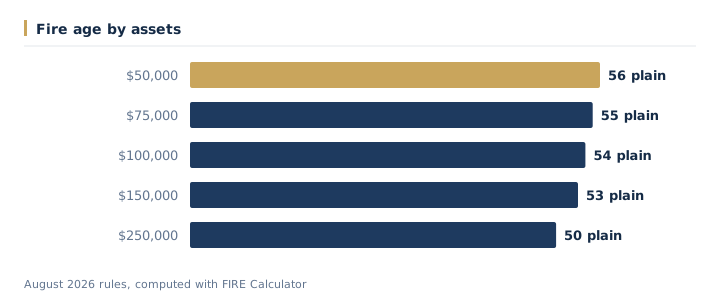
Running assets from $50,000 up to $250,000 moves fire age from 56 to 50 — a spread of 6. That gap is the part a single headline rate never shows.
The same runs seen through years to fire
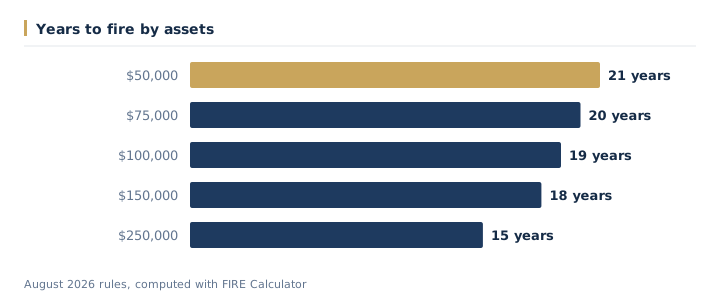
At $50,000, years to fire works out to 21 years; at $250,000 it is 15 years. Looking only at fire age tends to understate how much the outcome shifts across that range.
Assumptions behind these figures
| Input | Value |
|---|---|
| Age | 35 |
| Assets | $100,000 |
| Expenses | $50,000 |
| Savings | $25,000 |
| Ret | 7% |
| Swr | 4% |
| Coast target | 65 |
| As of | August 2026 |
| Method | identical to /tools/fire-calculator |
Brackets, thresholds and rates change from year to year, so treat these as August 2026 figures for the 2026 tax year. For your own situation, open the FIRE Calculator and enter your real numbers — the calculator runs the same code that produced every figure on this page.
Frequently Asked Questions
How do I plan for early retirement?
Planning for early retirement generally involves working through several linked steps: turning your savings rate into a realistic timeline, building a portfolio target based on your expected spending, solving how to access retirement funds before the standard penalty-free age, covering the health insurance gap before Medicare eligibility, and stress-testing the plan against a poor early sequence of investment returns. Because early retirement often means funding a much longer payout period than a traditional retirement, many practitioners use a more conservative withdrawal assumption than the standard 4% guideline. Given the complexity and irreversibility of some of these decisions, work through the details with a financial professional.
How can I access retirement funds before age 59½ without penalty?
There are a few commonly used approaches: building a taxable brokerage account as a spending bridge with no age restrictions, using a Roth conversion ladder where converted amounts can generally be withdrawn penalty-free after they've sat in the Roth for a set number of years, and certain IRS rules that allow structured early withdrawals under specific conditions. Each approach has its own tradeoffs and requirements, and mistakes can trigger taxes and penalties, so this is an area where professional tax guidance is particularly valuable. Most early retirees combine more than one of these tools rather than relying on just one.
What is a Roth conversion ladder?
A Roth conversion ladder generally involves converting a portion of a traditional IRA to a Roth IRA each year, then waiting a required number of years before withdrawing that specific converted amount without the early-withdrawal penalty, even if you're under 59½. By doing this repeatedly over multiple years, an early retiree can build a rolling stream of penalty-free, accessible funds. Because each conversion has its own separate timing requirement and creates taxable income in the year it's converted, careful planning and professional tax guidance are generally recommended.
How do early retirees handle health insurance before Medicare?
This is generally one of the most underplanned aspects of early retirement, since most people don't become eligible for Medicare until 65, leaving a potentially long gap to cover through other means, such as marketplace health insurance, COBRA continuation coverage, a spouse's employer plan, or part-time work that offers benefits. The cost and availability of coverage varies significantly, so research your specific options and budget for this expense well before you plan to stop working full-time. Some early retirees also manage their taxable income carefully to qualify for income-based health insurance subsidies.