Tutorials
How to Use the 4% Rule in Practice
By Editorial Team · Published March 24, 2026 · Updated August 22, 2026 · 12 min read
A hands-on operating manual for the 4% rule: setting year one, the annual mechanic, written guardrail trip-wires, and a numbered crash-year playbook.
Open any retirement forum on a Monday after a bad market week and you'll find the same panicked post: "I'm following the 4% rule, the portfolio is down 18%, do I still take my withdrawal?" The question is the giveaway. It means the writer learned what the rule is — withdraw 4%, inflation-adjust thereafter — but was never shown how to run it as an operating procedure across a real calendar year, in a real brokerage account, with a real market doing something unpleasant.
This is that operating manual. The theory, the Bengen backtest, the Trinity success rates, the sequence-risk math — all of that lives in the companion explainer and isn't repeated here. What follows assumes you've already decided 4%-ish is your starting point and now need to know exactly which buttons to press, in what order, in January and again the following January, including the January when stocks just fell off a cliff.
Step 1: Compute the year-one number from the right denominator
Almost every implementation error happens before a single dollar moves, in the choice of what you multiply 4% against. The procedure has one input that matters: the portfolio's value on the day you start, not a number from three months ago and not your total nest egg if part of it is earmarked for something else.
- Total only the accounts that will fund spending — taxable brokerage, traditional IRA/401(k), Roth. Exclude the house, the emergency cash you've already walled off, and any money committed to a known one-time expense.
- Multiply that total by your chosen starting rate. At 4% on $1,150,000 that's $46,000.
- Subtract the income that isn't coming from the portfolio. This is the step people skip.
That third step is the entire game. If Social Security and a small pension will deliver $34,000 a year, the portfolio is not responsible for your whole budget — it's responsible for the gap. A retiree spending $80,000 with $34,000 of guaranteed income needs the portfolio to produce $46,000, which at 4% means a target near $1.15M, not the $2M they'd calculate by running the multiple against gross spending. Size the gap before you size the withdrawal; the Retirement Income Calculator exists to stack guaranteed income against the budget so you're applying 4% to the correct, smaller number.
So the practical year-one figure is rarely "4% of everything." It's 4% of the investment pool, cross-checked against the spending the pool actually has to cover. Get this denominator right and the rest is bookkeeping. Get it wrong and every subsequent year inherits the error.
Where the first withdrawal should physically come from
The rule tells you the amount; it is silent on the account, and the account choice changes how many gross dollars you must pull to net your $46,000. Spending $46,000 entirely from a traditional pre-tax IRA might require withdrawing $54,000–$58,000 once federal tax is covered. The same $46,000 from a Roth or from already-taxed brokerage basis costs far fewer gross dollars. A workable default sequence in early retirement: taxable accounts first, then traditional, then Roth last — but fill up low tax brackets deliberately rather than blindly draining one bucket. The rule speaks in pre-tax dollars; you live on after-tax dollars, and the conversion rate between the two is set by which account you tap.
Step 2: Set the annual mechanic before you need it
The recurring engine is two lines long, and writing it down now — while markets are calm and you're unemotional — is what makes it survivable later.
- The default move: each January, take last year's dollar withdrawal and multiply by the prior year's inflation. Year one was $46,000; if CPI ran 3%, year two is $46,000 × 1.03 = $47,380. You do this regardless of the balance. Up year, down year, flat year — the unmodified rule does not look at the portfolio.
- The number you must also track: your current withdrawal rate, defined as this year's planned dollar withdrawal divided by today's portfolio value. In a calm year it drifts slightly. After a crash it spikes, and that spike is your early-warning instrument.
Inflation is the one figure here that changes annually and you should never guess it. Pull the actual prior-year change from the published federal CPI series rather than using a memory of "inflation's been about 3%" — in a year it ran 6%, guessing 3% silently cuts your real income by half the gap. The structure (bump last year's dollars by realized inflation) is fixed; the number you plug in is looked up each year, not assumed.
If you do nothing else, automate the default move as a scheduled transfer and put the withdrawal-rate calculation on a recurring calendar reminder. The mechanic only protects you if it actually runs.
Step 3: Install guardrails as written rules, not vibes
The unmodified rule's defining weakness is that it hands you an inflation raise even while the portfolio is collapsing. Guardrails fix this by adding two pre-decided trip wires, and the operative phrase is pre-decided — you write them before retirement so the bad-year version of you can't negotiate them away.
Here is a concrete, common parameterization. Suppose you chose a slightly higher starting rate of 4.5% on a $1,000,000 portfolio because you adopted guardrails — year-one withdrawal $45,000.
| Trigger | Test | Action |
|---|---|---|
| Upper guardrail (capital preservation) | Current withdrawal rate rises ~20% above the start (≈5.4%) | Cut the dollar withdrawal ~10% and hold it there |
| Lower guardrail (prosperity) | Current withdrawal rate falls ~20% below the start (≈3.6%) | Raise the dollar withdrawal ~10% |
| Inside the band | Rate stays between the rails | Apply the normal inflation bump only |
The arithmetic of the upper rail in practice: you start at $45,000 on $1,000,000 (4.5%). A brutal year drops the portfolio to $760,000. Your inflation-bumped withdrawal would be about $46,350, which against $760,000 is a 6.1% rate — past the 5.4% upper rail. The guardrail instructs a roughly 10% cut, taking the withdrawal to about $41,700 for now. That single move — a temporary trim of a few thousand dollars — is what protects the compounding base during the exact years that decide whether the money lasts.
Modeling how long the balance survives with versus without that trim is the clearest way to see why the rule's critics insist on flexibility — the Money Longevity Calculator lets you run the same starting balance through a hostile early sequence with the cut applied and with it skipped, and the depletion-date gap is usually years, not months.
Why the flexible setup can pay you more, not less
Guardrails feel like a sacrifice and usually aren't. A retiree who pre-commits to modest cuts in bad years can responsibly start nearer 5% than 4%, because the option to flex is itself a risk buffer. On $1,000,000 that's roughly $50,000 versus $40,000 of first-year income. The cuts, when they come, are temporary and partial; the higher baseline runs every year. Across a 30-year retirement the flexible plan frequently delivers more total lifetime spending and a larger ending balance than the rigid one, because a small early trim preserves the capital that compounds. Pressure-test your own starting rate and target multiple with the FIRE Calculator before you lock the year-one number — the difference between a 4% and 5% start is often hundreds of thousands of lifetime dollars, bought with nothing but a willingness to bend.
Step 4: The crash-year playbook
A sharp drop in your first decade is the scenario the whole apparatus is built for, and it's where people freeze or panic. Run this sequence instead.
- Do the withdrawal-rate calculation first, before deciding anything. Planned dollar withdrawal ÷ today's portfolio value. This converts a scary headline ("market down 25%") into a number you have a rule for.
- Check it against your upper guardrail. If the rate is still inside the band, the correct action is genuinely to do nothing different — take the normal inflation-adjusted amount. Many drops don't breach the rail and require no response, and reacting anyway is its own error.
- If the rail is breached, apply the written cut — don't improvise its size. The plan said ~10%; take ~10%. The discipline is in using the pre-set number, because mid-crash is precisely when judgment is worst.
- Apply the cut to discretionary lines, not fixed ones. The trim should land on travel, dining, a deferred renovation — not the mortgage or the insurance premium. This is why mapping spending into essential vs. flexible buckets before retirement matters operationally.
- Consider freezing the inflation raise as the gentler alternative. If a full cut feels too aggressive, simply not taking the inflation bump for a year or two — holding last year's dollar amount flat — is a lower-effort, lower-pain move that still meaningfully relieves the portfolio. A flat year is far easier to absorb than a cut, and it still works.
- Write down the recovery condition. Decide now what restores the cut: typically, the withdrawal rate falling back inside the band for a full year. Without a stated recovery rule, retirees either restore too early or stay frightened and under-spend for a decade.
The thing to internalize: a crash doesn't require heroics. It requires running a calculation and consulting a rule you already wrote. The plans that fail are the ones improvised in the moment.
The cash buffer that makes the crash-year rule easier to follow
One operational addition makes every step above less painful: holding one to two years of withdrawals in cash or short-term instruments, separate from the invested pool. When the selloff hits, the year's withdrawal comes from the buffer instead of from selling equities into the trough — you let the market fall without being forced to realize losses to eat. The buffer doesn't change the guardrail math; it changes the sequencing of where dollars come from while the math plays out. Replenish it from the portfolio during recovery years, not during the drop. This is the practical bridge between "the rule says don't panic" and the lived reality of needing grocery money in a month the portfolio is down 25%. Without it, even a disciplined retiree can be pushed into selling at exactly the wrong time, which no withdrawal rule can repair after the fact.
A 12-month worked walkthrough
Numbers make this concrete. A 64-year-old retires with $1,000,000 in invested accounts plus $26,000/year of Social Security, against a $66,000 budget. The portfolio's job is the $40,000 gap. They adopt guardrails and a 4.5% start on the portfolio's share — though here the gap math sets the dollar figure, so they sanity-check both: 4.5% of $1,000,000 is $45,000; the budget gap is $40,000; they take the lower, $40,000, leaving headroom.
| Month | Event | Action taken |
|---|---|---|
| January | Year begins, portfolio $1,000,000 | Withdraw $40,000 (split: $26,000 from taxable, $14,000 from traditional to fill a low bracket) |
| February–March | Market rises ~6% | No action; the rule doesn't react to up moves either |
| April | Prior-year CPI published at 3.1% | Note next year's default = $40,000 × 1.031 = $41,240 |
| August | Sharp selloff; portfolio falls to $780,000 | Run the rate check: $41,240 ÷ $780,000 = 5.3% — inside the 5.4% rail by a hair |
| September | Further drop to $720,000 | Recheck: $41,240 ÷ $720,000 = 5.7% — rail breached |
| October | Apply written rule | Cut ~10%: next year's withdrawal set to ~$37,100; trim falls on a postponed trip and dining out |
| November–December | Partial recovery to $810,000 | Hold the cut; recovery condition (a full year inside the band) not yet met |
| Next January | Year two begins at ~$37,100 | Continue; restore toward the inflation-adjusted path only once the rate sits back inside the band for four quarters |
Notice what actually happened across the year: one calculation repeated three times, one pre-written cut applied once, the pain absorbed by a skipped trip rather than a missed mortgage payment, and a stated condition governing when normal service resumes. No panic, no forum post, no improvisation. That's the rule working as a procedure instead of a slogan.
What the walkthrough deliberately avoided
It never sold equities in a panic — the cut came from the spending side, not by liquidating into a low. It never guessed inflation — the 3.1% came from the published series. It never applied the multiple to gross spending — the $40,000 gap, not the $66,000 budget, drove everything. And it never treated "the market is down" as automatically actionable; two of the three rate checks resulted in no change. Most crash years contain more non-action than action, and knowing that prevents the most common practical failure: thrashing the plan in response to noise.
The recurring annual checklist
Strip the whole method to what you actually do each January, and it fits on an index card:
- Look up the portfolio's current total value.
- Look up the prior year's published CPI change.
- Compute the default withdrawal: last year's dollars × (1 + that CPI).
- Compute the current withdrawal rate: that figure ÷ current portfolio value.
- Compare to your written guardrails; cut, raise, freeze, or proceed exactly as the rule states.
- Re-cross-check against guaranteed income in case Social Security or a pension changed the gap.
- Withdraw from accounts in your tax-aware order; document what you did and why.
Steps 2 and 6 are the ones tied to figures that move every year, and both are looked up, never assumed — CPI from the federal series, the benefit figure from your latest Social Security statement. Everything else is structural and stable. Re-running step 6 against updated guaranteed income each year is what keeps the Retirement Income Calculator honest as benefits start, stop, or step up.
Sources
- Consumer Financial Protection Bureau — practical guidance on planning a sustainable retirement spending strategy and adjusting it over time
- Social Security Administration — benefit statements that set the guaranteed-income figure you subtract before applying any withdrawal rate
- Internal Revenue Service — published inflation-adjustment mechanics and pre-tax account taxation that govern gross-to-net withdrawal conversion
- U.S. Department of Labor — plan distribution and fee disclosures relevant to which account a withdrawal should come from
Key takeaways
- The year-one number is 4%-ish of the investment pool cross-checked against the spending gap after Social Security — fix the denominator before anything else.
- The annual engine is two lines: bump last year's dollars by looked-up realized CPI, and track your current withdrawal rate as the warning instrument.
- Write guardrails as numeric, pre-committed rules before retirement; the bad-year version of you cannot be trusted to invent them.
- In a crash, calculate first, then consult your written rule — most rate checks result in no action, and a frozen inflation bump is a gentler alternative to a cut.
- The flexible setup usually pays more lifetime income than the rigid one; reduce to a seven-line January checklist where only CPI and guaranteed income are re-looked-up each year.
This is a procedural walkthrough for general education, not personalized investment, tax, or retirement advice; every dollar figure is illustrative, your guardrail parameters and account-withdrawal order should be set with a qualified advisor against your own tax brackets, horizon, and tolerance for a flat-spending year.
Run the numbers
Everything below came out of this site's own FIRE Calculator. The figures are not quoted from anywhere else: each row is one run of the same calculation the tool page performs, using August 2026 rules. Put the same inputs in and you will get the same output.
How the result moves with assets
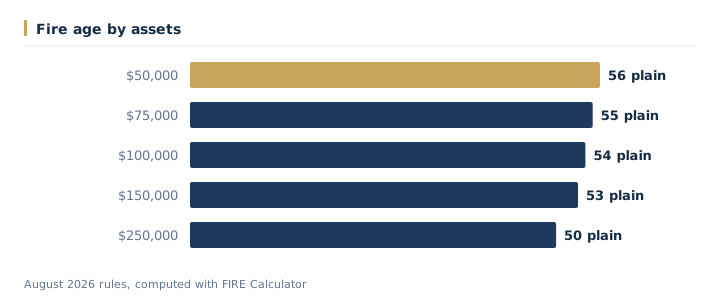
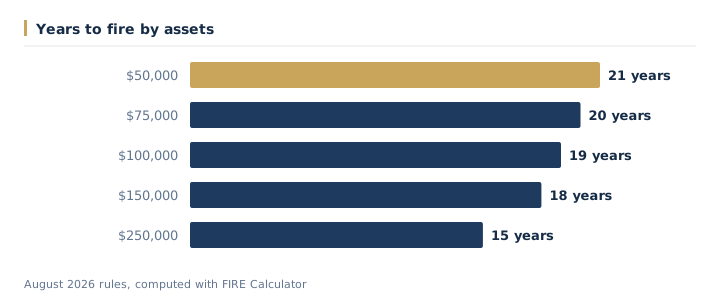
We ran 5 values of assets through the calculator and left every other input at its default. As of August 2026, the output was:
| Assets ($) | Fire age | Years to fire (years) |
|---|---|---|
| 50,000 | 56 | 21 years |
| 75,000 | 55 | 20 years |
| 100,000 | 54 | 19 years |
| 150,000 | 53 | 18 years |
| 250,000 | 50 | 15 years |
Running assets from $50,000 up to $250,000 moves fire age from 56 to 50 — a spread of 6. That gap is the part a single headline rate never shows.
The same runs seen through years to fire
At $50,000, years to fire works out to 21 years; at $250,000 it is 15 years. Looking only at fire age tends to understate how much the outcome shifts across that range.
Assumptions behind these figures
| Input | Value |
|---|---|
| Age | 35 |
| Assets | $100,000 |
| Expenses | $50,000 |
| Savings | $25,000 |
| Ret | 7% |
| Swr | 4% |
| Coast target | 65 |
| As of | August 2026 |
| Method | identical to /tools/fire-calculator |
Brackets, thresholds and rates change from year to year, so treat these as August 2026 figures for the 2026 tax year. For your own situation, open the FIRE Calculator and enter your real numbers — the calculator runs the same code that produced every figure on this page.
Frequently Asked Questions
How do I calculate my first-year withdrawal using the 4% rule?
Generally, you total only the investment accounts earmarked to fund retirement spending, multiply that total by your chosen starting withdrawal rate, commonly around 4%, and then subtract any income coming from sources like Social Security or a pension, since the withdrawal only needs to cover the remaining spending gap. This means the actual dollar figure that comes out of your portfolio is often smaller than a simple 4% of your total net worth, because guaranteed income is already covering part of your budget. Getting this starting calculation right matters because every following year's withdrawal typically builds on this initial figure.
Do I adjust my 4% rule withdrawal every year for inflation?
In the traditional, unmodified version of the rule, yes — each year you generally take the prior year's dollar withdrawal and increase it by the actual prior-year inflation rate, regardless of how the portfolio performed that year. It's generally recommended to use the actual published inflation figure rather than guessing, since a rough estimate in a high-inflation year can meaningfully understate your real spending power. Some retirees modify this basic mechanic with guardrails that adjust the withdrawal based on portfolio performance rather than following inflation blindly.
What are guardrails in the 4% rule?
Guardrails are pre-decided trigger points that adjust your withdrawal based on how your current withdrawal rate compares to your original starting rate — generally, if the portfolio falls enough that your effective withdrawal rate rises significantly above the starting point, you cut spending by a set amount, and if the portfolio grows enough that your rate falls well below the starting point, you can increase spending. The idea is to build these rules before retirement, while you're unemotional, so a bad market year doesn't require making a difficult decision in the moment. This approach generally allows for a somewhat higher starting withdrawal rate than the strict, unmodified rule, since it responds to market conditions instead of ignoring them.
Should the 4% withdrawal come from a specific type of account?
The 4% rule itself generally specifies only the dollar amount to withdraw, not which account it should come from, but the account matters because taxes affect how many gross dollars you need to pull to net your target amount. A commonly cited default sequence is taxable accounts first, then traditional tax-deferred accounts, then Roth last, though many planners prefer filling up low tax brackets deliberately with tax-deferred withdrawals rather than draining accounts in a fixed order. Since the tax cost varies significantly by account type, work through the sequencing with a tax professional.