Tutorials
How to Convert a Traditional IRA to Roth
By Editorial Team · Published December 24, 2025 · Updated August 22, 2026 · 14 min read
The keystroke-level mechanics of a Roth conversion: the procedure, the pro-rata rule, Form 8606, the two 5-year clocks, bracket-filling, and the IRMAA ripple.
There is a moment in a Roth conversion where the whole thing can go quietly wrong, and it isn't the part everyone worries about. It's the box on the brokerage screen that asks whether to withhold taxes from the conversion. Click "yes," and a transaction that should have moved every dollar from one tax treatment to a better one instead leaks money out of tax shelter, sometimes triggers a penalty, and shrinks the very balance you were trying to protect. Most people deciding whether to convert spend their energy on the question "should I?" and almost none on "how, exactly, do the keystrokes go?" — which is backwards, because the mechanics are where conversions are won or lost.
This walkthrough assumes you've already concluded a conversion makes sense for you and skips straight to execution: the actual procedure, the rule that surprises people with old pre-tax IRA money, the form that has to be filed, the two separate five-year clocks, how to size the conversion to a tax bracket on purpose, and the withholding trap above. US rules only, and the dollar figures are illustrations of the arithmetic, not current-year constants.
What a conversion actually is, mechanically
Strip away the strategy and a Roth conversion is a single mechanical event: you take money sitting in a pre-tax account (traditional IRA, or a rollover from a pre-tax 401(k)), you declare it as ordinary income this year, you pay the income tax on it, and the money lands in a Roth IRA where it — and all its future growth — is never taxed again if you follow the rules.
You are not "moving money." You are prepaying tax on retirement money, voluntarily, in a year you've chosen, in exchange for that money never being taxed again and never being subject to required minimum distributions during your lifetime. Everything that follows is about doing that prepayment cleanly and at the lowest possible rate.
The procedure, step by step
The operational sequence at a typical custodian:
- Have a Roth IRA open and funded-eligible first. If you don't already own a Roth IRA, open one at the same custodian before you start. The conversion needs a destination account that exists.
- Decide the dollar amount, not "the whole thing" by reflex. The amount is a tax decision (see the bracket section below), not a "convert it all" default. Write the number down before you touch the screen.
- Initiate the conversion as an internal transfer, traditional IRA → Roth IRA, same institution. Doing it inside one custodian avoids the 60-day-rollover rules that apply to checks mailed to you, and avoids accidental indirect-rollover mistakes.
- At the withholding prompt, elect 0% withholding from the IRA. Pay the resulting tax from a separate, taxable account instead. This is the single most consequential keystroke in the process; the dedicated section below explains why.
- Let the assets transfer. You can convert cash, or convert securities in-kind. In-kind conversion moves the shares as they are, which is useful if you expect a depressed asset to recover inside the Roth.
- Record the basis and the amount for tax filing. The custodian will issue a Form 1099-R for the distribution from the traditional IRA and a Form 5498 showing the Roth contribution/conversion. You report it on Form 8606 (covered below).
- Do not undo it. Reversing a conversion (the old "recharacterization" of a conversion) was eliminated by the 2017 tax law. Once converted, it's permanent — which is exactly why step 2 matters.
That's the entire physical procedure. It's short. The difficulty is everything that determines the amount and the tax.
The pro-rata rule — the one that ambushes people
Here is the rule that turns a "tax-free backdoor" into a surprise tax bill. The IRS does not let you cherry-pick only the after-tax dollars out of your IRAs to convert. For pro-rata purposes it treats all of your traditional, SEP, and SIMPLE IRAs as one single combined account, and every conversion comes out proportionally pre-tax and after-tax based on the ratio across that whole aggregate on December 31 of the conversion year.
Work the arithmetic, because the words don't land until you see numbers:
- You have one IRA with $7,000 of after-tax (non-deductible) contributions you intended to convert tax-free.
- You also have a separate rollover IRA holding $63,000 of pre-tax money from an old 401(k).
- Combined IRA balance: $70,000. After-tax portion: $7,000 ÷ $70,000 = 10%.
- You convert $7,000, expecting it to be tax-free. Instead, only 10% ($700) is treated as the return of after-tax basis. The other 90% ($6,300) is taxable ordinary income.
The pre-tax money you forgot about "contaminated" the conversion. This is why the clean backdoor Roth depends on having no pre-tax IRA balances on December 31. Two legitimate ways out: roll the pre-tax IRA money into an employer 401(k) that accepts roll-ins (401(k)s are not in the IRA aggregation), or simply convert the pre-tax money too and pay the tax deliberately. Either way, the pro-rata rule is computed on year-end balances, so timing the cleanup before December 31 is what matters. Before assuming a conversion is "free," model the pre-tax-to-Roth tradeoff for your own balances with the Roth vs. Traditional IRA Calculator, because the pro-rata math frequently changes the answer.
Form 8606 — the paperwork that protects you for decades
Every conversion is reported on IRS Form 8606, and skipping it is how people end up paying tax twice on the same dollars. The form does two jobs: it tracks your basis (after-tax money the IRS has already let you keep tax-free) and it reports the taxable portion of the conversion.
The mechanics that matter:
- File Form 8606 for every year you make a non-deductible contribution or a conversion. Basis carries forward year to year on this form; a missing year breaks the chain.
- The form is what proves that the $700 in the pro-rata example was a tax-free return of basis. Without it, the IRS has no record you ever paid tax on that money, and you risk being taxed on it again at withdrawal.
- It's filed with your normal return for the year of the conversion. The conversion shows up as income on the return; Form 8606 is the worksheet that computes how much of it is actually taxable after basis.
Keep every Form 8606 you ever file, indefinitely. It is the multi-decade receipt that your basis is real. This is unglamorous record-keeping and it is also the difference between a Roth that pays off and one that gets partially taxed a second time at age 75.
The two five-year clocks (yes, two)
People hear "five-year rule" and assume it's one rule. There are two, they answer different questions, and conflating them produces wrong decisions about when money can be touched.
Clock 1 — the Roth-account clock (for earnings). Starts January 1 of the first year you fund any Roth IRA. Once five years have passed and you're 59½, all withdrawals — including earnings — are qualified and tax-free. This clock runs once per person, not per account; opening a Roth even with a small amount starts it ticking.
Clock 2 — the per-conversion clock (for the converted principal). Each conversion has its own five-year clock. Withdraw the converted amount before its five years are up and before age 59½, and the 10% early-distribution penalty can apply to that converted amount — even though you already paid income tax on it at conversion. The point of this clock is to stop people from using conversions to dodge the early-withdrawal penalty on traditional IRA money.
| Roth-account clock | Per-conversion clock | |
|---|---|---|
| What it gates | Tax-free earnings | Penalty-free access to converted principal |
| When it starts | First Roth contribution ever | Each individual conversion's year |
| How many | One per person | One per conversion |
| Irrelevant once | 59½ and 5 years met | Age 59½ (penalty exception applies) |
The practical consequence: if you convert at 57 and might need that specific money at 60, the converted principal is fine at 60 (you're over 59½), but a conversion done at 58 that you tap at 60 sits in a grayer zone if the account clock isn't also satisfied for earnings. The clean rule of thumb — don't plan to spend converted dollars within five years of converting them, and don't convert money you'll need soon.
Filling a tax bracket on purpose
The reason conversions are a timing tool and not just a yes/no tool: ordinary income tax is graduated, so you can convert exactly enough to "fill up" a low bracket without spilling into the next one.
The technique, year by year:
- Estimate your taxable income before any conversion for the year.
- Identify the top of the bracket you're comfortable paying tax at this year.
- Convert an amount equal to the room between your current taxable income and the top of that bracket.
A worked case. Suppose a retiree's pre-conversion taxable income is $50,000, and the top of the bracket they're willing to pay is at $96,000 (use whatever the current threshold actually is — brackets adjust every year). The room is $96,000 − $50,000 = $46,000. Convert $46,000, and every converted dollar is taxed at that lower bracket's rate. Convert $60,000 instead and the last $14,000 spills into the next bracket up, taxed at the higher marginal rate — usually a bad trade unless you have a specific reason.
The sweet spot for this is the gap years: retired, but not yet claiming Social Security and not yet taking required minimum distributions (RMDs begin at age 73 under current law). Taxable income is often unusually low in those years, the brackets are wide open, and every dollar converted then is a dollar that won't be force-distributed and taxed later at a potentially higher rate once Social Security and RMDs stack on top. Modeling how a conversion reshapes your taxable income across the gap years and into RMD age is exactly what the Retirement Income Calculator is for — the value of a conversion is almost always about the future tax rate it avoids, not this year's rate it incurs.
The withholding mistake, in dollars
Back to the keystroke from the start. When you convert $50,000 and tell the custodian to withhold, say, 24% for federal tax, here is what physically happens:
- $50,000 leaves the traditional IRA.
- $12,000 is sent to the IRS as withholding. Only $38,000 actually lands in the Roth.
- You've converted $50,000 (the full amount is taxable income), but $12,000 of formerly tax-sheltered money just left the retirement system entirely instead of compounding tax-free for decades.
- Worse: if you're under 59½, that $12,000 withheld from the IRA is itself treated as a distribution that didn't get converted, so it can trigger the 10% early-withdrawal penalty on top — $1,200 of pure avoidable cost in this example.
The fix is the same in every case: elect 0% withholding and pay the conversion tax from a taxable bank or brokerage account using estimated taxes or increased paycheck withholding elsewhere. That keeps the entire $50,000 inside the Roth working for you. The difference over thirty years of tax-free growth on that $12,000 is not a rounding error — it's frequently tens of thousands of dollars. A conversion paid for with outside money is dramatically more valuable than the same conversion paid for with the IRA itself, which is why the strategy only makes clean sense when you have non-retirement cash to cover the tax.
The second-order effects that change the right amount
A conversion doesn't happen in a vacuum the way the bracket-filling math implies. Two extra dollars of income from a conversion can drag along costs that the income-tax bracket alone doesn't show, and ignoring them is how a "fill the bracket exactly" plan ends up costing more than expected.
- Medicare premium surcharges (IRMAA). Once you're 65 and on Medicare, the income-related monthly adjustment amount raises Part B and Part D premiums above certain income thresholds, and it works as a cliff, not a ramp — one dollar over a threshold can move you an entire surcharge tier. Worse, it's assessed on a two-year lookback, so a large conversion at 63 can raise premiums at 65. The fix isn't to avoid converting; it's to know where the nearest IRMAA threshold sits (confirm the current figures at medicare.gov) and treat it as a second ceiling alongside the tax bracket.
- Social Security taxation. If you convert in a year you're already drawing Social Security, the added income can push more of the benefit into the taxable range through the combined-income formula — effectively taxing the conversion and dragging more of the benefit along with it. This is a strong argument for doing conversions in the gap years before claiming.
- Capital-gains and dividend rates. A large conversion raises taxable income and can push long-term capital gains or qualified dividends from a lower preferential rate into a higher one in the same year.
None of these say "don't convert." They say the right conversion amount is the one that fills a chosen bracket and stays under the nearest IRMAA and benefit-taxation cliffs — which is why the planning question is "how much, in which years," not a single yes-or-no. Layering a conversion against future RMDs, Social Security, and these surcharges across multiple years is what the Retirement Income Calculator is built to do, and it routinely shows that a series of modest conversions beats one large one.
When the procedure simply shouldn't run yet
Knowing how to execute a conversion includes knowing when the keystrokes should wait. The mechanics argue against converting if you'd have to pay the tax from the IRA (the leaked-withholding problem makes it a poor trade), if you have large pre-tax IRA balances you can't clean up before year-end (pro-rata contamination), if the conversion would spill well into a higher bracket with no offsetting future benefit, or if you'll need the converted principal within five years and you're under 59½. These aren't strategy opinions; they're situations where the mechanics themselves destroy the value, regardless of whether conversion is conceptually attractive. The discipline is to run the procedure only when every one of those gates is clear — and to size each year's conversion to whichever ceiling (bracket, IRMAA, benefit taxation) you hit first.
A clean end-to-end example
Tie it together. A 63-year-old retiree, not yet on Social Security, $50,000 of other taxable income, $40,000 of taxable-account cash available, no pre-tax IRA except the one being converted (so pro-rata isn't an issue), wants to convert into the room below a bracket top at $96,000.
- Room = $96,000 − $50,000 = $46,000. Target conversion: $46,000.
- Open/confirm a Roth IRA at the same custodian.
- Initiate $46,000 traditional → Roth, internal transfer, 0% withholding.
- $46,000 lands in the Roth in full.
- Pay the resulting federal (and any state) tax — on $46,000 of added income at the lower bracket's rate — from the $40,000 taxable cash via an estimated payment.
- File Form 8606 with that year's return reporting the conversion and any basis.
- Don't touch the converted $46,000 for five years (irrelevant for the penalty once past 59½, but a good habit).
- Repeat the room calculation next year. Conversions are usually a multi-year campaign across the gap years, not one event.
Every expensive mistake — pro-rata contamination, double-taxed basis, leaked withholding, bracket spillover — was avoided not by being clever but by doing the steps in order.
Sources
- Internal Revenue Service — Form 8606 instructions, the pro-rata rules, and conversion reporting requirements
- U.S. Department of Labor — rules on rolling pre-tax 401(k) money, which interacts directly with the pro-rata calculation
- Medicare — the income-related Part B and Part D premium thresholds a large conversion can trip
- Social Security Administration — benefit-timing information relevant to choosing low-income conversion years before claiming
Key takeaways
- A conversion is a deliberate prepayment of tax on pre-tax money; the procedure itself is short — the difficulty is the amount and the tax handling.
- The pro-rata rule aggregates all your traditional/SEP/SIMPLE IRAs, so hidden pre-tax balances can make a "tax-free" conversion taxable; fix balances before December 31.
- File Form 8606 every conversion year and keep them forever — it's the only proof your after-tax basis isn't taxed again.
- There are two five-year clocks: one for tax-free earnings (per person), one for penalty-free access to each conversion's principal (per conversion).
- Convert only enough to fill a chosen bracket, do it in low-income gap years, and always pay the tax from outside money with 0% withholding.
This is a general explanation of how a Roth conversion is executed under current US federal rules, not tax advice for your return — conversion timing interacts with your bracket, state taxes, Medicare premium thresholds, and filing status in ways only a qualified tax professional reviewing your full picture can responsibly assess.
Run the numbers
Everything below came out of this site's own Roth vs. Traditional IRA Calculator. The figures are not quoted from anywhere else: each row is one run of the same calculation the tool page performs, using August 2026 rules. Put the same inputs in and you will get the same output.
How the result moves with contribution
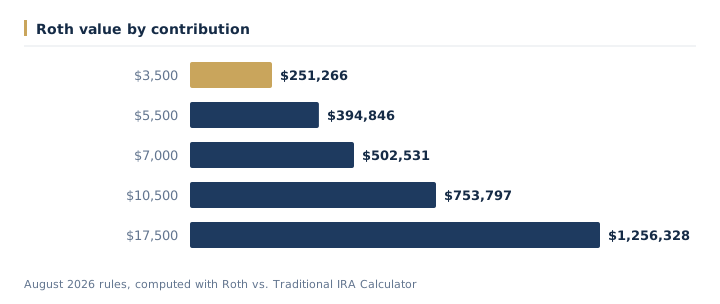
We ran 5 values of contribution through the calculator and left every other input at its default. As of August 2026, the output was:
| Contribution ($) | Roth value ($) | Traditional value ($) | Difference ($) |
|---|---|---|---|
| 3,500 | 251,265.69 | 257,877.95 | 6,612.26 |
| 5,500 | 394,846.09 | 405,236.77 | 10,390.69 |
| 7,000 | 502,531.38 | 515,755.89 | 13,224.51 |
| 10,500 | 753,797.07 | 773,633.84 | 19,836.77 |
| 17,500 | 1,256,328.46 | 1,289,389.73 | 33,061.28 |
Running contribution from $3,500 up to $17,500 moves roth value from $251,266 to $1,256,328 — a spread of $1,005,063. That gap is the part a single headline rate never shows.
The same runs seen through traditional value
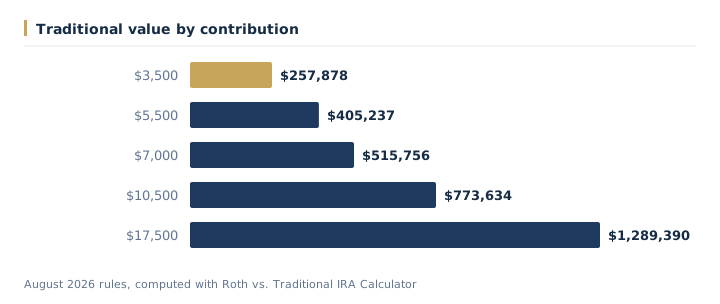
At $3,500, traditional value works out to $257,878; at $17,500 it is $1,289,390. Looking only at roth value tends to understate how much the outcome shifts across that range.
Assumptions behind these figures
| Input | Value |
|---|---|
| Current age | 35 |
| Retire age | 65 |
| Contribution | $7,000 |
| Tax now | 24% |
| Tax ret | 22% |
| Ret | 7% |
| As of | August 2026 |
| Method | identical to /tools/roth-vs-traditional-ira-calculator |
Brackets, thresholds and rates change from year to year, so treat these as August 2026 figures for the 2026 tax year. For your own situation, open the Roth vs. Traditional IRA Calculator and enter your real numbers — the calculator runs the same code that produced every figure on this page.
Frequently Asked Questions
How do I convert a traditional IRA to a Roth IRA?
The general process involves having a Roth IRA already open, deciding on a specific dollar amount to convert rather than converting everything by default, and initiating the conversion as an internal transfer at your custodian from the traditional IRA to the Roth IRA. It's generally recommended to elect zero withholding on the conversion and instead pay the resulting tax bill from a separate taxable account, so the full converted amount lands in the Roth. Because conversions are treated as ordinary income and are generally permanent, plan the amount carefully or consult a tax professional first.
Should I withhold taxes from a Roth conversion?
Generally, no — electing to withhold taxes directly from the converted funds reduces the amount that actually reaches the Roth IRA, undermining much of the benefit of the conversion, and for those under 59½, the withheld amount can potentially be treated as an early distribution subject to penalty. Most guidance suggests electing 0% withholding and paying the tax bill from a separate, taxable account instead. This single choice is often described as one of the most consequential decisions in the conversion process.
Can I undo a Roth conversion?
No, generally not — the ability to reverse or recharacterize a Roth conversion was eliminated by federal tax law changes some years ago, so once you convert, it's typically permanent. This makes it important to decide the exact dollar amount you want to convert before initiating the transaction, rather than converting an entire balance by default. If you're unsure how much to convert, model the tax impact carefully or consult a tax professional beforehand.
What is Form 8606 used for?
IRS Form 8606 is generally used to report nondeductible IRA contributions and Roth conversions, tracking your after-tax basis over time and calculating the taxable portion of any conversion. Filing it accurately for every relevant year matters because a missing year can break the chain of your basis tracking, potentially causing you to pay tax twice on the same money. Your custodian typically issues related forms, but reporting the conversion correctly on Form 8606 is your responsibility.
What is the five-year rule for Roth conversions?
Generally, converted amounts need to sit in the Roth IRA for five years before they can be withdrawn without a 10% penalty if you're under 59½, and this five-year clock applies separately to each conversion you make. This is distinct from a separate five-year rule that applies to Roth IRA earnings overall. Because these rules can be confusing and consequential if you plan to access converted funds early, confirm the details with a tax professional before relying on a specific conversion for near-term spending.