Tutorials
How to Calculate Your Social Security Benefit
By Editorial Team · Published December 26, 2025 · Updated August 22, 2026 · 13 min read
How SSA actually builds your benefit: the indexed 35-year AIME, the 90/32/15 bend points, claim-age adjustments, taxation, and fixing your earnings record.
The Social Security benefit on your statement looks like a number the government simply decided to pay you. It isn't. It's the output of a specific formula with named parts — indexed earnings, an average, two bend points, a percentage at each tier, then an age adjustment — and once you've watched the formula run on real numbers, the estimate stops being a mystery and starts being something you can sanity-check, plan around, and even change by working a different year or claiming at a different age. Most people never see the gears. This is the gears.
We'll build the benefit the way the Social Security Administration builds it: from a 35-year earnings history up to a monthly figure at full retirement age, then adjust for claiming early or late, then deal with the part almost nobody plans for — that the benefit can itself be taxed. Structural formula steps (the 35-year rule, the bend-point method, the adjustment factors) are stable; the specific bend-point dollar thresholds and the taxable-earnings cap change every year and should be confirmed at ssa.gov.
Step 1 — your 35 best years, indexed, not just averaged
The benefit isn't based on your final salary or your best single year. It's based on the highest 35 years of earnings across your whole career, and two details inside that sentence do most of the work.
First, 35 years is a fixed count, not "however many years you worked." If you worked 30 years, the formula doesn't average 30 — it inserts five zeros to reach 35 and averages all 35. Those zeros drag the average down hard. This is why one more year of work late in a career, replacing a zero or a low early year, can move a benefit more than people expect: you're not adding a year, you're deleting a zero.
Second, earnings are indexed, not taken at face value. Money you earned decades ago is scaled up by a wage-index factor so that an old salary is expressed in something comparable to recent wage levels. A $20,000 salary from early in a career might be indexed to something far higher before it enters the average — the formula is comparing your earnings to the standard of living of each year, not their raw dollar amounts. Only earnings up to each year's taxable maximum count; income above that cap is invisible to the formula.
Add the 35 highest indexed annual amounts, divide by 420 (35 years × 12 months), and you have your AIME — Average Indexed Monthly Earnings. That single monthly number is the raw material everything else is built from.
Step 2 — the bend points turn AIME into PIA
The benefit formula is intentionally progressive: it replaces a high percentage of a low earner's pre-retirement income and a low percentage of a high earner's. It does this with two "bend points" that split your AIME into three slices, each credited at a different rate. The structure — and these percentages — are fixed in law:
- 90% of the first slice of AIME (up to the first bend point)
- 32% of the slice between the first and second bend points
- 15% of any AIME above the second bend point
Sum those three pieces and you get the PIA — Primary Insurance Amount: the monthly benefit you'd receive at exactly your full retirement age. The dollar values of the bend points are reset every year for new retirees; the method never changes, so you can always reconstruct your own PIA if you know that year's two thresholds.
A worked PIA, with numbers
Use round, illustrative bend points of $1,200 and $7,200 (confirm the real current figures at ssa.gov — they move annually). Suppose a worker's AIME comes out to $6,000.
| Slice | Range | Amount in slice | Rate | Credit |
|---|---|---|---|---|
| First | $0 – $1,200 | $1,200 | 90% | $1,080.00 |
| Second | $1,200 – $6,000 | $4,800 | 32% | $1,536.00 |
| Third | above $7,200 | $0 | 15% | $0.00 |
| PIA | $2,616.00 |
Now run a higher earner with AIME of $9,000 through the same bend points:
| Slice | Range | Amount in slice | Rate | Credit |
|---|---|---|---|---|
| First | $0 – $1,200 | $1,200 | 90% | $1,080.00 |
| Second | $1,200 – $7,200 | $6,000 | 32% | $1,920.00 |
| Third | above $7,200 | $1,800 | 15% | $270.00 |
| PIA | $3,270.00 |
Look at what just happened. The second worker's AIME is 50% higher ($9,000 vs $6,000), but their PIA is only about 25% higher ($3,270 vs $2,616). That compression is the 90/32/15 structure working as designed — every extra dollar of high earnings buys progressively less benefit. It also explains a planning truth: for high earners, Social Security replaces a small fraction of income and the portfolio has to do most of the work; the Retirement Income Calculator is built to coordinate that split rather than treat the benefit as the whole answer.
Step 3 — the claiming-age adjustment
PIA is the benefit at full retirement age (FRA). FRA is 67 for people born in 1960 or later (slightly earlier for those born before). You can start as early as 62 or as late as 70, and the adjustment is large, permanent, and one of the highest-stakes decisions in retirement.
The mechanics:
- Claim before FRA: the benefit is permanently reduced. The reduction is roughly 5/9 of 1% per month for the first 36 months early, then 5/12 of 1% per month beyond that. Claim at 62 with an FRA of 67 — 60 months early — and the benefit lands around 30% below PIA, for life.
- Claim at FRA: you get exactly your PIA.
- Claim after FRA: delayed retirement credits add about 8% per year (2/3 of 1% per month) up to age 70. Wait from 67 to 70 and the benefit is roughly 24% above PIA, for life. There is no additional credit after 70 — waiting past 70 only loses money.
Apply this to the $2,616 PIA from the worked example:
| Claim age | Adjustment | Approx. monthly benefit |
|---|---|---|
| 62 | −30% | ~$1,831 |
| 67 (FRA) | PIA | $2,616 |
| 70 | +24% | ~$3,244 |
That's a swing of about $1,413 a month — roughly $17,000 a year — for life, decided entirely by claiming age, on identical lifetime earnings. The early-versus-late tradeoff is fundamentally a bet on longevity and a question of whether other income can bridge the delay; running your own PIA and the breakeven across claim ages is exactly what the Social Security Calculator is for, and it's worth doing with your real numbers rather than the round ones here.
The breakeven the adjustment table hides
The claiming table shows the monthly numbers but not the decision underneath them, which is a crossover problem. Claim early and you collect smaller checks but you collect more of them. Delay and you collect larger checks but start later, having forgone years of income. There's an age where the cumulative totals cross.
Work it with the $2,616 PIA figures. Claiming at 62 pays roughly $1,831/month; waiting to 67 pays $2,616. The 67 claimant gave up 60 months of $1,831 — about $109,860 — to get an extra $785/month for life. Divide the forgone amount by the monthly gain: $109,860 ÷ $785 ≈ 140 months, or roughly 11.7 years after age 67, so a crossover in the late 70s. Live past that and delaying wins; die before it and claiming early won. The same arithmetic between 67 and 70 produces a crossover in the early-to-mid 80s.
This is why claiming age is fundamentally a longevity-and-liquidity question, not a math error to be optimized away. Someone in poor health, or who needs the cash now and has no bridge income, can rationally claim early even though the "bigger number" sits at 70. Someone healthy with other assets to live on until 70 is, in effect, buying an inflation-adjusted, government-backed annuity at a price rarely available anywhere else. Neither is wrong; they're answers to different lives. The breakeven framing matters because it converts a vague "wait if you can" into a number you can actually weigh.
The spousal and survivor layer
For married couples the calculation doesn't stop at one person's PIA, and treating it as two independent benefits is a frequent and costly simplification. Two structural rules change the math:
- A spousal benefit can be up to 50% of the higher earner's PIA, which matters when one spouse has a much lower earnings record (a string of zeros from years out of the workforce). The lower earner's own formula-derived benefit and the spousal amount are compared, and the larger applies — so a low-earning spouse's "number" may be set by their partner's record, not their own.
- A survivor benefit generally lets the surviving spouse step up to roughly the higher of the two benefits after the first death. This is the rule that quietly makes delaying the higher earner's claim so powerful: that larger check isn't just for that person's lifetime — it becomes the floor the survivor lives on, often for many additional years. Delaying the higher earner to 70 is, in part, buying longevity insurance for whichever spouse lives longest.
The practical consequence is that household claiming strategy is a joint optimization, not two solo ones, and the move that matters most is usually maximizing the larger earner's benefit because of its survivor afterlife.
Step 4 — the part people forget: the benefit can be taxed
Calculating the gross benefit is only most of the job. A meaningful share of retirees owe federal income tax on part of their Social Security, and missing this overstates retirement cash flow.
The mechanism uses a figure called "combined income" (sometimes called provisional income): your adjusted gross income, plus any tax-exempt interest, plus half of your annual Social Security benefit. The structure:
- Below a lower threshold, none of the benefit is taxable.
- Above the lower threshold, up to 50% of the benefit becomes taxable.
- Above a higher threshold, up to 85% of the benefit becomes taxable.
"Up to 85% taxable" is the most misunderstood phrase in retirement income. It does not mean an 85% tax rate. It means at most 85% of the benefit dollars get added to your taxable income and then taxed at your ordinary rate. The threshold dollar amounts have not been indexed to inflation, so over time more retirees cross them — which is one reason a benefit estimate alone isn't a spendable-income estimate. This interaction is also why Roth income (which doesn't enter the combined-income formula) and the order you draw accounts can quietly change how much of your Social Security is taxed; modeling the whole income stack rather than the benefit in isolation is what the Retirement Income Calculator does.
Verifying the input the formula depends on most
Every step above is downstream of one thing: the earnings record the Social Security Administration has on file for you. The formula is exact, but it's exact about whatever earnings it was given, and that record is not guaranteed to be complete. A year where an employer reported wages under a wrong Social Security number, a name change that wasn't reconciled, self-employment income that was misfiled — any of these can leave a year understated or blank, and a blank year is a zero pulled straight into the 35-year average.
The check is concrete and worth doing before you ever trust an estimate:
- Create or sign in to your account at ssa.gov and open the earnings record — it lists your reported Social Security earnings year by year.
- Compare each year against your own records: old W-2s, tax returns, or year-end pay statements.
- Look hardest at early-career years, years you changed jobs or names, and any year showing zero when you know you worked. Early years matter disproportionately because, after indexing, even a modest early salary can be a meaningful contributor.
- If a year is wrong, the SSA has a correction process, but it depends on evidence — which is the real reason to keep old tax returns and W-2s far longer than feels necessary. The further back the error, the harder the documentation is to reconstruct, so the time to find an error is now, not at 66.
A single corrected year that replaces a mistaken zero with a real indexed figure can raise the AIME and therefore the lifetime benefit, every month, for as long as benefits are paid — and for a surviving spouse after that. Of all the levers in this article, fixing a genuine earnings error is the only one that costs nothing and can only help.
Putting the whole calculation in order
The full sequence, start to finish:
- Pull your earnings record from your official Social Security statement and confirm it's accurate — errors in your reported earnings directly lower the AIME, and you can correct them.
- Take your 35 highest indexed years (with zeros filling any short career), sum them, divide by 420 → AIME.
- Apply the current year's two bend points at 90% / 32% / 15% → PIA.
- Adjust PIA for your chosen claiming age (−~30% at 62 through +~24% at 70) → gross monthly benefit.
- Run that benefit through the combined-income test to estimate the portion that's taxable → net spendable benefit.
- Verify every number against the official estimate at ssa.gov, which performs this exact calculation on your real, indexed earnings record.
The reason to know the formula even though the SSA computes it for you: it shows you the levers. Replacing a zero or a low year raises AIME. Working past 35 years only helps if the new year beats an existing one. Delaying claiming is an ~8%-per-year guaranteed, inflation-adjusted raise. And the taxation rules mean two retirees with identical PIAs can keep very different amounts. The estimate on the statement is the answer; the formula is the set of dials you can actually turn.
Sources
- Social Security Administration — your official earnings record, personalized benefit estimate, and the current-year bend points and adjustment factors
- Internal Revenue Service — the combined-income thresholds and rules that determine how much of the benefit is taxable
- Consumer Financial Protection Bureau — claiming-age decision guidance and the longevity tradeoffs behind early-versus-delayed benefits
- U.S. Department of Labor — how Social Security coordinates with employer pensions and retirement plan income
Key takeaways
- The benefit is built from your 35 highest indexed earnings years — a short career inserts zeros that pull the average down, so deleting a zero can matter more than a raise.
- AIME runs through fixed 90% / 32% / 15% bend-point tiers to produce PIA, which deliberately replaces less income for higher earners.
- PIA is the benefit at full retirement age; claiming ranges from roughly −30% at 62 to +24% at 70, a lifetime swing often worth five figures a year.
- Up to 85% of the benefit can be included in taxable income (not taxed at 85%), and the thresholds aren't inflation-indexed, so more retirees owe over time.
- The SSA does the math for you, but knowing the formula reveals the levers — earnings record accuracy, the 35-year count, claiming age, and account-draw order all change the result.
Everything above describes how the US Social Security benefit formula operates in general and uses rounded numbers purely to illustrate the arithmetic; your actual benefit depends on your verified earnings record and current-year figures at ssa.gov, and decisions about when to claim should be made with a qualified advisor who can weigh your health, marital situation, and other income.
Run the numbers
Everything below came out of this site's own Social Security Calculator. The figures are not quoted from anywhere else: each row is one run of the same calculation the tool page performs, using August 2026 rules. Put the same inputs in and you will get the same output.
How the result moves with avg earnings
We ran 5 values of avg earnings through the calculator and left every other input at its default. As of August 2026, the output was:
| Avg earnings ($) | Pia monthly ($) | Chosen monthly benefit ($) | Chosen annual benefit ($) |
|---|---|---|---|
| 30,000 | 1,511.08 | 1,511.08 | 18,132.96 |
| 45,000 | 1,911.08 | 1,911.08 | 22,932.96 |
| 60,000 | 2,311.08 | 2,311.08 | 27,732.96 |
| 90,000 | 3,092.55 | 3,092.55 | 37,110.6 |
| 150,000 | 3,842.55 | 3,842.55 | 46,110.6 |
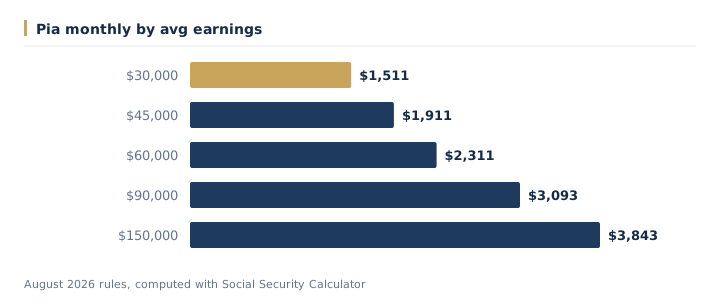
Running avg earnings from $30,000 up to $150,000 moves pia monthly from $1,511 to $3,843 — a spread of $2,331. That gap is the part a single headline rate never shows.
The same runs seen through chosen monthly benefit
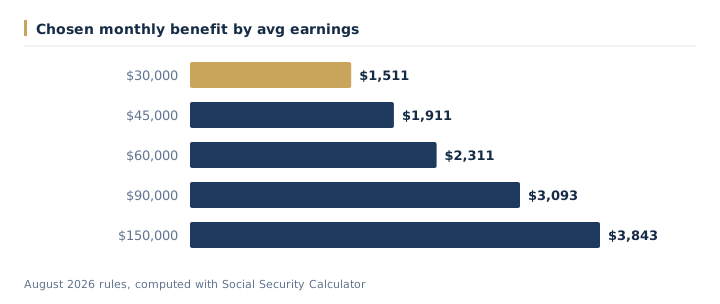
At $30,000, chosen monthly benefit works out to $1,511; at $150,000 it is $3,843. Looking only at pia monthly tends to understate how much the outcome shifts across that range.
Assumptions behind these figures
| Input | Value |
|---|---|
| Avg earnings | $60,000 |
| Birth year | 1975 |
| Claim age | 67 |
| As of | August 2026 |
| Method | identical to /tools/social-security-calculator |
Brackets, thresholds and rates change from year to year, so treat these as August 2026 figures for the 2026 tax year. For your own situation, open the Social Security Calculator and enter your real numbers — the calculator runs the same code that produced every figure on this page.
Frequently Asked Questions
How is my Social Security benefit calculated?
Your benefit is generally built from your highest 35 years of wage-indexed earnings, averaged into a monthly figure called AIME, which is then run through a progressive formula with bend points to produce your Primary Insurance Amount — the benefit you'd receive at full retirement age. That amount is then permanently adjusted up or down depending on whether you claim before, at, or after full retirement age. The structure of this formula is fixed in law, though specific dollar thresholds are adjusted periodically, so confirm your own estimate against your official Social Security statement.
What is AIME in Social Security?
AIME stands for Average Indexed Monthly Earnings, calculated by taking your highest 35 years of earnings, adjusting each year's earnings for wage inflation, adding them together, and dividing by 420 (35 years times 12 months). If you worked fewer than 35 years, the formula fills the remaining years with zeros, which lowers your average — meaning an additional year of work replacing a zero or low-earning year can meaningfully raise your benefit. AIME is the raw input used to calculate your Primary Insurance Amount.
What are Social Security bend points?
Bend points are thresholds in the Social Security benefit formula that split your AIME into three segments, each credited at a different rate — generally 90% of the first segment, 32% of the middle segment, and 15% of the amount above the second bend point. This structure is intentionally progressive, replacing a higher percentage of income for lower earners and a lower percentage for higher earners. The specific dollar values of the bend points are adjusted annually, though the method itself stays consistent.
How much does claiming early or late change my Social Security benefit?
Claiming before your full retirement age generally reduces your benefit permanently, by roughly 5/9 of 1% per month for the first three years early and a smaller rate beyond that — commonly resulting in around a 30% reduction if claimed at 62 with a full retirement age of 67. Delaying past full retirement age generally adds about 8% per year in delayed retirement credits up to age 70, which can raise the benefit by roughly 24% or more above the full-retirement-age amount. This swing can amount to a very large difference in lifetime income, so review your personal numbers carefully, ideally with a financial professional.
Can working more years increase my Social Security benefit?
Generally, yes — since your benefit is based on your highest 35 years of indexed earnings, working an additional year can replace a zero or a lower-earning year in that calculation, which can raise your Average Indexed Monthly Earnings and therefore your benefit. This effect tends to be most impactful for people who have fewer than 35 years of earnings on record. Because the benefit formula is progressive, the relative benefit of extra high earnings diminishes as your income rises.