Guides
How Much Do I Need to Retire? The Complete Answer
By Editorial Team · Published December 19, 2025 · Updated August 22, 2026 · 12 min read
Three ways to estimate your retirement number — replacement rate, the 25x rule, and bottom-up budgeting — stress-tested on a real example.
Somewhere along the way, "how much do I need to retire?" got answered with a single round number. A million dollars. Two million. "Your age times your salary by 40." These numbers travel well because they're easy to repeat, and they're nearly useless as plans, because the honest answer is that the figure is an output of four inputs you control or estimate — not a constant you look up.
Watch how fast the magic number falls apart. Two people earn identical $80,000 salaries. One owns her home outright, lives in a low-cost county, and wants a quiet retirement near family. The other rents in an expensive metro, plans to travel four months a year, and will retire at 55 instead of 67. Same income. Their required portfolios aren't in the same ballpark — they're not even in the same sport. Any number that ignores spending, lifespan, other income, and time horizon is a slogan, not an estimate. So the useful question is never "what's the number." It's "what's my number, and how much does it move when my assumptions are wrong?" This article answers both: three methods to triangulate the number, then a single household run through several scenarios so you can see how fragile the answer really is.
Every figure here is illustrative and year-labeled. IRS and SSA thresholds are indexed and change annually; confirm the current numbers before planning around them.
Three ways to estimate, used together
No single method is trustworthy alone. Each has a blind spot the others cover.
Method one works from your income, top-down. The logic: in retirement you stop saving for retirement, stop paying payroll tax on wages, and usually shed commuting and some housing costs, so you need less than 100% of working income to hold your lifestyle. Many planners use 70–85%. On a $70,000 income, an 80% replacement rate implies roughly $56,000 a year of total retirement income — and "total" is doing heavy lifting there, because it includes Social Security and any pension, not just the portfolio. This method is fast and blunt. It assumes spending tracks income, which is flatly untrue for aggressive savers and for anyone whose retirement life looks nothing like their working one. A household that already lives on 55% of its income and banks the rest will badly overstate its needs with a flat replacement rate. Use it as a 60-second gut check, not a conclusion.
Method two works from the portfolio, and it's where most casual math goes wrong. It's the inverse of the 4% guideline: if a 4% initial withdrawal is roughly sustainable, the portfolio you need is 1 ÷ 0.04 = 25 times the annual amount the portfolio itself must deliver. The 4% framework comes from William Bengen's 1994 research and the later Trinity Study, which found that an inflation-adjusted 4% initial withdrawal historically lasted around 30 years in U.S. data — a heuristic with real caveats, not a guarantee. The trap is the word portfolio. You subtract guaranteed income — Social Security, pension — from your spending need first, and apply 25x only to the remaining gap. Skip that subtraction and you can overstate the target by hundreds of thousands of dollars, because Social Security covers a large share of spending for many middle-income households. The Social Security Calculator gives you the guaranteed-income figure you get to subtract, and the Retirement Savings Calculator shows whether your current path reaches whatever target falls out.
Method three ignores income entirely and builds the budget from scratch. Housing, food, insurance, healthcare, transportation, travel, discretionary spending — line by line, plus a healthcare buffer and an inflation assumption, then subtract guaranteed income to find the portfolio gap. It's more work and it produces the most defensible number, especially when retirement spending will diverge from working spending. A good way to structure it is in two tiers: essentials (housing, food, utilities, insurance, basic healthcare) form a floor that guaranteed income should ideally cover, so a market crash never threatens your basic security; discretionary spending (travel, hobbies, gifts) is the flexible layer the portfolio funds and that you can throttle after a bad year. That tiered structure pairs naturally with the Retirement Income Calculator for mapping which income stream covers which tier.
There's a practical wrinkle in the bottom-up method worth flagging, because it's where careful people still go wrong: spending in retirement is not flat. Research on actual retiree behavior tends to find a "go-go, slow-go, no-go" pattern — higher discretionary spending in the active early years, a tapering middle, then a late-life rise driven by healthcare and care costs. A budget that assumes one constant inflation-adjusted figure for 30 years is tidy and slightly wrong in both directions: it may overstate the boring middle and understate the expensive end. You don't need actuarial precision to account for this. Building the budget in the two tiers above and stress-testing the discretionary layer separately from the essential floor captures most of the effect without pretending to forecast a specific year.
The methods earn their keep together. When they disagree sharply, the disagreement is the signal — it almost always means your retirement spending won't mirror your working spending, and the bottom-up budget is the tiebreaker. A blunt heuristic: if the replacement-rate estimate and the bottom-up estimate are within roughly 10% of each other, trust the average and move on. If they're 30% apart, stop and find out why before you anchor a 30-year plan to either one — the gap is usually telling you something specific about your savings rate or your intended lifestyle that a ratio can't see.
One household, run through the wringer
Abstract numbers don't teach anything. Let's take a single household and stress it across scenarios, changing one assumption at a time so you can see exactly which lever moves the answer.
The Carters: married, household income $70,000, planning to retire at 67, no pension.
Baseline. Eighty percent replacement puts their target income near $56,000. A bottom-up budget check — car paid off, mortgage nearly done, modest travel — lands at $54,000–$58,000, so $56,000 holds. Personalized SSA estimates suggest combined Social Security at 67 of about $34,000. That leaves a $22,000 gap the portfolio funds. Twenty-five times $22,000 is $550,000. Add a 15–25% cushion for surprise healthcare, IRMAA, and a long life, and a prudent target lands in the high-$600,000s — call it $630,000–$690,000. Note what just happened: a household everyone would assume needs "a million" actually needs roughly two-thirds of that, purely because Social Security covers more than half their spending. The single biggest error in casual estimates is forgetting that subtraction.
Now we break things on purpose.
Scenario A — they spend more. Push the budget to $72,000 instead of $56,000 (more travel, a second home base). The gap after the same $34,000 Social Security jumps to $38,000. Twenty-five times that is $950,000, and the prudent cushioned target crosses $1.1M. One assumption — spending — nearly doubled the number. This is why annual spending is the dominant driver: the 25x multiplier magnifies every single dollar of spending by twenty-five.
Scenario B — the withdrawal rate moves. Hold the baseline $22,000 gap and just change the assumed safe rate. At 4%, the target is $550,000. At a more conservative 3.5% — appropriate for a longer horizon or a lower-return environment — it's about 28.6x, or roughly $629,000. At a more aggressive 5%, it's 20x, or $440,000, but with a materially higher chance of running out. A swing of 1.5 percentage points in one assumption moved the target by nearly $190,000. The rate is not a fact; it's a judgment call, and reasonable analysts pick different ones.
Scenario C — they retire at 60 instead of 67. Now there's a seven-year stretch with no Social Security at all, funded entirely from the portfolio, plus pre-65 health coverage to buy. The horizon also lengthens, which argues for a lower withdrawal rate. The target doesn't nudge — it jumps well past $900,000 even at baseline spending, because early retirement stacks three penalties at once: more years, no Social Security yet, and unsubsidized healthcare.
Scenario D — one spouse lives to 96. The 25x rule roughly corresponds to a 30-year horizon. A retirement that runs 34 years isn't covered by a 30-year-based heuristic, so a lower rate (a higher multiple) is the honest response. The asymmetry here decides the default: plan for too short a life and being wrong means running out at 90, when returning to work isn't realistic; plan for too long a life and being wrong just means a larger estate. Given that, erring toward longevity is the rational choice, not the cautious one. The Money Longevity Calculator is built to test exactly this — how long a given balance and spending level survive across different lifespans — and the FIRE Calculator handles the early-retirement variant in Scenario C.
The lesson from running one household five ways: the Carters' "number" ranged from roughly $440,000 to well over $1.1M depending on which assumptions you fed it. The number is not a national average. It's a function, and you supply the variables.
The variables, ranked by how much they move the answer
Not all assumptions matter equally. From the scenarios above, the rough ranking:
- Annual spending — by far the largest. The 25x multiplier turns every dollar of spending into twenty-five dollars of required portfolio.
- Longevity — high. Funding 35 years versus 25 is dramatically more expensive, and it's the variable people most want to underestimate.
- Healthcare — high and chronically lowballed. The standard Medicare Part B premium runs about $185/month in 2025 (confirm the current figure), higher earners pay income-based IRMAA surcharges set from a tax return two years prior, and pre-65 retirees buy bridge coverage that can run five figures a year. The two-year IRMAA lookback is a quiet trap: a large Roth conversion or asset sale in your early 60s can inflate Medicare premiums two years later.
- Inflation — high over decades. At 3%, prices roughly double in about 24 years. A 40-year-old planning for $56,000 of spending may need closer to $90,000 of nominal income at retirement, and more still deep into a long one. Plan in today's dollars for clarity, but use real (inflation-adjusted) return assumptions and revisit the figure rather than freezing it.
- Social Security timing — moderate to high. Delaying the higher earner's claim toward 70 can raise guaranteed income by roughly 24%+ versus full retirement age, shrinking the gap the portfolio has to fill.
- Investment return and location — moderate. They affect how fast you reach the target and how durable the drawdown is, but they move the number less than spending or longevity.
The mistakes that distort the estimate
Most bad retirement numbers come from a short list of recurring errors:
- Applying 25x to total spending instead of the post-Social-Security gap — the single most common and most expensive distortion.
- Planning around an average lifespan rather than a long one; outliving the money is the failure mode that actually matters.
- Treating 4% as a promise rather than a 30-year-based historical heuristic with real risk in low-return environments.
- Reusing the 25x multiple for a 40-year early retirement it was never designed to cover.
- Lowballing healthcare, especially pre-65 coverage and IRMAA for higher-income retirees.
- Relying on one method instead of cross-checking all three and investigating the disagreement.
- Setting the number once and never revisiting it as spending, health, and markets evolve.
Common questions
How much do I need if I make $70,000? Depends on spending and Social Security, but a typical $70,000 household needing about $56,000 a year with roughly $34,000 from Social Security has a ~$22,000 portfolio gap — about $550,000 at 4%, or $630,000–$690,000 with prudent buffers. A higher-spending household at the same income could need $1M or more (see Scenario A).
Is $1 million enough? For many moderate-spending households with meaningful Social Security, yes, sometimes comfortably — the Carters need well under it. For high spenders, early retirees, or high-cost areas, often not. The relevant variables are your spending and other income, never the round number.
What exactly is the 4% rule? A heuristic from 1990s research: an initial 4% withdrawal, adjusted yearly for inflation, historically lasted about 30 years in U.S. data. A starting point, not a contract. Flexible spending improves its durability; longer horizons argue for a lower rate.
Does Social Security count toward my number? Yes, and decisively. You subtract guaranteed income from the spending need first; only the remaining gap gets the 25x treatment. Ignoring it badly overstates the target — the most frequent error in back-of-envelope estimates.
How much does retiring early change things? A lot. A longer horizon means a lower safe withdrawal rate, plus years of healthcare costs before Medicare and no Social Security yet — Scenario C pushed the same household well past $900,000.
Today's dollars or future dollars? Plan in today's dollars for an intuitive target, but ensure your projection grows that target with inflation and uses real return assumptions. The danger isn't the unit — it's letting a fixed nominal number quietly lose purchasing power because you never revisit it.
Key takeaways
- There is no universal number; it's a function of spending, longevity, healthcare, other income, and time horizon — and you supply the inputs.
- Triangulate with all three methods (replacement rate, 25x, bottom-up budget) and treat sharp disagreement as a signal to dig, not average away.
- Always subtract Social Security and any pension before applying 25x; this one step is the most common source of inflated estimates.
- Running one household across scenarios moved its number from ~$440,000 to over $1.1M — proof the answer is a range you maintain, not a figure you carve.
- Longevity and healthcare are the chronically underestimated drivers; build explicit buffers and use a lower withdrawal rate for early or long retirements.
Sources
- Social Security Administration — estimate your benefits
- Medicare — Part B premiums and IRMAA
- U.S. Bureau of Labor Statistics — consumer spending and inflation data
- Internal Revenue Service — retirement and required distributions
- Consumer Financial Protection Bureau — planning for retirement
Everything above is general educational analysis of U.S. retirement math for a broad audience, with illustrative figures, and is not personalized financial, investment, or tax advice. Indexed IRS and SSA amounts change every year — confirm the current numbers and speak with a qualified professional about your own circumstances before acting.
Run the numbers
Everything below came out of this site's own Retirement Savings Calculator. The figures are not quoted from anywhere else: each row is one run of the same calculation the tool page performs, using August 2026 rules. Put the same inputs in and you will get the same output.
How the result moves with current savings
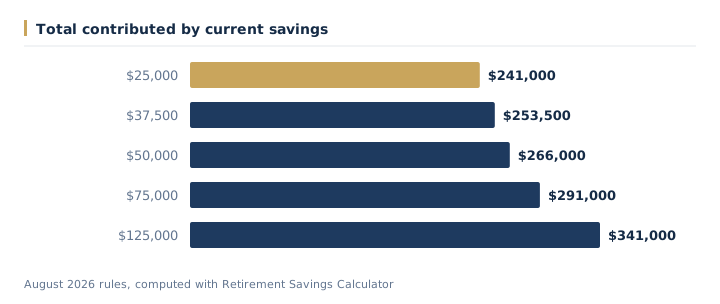
We ran 5 values of current savings through the calculator and left every other input at its default. As of August 2026, the output was:
| Current savings ($) | Total contributed ($) | Projected balance ($) | Real balance today dollars ($) |
|---|---|---|---|
| 25,000 | 241,000 | 870,424.04 | 358,603.18 |
| 37,500 | 253,500 | 965,577.23 | 397,805.03 |
| 50,000 | 266,000 | 1,060,730.41 | 437,006.89 |
| 75,000 | 291,000 | 1,251,036.79 | 515,410.59 |
| 125,000 | 341,000 | 1,631,649.54 | 672,218.01 |
Running current savings from $25,000 up to $125,000 moves total contributed from $241,000 to $341,000 — a spread of $100,000. That gap is the part a single headline rate never shows.
The same runs seen through projected balance
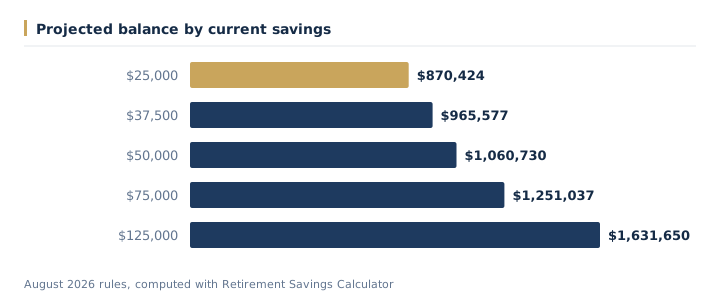
At $25,000, projected balance works out to $870,424; at $125,000 it is $1,631,650. Looking only at total contributed tends to understate how much the outcome shifts across that range.
Assumptions behind these figures
| Input | Value |
|---|---|
| Current age | 35 |
| Retire age | 65 |
| Current savings | $50,000 |
| Monthly | $600 |
| Ret | 7% |
| Infl | 3% |
| As of | August 2026 |
| Method | identical to /tools/retirement-savings-calculator |
Brackets, thresholds and rates change from year to year, so treat these as August 2026 figures for the 2026 tax year. For your own situation, open the Retirement Savings Calculator and enter your real numbers — the calculator runs the same code that produced every figure on this page.
Frequently Asked Questions
How much money do I need to retire?
There's no single number that fits everyone, since the amount depends on your spending, expected lifespan, other guaranteed income like Social Security or a pension, and when you plan to retire. A useful approach is to triangulate using multiple methods — an income-replacement estimate, a savings-multiple calculation, and a bottom-up budget — and treat significant disagreement between them as a signal to dig deeper rather than picking one number and moving on. A financial professional can help translate these methods into a plan specific to your situation.
What is the 25x rule for retirement savings?
The 25x rule estimates your retirement savings target as roughly 25 times the annual spending your portfolio needs to cover, based on inverting a roughly 4% initial withdrawal guideline. The key detail many people miss is that the 25x multiple should apply only to the spending gap remaining after subtracting guaranteed income like Social Security or a pension, not your total spending. Skipping that subtraction step can overstate your target by a large margin.
What is a good income replacement rate for retirement?
Many planners use a rough range of roughly 70% to 85% of pre-retirement gross income as a target for total retirement income, reflecting that retirees typically stop saving for retirement and may shed some work-related costs. This is best used as a quick directional check rather than a precise answer, since it assumes your retirement spending will track your working-age income, which isn't true for everyone — particularly aggressive savers or people planning a very different lifestyle. A bottom-up budget generally produces a more defensible, personalized number.
Does retirement spending stay the same throughout retirement?
Not necessarily — research on actual retiree spending often finds a go-go, slow-go, no-go pattern, with higher discretionary spending in the active early retirement years, a tapering middle period, and a possible late-life rise driven by healthcare and care costs. A budget that assumes one flat, constant inflation-adjusted spending figure for the entire retirement can therefore be somewhat inaccurate in both directions. Building essential and discretionary spending into separate tiers, and stress-testing each, tends to produce a more realistic plan.