Guides
FIRE Movement Explained: Financial Independence Roadmap
By Editorial Team · Published February 16, 2026 · Updated August 22, 2026 · 13 min read
What FIRE really is, the savings-rate-to-freedom math, Lean/Fat/Coast/Barista variants, and the pre-65 healthcare gap nobody warns you about.
There's a cartoon version of FIRE that gets passed around: a 28-year-old eating rice and beans in a studio apartment, gleefully refusing to turn on the heat, so they can stop working at 35 and do nothing for the next sixty years. That caricature exists because it's easy to mock. It also misses almost everything that matters.
FIRE stands for Financial Independence, Retire Early, and the two halves are not equally important. Financial independence is the real prize: the point where your investments can cover your cost of living without a paycheck. "Retire early" is just one thing you might do once you get there. Plenty of people who hit FI keep working — they just stop having to. The frugal-extremist stereotype describes a loud minority. The median person running these numbers is a software engineer or a nurse who got tired of feeling like one bad quarter at work would upend their life, ran the math, and realized the math was knowable.
This piece is about that math, and about the structural problems the math conveniently skips over. It is not about Roth conversion ladders or the fine print of which account to drain first — those are real tools for early retirees, but they're a different conversation. Here the focus is the engine itself: how a savings rate translates into a number of years, what the FIRE variants actually mean, and the pre-65 healthcare problem that quietly sinks otherwise sound plans.
Why your savings rate is the only number that matters at first
Most people, when they think about retiring early, fixate on income. Earn more, retire sooner. That's true at the margins but it buries the real driver, which is the percentage of your take-home pay you don't spend.
Here's the mechanism, and it's worth slowing down for because it's the whole game. Your savings rate does two jobs simultaneously. A dollar you save goes into the portfolio and starts compounding — that's the obvious part. But that same dollar is also a dollar you've proven you don't need to live on, which lowers the size of the portfolio you're trying to build. Raising your savings rate shrinks the target and speeds you toward it at the same time. That double action is why the relationship between savings rate and years-to-FI is so steep, and why it barely depends on the absolute dollars.
A widely cited illustration, assuming roughly 5% real returns, a 4% withdrawal target, and starting from zero:
| Savings rate of take-home pay | Rough years to financial independence |
|---|---|
| 10% | around 50+ |
| 20% | around 37 |
| 30% | around 28 |
| 40% | around 22 |
| 50% | around 17 |
| 60% | around 12.5 |
| 70% | around 8.5 |
Read that table once for the numbers and a second time for the shape. Going from 10% to 20% saved chops more than a decade off a working life. Going from 50% to 60% saves another four-plus years. The curve is brutal at the bottom and generous in the middle.
Now the honest caveat, because the table flatters the strategy. A 60% savings rate is not available to most households. If you're raising kids in a high-cost metro on a single income, the difference between 12% and 18% may be the entire realistic range, and that's fine — the point of the table is directional, not prescriptive. It tells you that a sustained, boring increase in your savings rate beats almost anything you could do by chasing a hotter investment return. That part is true at every income level.
The 25x target, and why early retirees shouldn't trust it at face value
The withdrawal side of FIRE rests on the so-called 4% rule. It comes from financial planner William Bengen's 1994 research and was reinforced by the Trinity Study: looking at historical US stock-and-bond returns, a retiree who withdrew 4% of the starting balance and then adjusted that dollar figure for inflation each year had a strong historical chance of the money lasting at least 30 years.
Invert 4% and you get the target. One divided by 0.04 is 25, so your "FIRE number" is roughly 25 times your annual spending.
| Annual spending | Target at 25x | First-year 4% draw |
|---|---|---|
| $40,000 | $1,000,000 | $40,000 |
| $50,000 | $1,250,000 | $50,000 |
| $60,000 | $1,500,000 | $60,000 |
| $80,000 | $2,000,000 | $80,000 |
| $120,000 | $3,000,000 | $120,000 |
The clean arithmetic hides a real problem for this audience specifically. Bengen modeled 30-year retirements. Someone who quits at 42 might need the portfolio to survive 50 years or more, and the 4% rule was never tested for that. This is where serious early-retirement practitioners disagree among themselves: some run 3.25% to 3.5% (effectively a 28x to 31x target) for the longer horizon and the bigger safety margin; others argue that a fixed withdrawal rate of any kind is the wrong tool and that you should vary spending with market conditions instead. There is no settled consensus, and anyone who tells you 4% is "safe" for a 50-year retirement is overstating what the research actually shows. Pressure-test your own figure with the FIRE Calculator, then stress how long the balance survives under different return sequences with the Money Longevity Calculator.
A concrete case: where one $500 decision moves the finish line
Maya is 32. She takes home $7,500 a month — call it $90,000 a year after tax. She and her partner spend $4,500 a month and bank the other $3,000. That's a 40% savings rate.
Run it forward:
- Annual spending of $54,000, so a 25x target of $1,350,000
- Annual savings of $36,000
- Assume 5% real return, starting from a $40,000 balance
At those inputs the portfolio reaches roughly $1.35 million in today's dollars in about 22 years, putting Maya's FI age near 54. Not "retire at 35," but a decade and a half earlier than the default.
Now change exactly one thing. Suppose they trim spending by $500 a month, to $48,000 a year. Watch both levers move at once: the target drops to $1,200,000 (25 × $48,000), and annual savings rise to $42,000. That single recurring $500 decision pulls FI in by roughly three to four years. Not from a raise, not from a better fund — from spending less, which is the lever you actually control.
The four FIRE variants, and who each one is honestly for
FIRE isn't monolithic. The community uses a handful of labels, and choosing the right one is mostly about being honest with yourself rather than copying a forum hero.
Lean FIRE. Built on a deliberately low spending number, often under $40,000 for a household. It gets you to FI fastest because the target is smallest. The trade-off is thin margin: a serious health event, a roof replacement, or supporting an aging parent can blow through a lean budget. It genuinely works for people who are content frugal, and it's a slow-motion disaster for people who only think they are.
Fat FIRE. The opposite end. A generous spending target, frequently $100,000-plus a year, that preserves a comfortable lifestyle. It needs a much bigger portfolio — $2.5 million and up — which means either a long accumulation phase or a high income doing the heavy lifting. Less ascetic, more arithmetic.
Coast FIRE. You front-load investments early so that, even if you never contribute another cent, compounding alone grows the balance to your full number by traditional retirement age. After you hit Coast, you only need to earn enough to cover this year's expenses. The hard saving is finished; the job becomes optional in a different way.
Barista FIRE. A deliberate hybrid: the portfolio covers most expenses, but you keep a part-time or lower-stress job — frequently for the employer health insurance specifically. It's less a destination than a bridge, and as the next section explains, the health-insurance angle is doing more work than it first appears.
| Variant | Typical spending | Portfolio size | Still working? |
|---|---|---|---|
| Lean | Under ~$40k | Smallest | No |
| Coast | Varies | Funded early, then coasts | Yes — covers current expenses only |
| Barista | Moderate | Partial | Yes — part-time, often for benefits |
| Fat | $100k+ | Largest | No |
The roadmap, in the order that actually works
- Track real spending for 60 to 90 days. You cannot multiply a number you don't have. Estimated budgets are reliably wrong on the low side.
- Stabilize before you accelerate. A starter emergency fund and the death of any 20%+ credit-card debt come before aggressive investing. No portfolio reliably out-earns card interest.
- Set the number. Realistic annual spending times 25, or times 28 to 31 if you're targeting a very long retirement. Recompute it whenever spending shifts materially.
- Fill tax-advantaged space in order. Employer 401(k) match first (it's an instant return), then 401(k), IRA, and HSA, before taxable investing.
- Build a taxable bridge. Retirement accounts have age gates. An early retiree needs accessible money for the years before penalty-free access — this is where conversion-ladder and 72(t) strategies enter, but they belong in their own dedicated planning, not a footnote.
- Invest simply and automate it. Low-cost broad index funds, automatic contributions, emotion removed from the loop.
- Send raises to the portfolio, not the lifestyle. Lifestyle inflation is the silent timeline-killer.
- Plan the spending-down phase before you quit. Withdrawal rate, account sequence, and healthcare get decided in advance, not improvised after you've given notice.
The two risks that actually sink early-retirement plans
Sequence-of-returns risk is the one that gets named at conferences. It's the danger of a steep market drop in the first few years after you stop working. Pulling income from a shrinking portfolio early can permanently cripple it, even if the long-run average return ends up looking fine — two retirees with identical average returns can land in completely different places purely based on the order the good and bad years arrive in. Reasonable defenses: hold one to three years of spending in cash or short bonds, use a flexible withdrawal approach that genuinely spends less in bad years, and start at a lower withdrawal rate than you think you need.
The pre-65 healthcare gap gets named less and sinks more plans. In the US, Medicare doesn't start until 65. Retire at 52 and you've signed up to self-fund health coverage for 13 years. The options are an Affordable Care Act marketplace plan (where premium subsidies are tied to your taxable income, so managing income can sometimes lower the premium), coverage through a working spouse, COBRA as a short-term bridge, or a part-time job that carries benefits. That last one is the entire structural reason Barista FIRE exists — it's not a lifestyle preference, it's an insurance strategy wearing a casual outfit. Underestimating this line item is one of the most common ways a numerically sound plan quietly fails.
The criticisms worth taking seriously
A few of the standard objections to FIRE are weak. These aren't.
It tilts toward high earners. A 50% savings rate is far easier on $200,000 than on $60,000. For many households the realistic version of FIRE is "financially independent in my fifties," not "done at 40," and pretending otherwise is dishonest.
The 4% rule is a US-history artifact, not a law of nature. It was derived from one country's market record over rolling 30-year windows. Long horizons and low-return environments can break it, and the people most exposed — early retirees — are exactly the ones the original research didn't model.
Spending estimates drift upward. Kids, aging parents, health events, and slow lifestyle creep all push real spending past the tidy projection. A plan built on an optimistic budget is a plan with a hidden crack.
Purpose is not a footnote. Some early retirees discover that work supplied structure and identity they'd undervalued, which is precisely why so many "retire" into encore careers and projects. That's not a failure of FIRE; it's evidence that the "RE" was always the less important letter.
None of this invalidates the approach. It argues for conservative withdrawal assumptions, an honest budget, and built-in flexibility — which is what the careful practitioners were already doing.
Where people get this wrong
The recurring failure modes are predictable enough to name flatly. Building the target off a budget that quietly omits healthcare, home maintenance, and irregular costs. Retiring straight into a downturn with a rigid 4% draw and no cash buffer. Discovering the pre-65 insurance problem only after the resignation email is sent. Chasing a hotter return instead of the dependable savings-rate lever. Locking every dollar inside retirement accounts so there's nothing penalty-free to spend during the bridge years. And treating the 4% rule as a guarantee rather than a starting assumption to stress-test downward.
Questions people actually ask
How big does the portfolio need to be? Realistic annual spending times 25 as a baseline; many planners use 28 to 31 for a 40-plus-year horizon. It's driven by spending, not income.
Is 4% still safe? A reasonable historical guide for roughly 30-year retirements, not a promise — and weakest precisely for the long early-retirement horizons it was never tested on. Starting lower and staying flexible is the cautious default.
What savings rate gets me out in 15 years? Very roughly, a sustained rate near 50% of take-home from a near-zero start, at typical real returns. "Roughly" is doing real work in that sentence — model it rather than trusting the rule of thumb.
How do early retirees handle health insurance before 65? ACA marketplace plans (income-based subsidies), a working spouse's plan, COBRA as a bridge, or a benefits-carrying part-time job — the foundation of Barista FIRE. Put a realistic number in the budget.
Coast vs. Barista — what's the difference? Coast means compounding alone will reach your full number by normal retirement age, so you only cover current costs. Barista means the portfolio covers most expenses while a part-time job fills the gap, frequently for health benefits.
Can I do this on an average income? Yes, on a longer timeline — likely "independent in my fifties" rather than "retired at 40." The principles scale; the dollars and the calendar scale with your circumstances.
Sources
- IRS — current-year retirement account contribution limits and early-withdrawal rules
- Social Security Administration — benefit timing and how early claiming interacts with an early-retirement plan
- Consumer Financial Protection Bureau — saving, investing, and debt-payoff guidance for the accumulation phase
- U.S. Department of Labor — 401(k) and employer-plan rules relevant to building the tax-advantaged base
Key takeaways
- Financial independence is the real goal; retiring early is just one option it unlocks, and many people who reach FI keep working by choice.
- Your savings rate, not your income, dominates how fast you get there — because it shrinks the target and speeds you toward it at the same time.
- The 25x target comes from Bengen's 1994 work and the Trinity Study; for 40-plus-year retirements, treat 4% with real suspicion and lean toward 3.25%–3.5%.
- Lean, Fat, Coast, and Barista are different destinations — pick the one your real life supports, not the one that sounds best on a forum.
- Sequence-of-returns risk and the pre-65 healthcare gap are the two failure points most likely to take down an otherwise solid plan.
- Test your own numbers conservatively with the FIRE Calculator and Money Longevity Calculator before betting a working life on them.
The figures here use illustrative and recent-year numbers; IRS contribution limits and withdrawal rules change every year, so confirm the current IRS figure before you act. This is general education about the FIRE movement, not personalized financial, investment, or tax advice for your situation.
Run the numbers
Everything below came out of this site's own FIRE Calculator. The figures are not quoted from anywhere else: each row is one run of the same calculation the tool page performs, using August 2026 rules. Put the same inputs in and you will get the same output.
How the result moves with assets
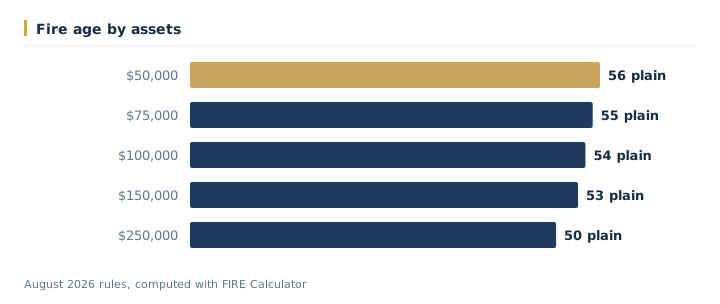
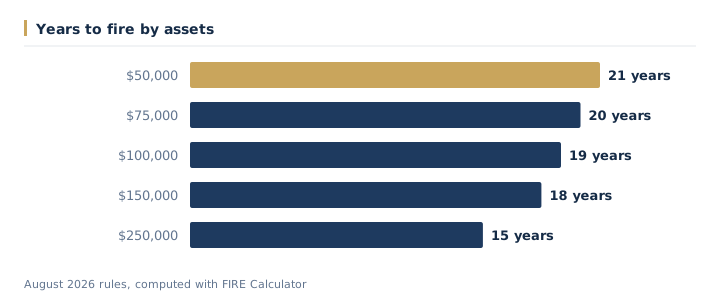
We ran 5 values of assets through the calculator and left every other input at its default. As of August 2026, the output was:
| Assets ($) | Fire age | Years to fire (years) |
|---|---|---|
| 50,000 | 56 | 21 years |
| 75,000 | 55 | 20 years |
| 100,000 | 54 | 19 years |
| 150,000 | 53 | 18 years |
| 250,000 | 50 | 15 years |
Running assets from $50,000 up to $250,000 moves fire age from 56 to 50 — a spread of 6. That gap is the part a single headline rate never shows.
The same runs seen through years to fire
At $50,000, years to fire works out to 21 years; at $250,000 it is 15 years. Looking only at fire age tends to understate how much the outcome shifts across that range.
Assumptions behind these figures
| Input | Value |
|---|---|
| Age | 35 |
| Assets | $100,000 |
| Expenses | $50,000 |
| Savings | $25,000 |
| Ret | 7% |
| Swr | 4% |
| Coast target | 65 |
| As of | August 2026 |
| Method | identical to /tools/fire-calculator |
Brackets, thresholds and rates change from year to year, so treat these as August 2026 figures for the 2026 tax year. For your own situation, open the FIRE Calculator and enter your real numbers — the calculator runs the same code that produced every figure on this page.
Frequently Asked Questions
What does FIRE stand for?
FIRE stands for Financial Independence, Retire Early. Financial independence — the point where investments can cover your living costs without a paycheck — is generally considered the core goal, while retire early describes just one thing you might choose to do once you reach it; many people who achieve financial independence keep working because they want to, not because they have to.
How does savings rate affect how soon you can retire?
Your savings rate — the share of take-home pay you don't spend — is generally the biggest lever in how quickly you can reach financial independence, because it simultaneously shrinks the portfolio size you need and speeds up how fast you build it. Illustrative models suggest the relationship is steep: raising your savings rate from a low level to a moderate one can cut many years off the timeline, though actual results depend heavily on investment returns and expenses, which can't be guaranteed. A dedicated retirement calculator can help you model your own numbers.
What are the different types of FIRE (Lean, Fat, Coast, Barista)?
Lean FIRE and Fat FIRE both describe the size of your target portfolio — Lean aims for a compressed, minimal budget reached through an aggressive savings rate, while Fat FIRE funds a more comfortable or generous lifestyle and requires a much larger target. Coast FIRE is different in kind: it's a timing strategy where you save aggressively early until your existing balance is projected to grow into a full retirement number by a traditional retirement age with no further contributions, then you stop saving and just cover current expenses. Barista FIRE sits in between, where you stop full-time work but keep part-time income, often to bridge a spending gap or access benefits like health coverage.
What's the biggest challenge with retiring early under FIRE?
One commonly overlooked challenge is health insurance before Medicare eligibility, since most FIRE math focuses on the savings and withdrawal side and glosses over the cost and logistics of covering healthcare for potentially decades before age 65. Early retirees also generally need to solve for accessing tax-advantaged retirement funds before the standard penalty-free age, since a large accumulated balance can still be effectively locked up. These structural issues are worth planning for as carefully as the savings math itself.
Does the standard 4% rule work for early retirees?
Not necessarily — the 4% rule was generally built around roughly 30-year retirement horizons, while someone retiring in their 30s or 40s may need the portfolio to last 45 to 50 years or more, a scenario the original research didn't specifically test. Because of this, some early-retirement researchers favor a lower starting withdrawal rate, often discussed in the 3.25%–3.5% range, for a larger safety margin, while others argue for varying spending with market conditions instead. There's no settled consensus on the safe rate for very long retirements, so stress-testing your own plan against a range of scenarios is generally recommended.