Guides
Backdoor Roth IRA: Complete Guide
By Editorial Team · Published March 7, 2026 · Updated August 22, 2026 · 12 min read
Step-by-step backdoor Roth, the pro-rata rule and Form 8606 trap explained with numbers, plus the mega backdoor Roth via after-tax 401(k).
Past a certain income, the front door to a Roth IRA is locked. The IRS phases out direct Roth contributions above a modified adjusted gross income that, for a recent year (2025), ran roughly $150,000–$165,000 for single filers and roughly $236,000–$246,000 for married couples filing jointly. Confirm the current figures with the IRS, because they're inflation-adjusted annually. Clear the top of that range and you cannot put a single dollar into a Roth IRA the normal way.
The backdoor Roth exists because the tax code locks the front door but leaves a side door wide open. There is no income limit on making a nondeductible contribution to a traditional IRA, and no income limit on converting a traditional IRA to a Roth. Chain those two permitted moves together and a high earner lands in roughly the same place a direct Roth contributor would — Roth space, funded.
This guide is the how-to: the exact sequence, the one rule that quietly turns it into a tax bill (pro-rata, reported on Form 8606), a worked example of that trap, and the much larger sibling strategy, the mega backdoor. It is not about when to convert existing pre-tax balances for tax-bracket reasons — that's a different decision with its own logic. Here the technique is fixed; the question is whether you execute it cleanly.
One filter before anything else: if your income is below the Roth phase-out, don't do any of this. Contribute to the Roth directly. The backdoor only earns its complexity when the front door is actually shut. For a recent year the IRA contribution limit was $7,000, or $8,000 at age 50 or older — confirm the current number. You can sanity-check Roth versus traditional outcomes for your situation with the Roth vs. Traditional IRA Calculator.
The procedure, step by step
- Open both a traditional IRA and a Roth IRA, ideally at the same custodian, if you don't already have them.
- Contribute up to the annual limit to the traditional IRA on a nondeductible basis. Do not claim the deduction. You'll report the nondeductible contribution on Form 8606 regardless of whether the custodian flags it.
- Let the cash settle. Usually a few business days. Keep it parked in cash or a money-market position so it doesn't generate gains before the next step.
- Convert the entire traditional IRA balance to the Roth. All of it, including a few dollars of incidental interest. A clean conversion leaves nothing behind.
- Pay tax only on growth and on any pre-tax portion. If the contribution was fully nondeductible and you hold no other pre-tax IRA money, the only taxable amount is whatever tiny earnings accrued between contribution and conversion.
- File Form 8606 for that tax year. This is the step people skip and the step that costs them. It records your nondeductible basis and documents the conversion.
- Repeat each year you want Roth funding and remain over the income limit.
The procedure itself is not hard. Almost every problem with the backdoor Roth traces back to a single rule that step 5 quietly assumed away.
The pro-rata rule, and why it ambushes people
Here is the rule that breaks the "tax-free" assumption. When you convert, the IRS does not let you point at the specific after-tax dollars and convert only those. It treats every traditional, SEP, and SIMPLE IRA you own as one combined pool, and taxes any conversion proportionally based on how much of that whole pool is pre-tax versus after-tax — measured on December 31 of the conversion year.
Form 8606 implements this with, in essence:
Taxable portion = Amount converted × (Pre-tax IRA balance ÷ Total IRA balance)
If your pre-tax IRA balance is zero, the pre-tax ratio is 0% and the conversion is essentially tax-free aside from any trivial earnings. If you're holding a meaningful pre-tax balance — most commonly an old 401(k) rolled into a traditional IRA — a large slice of your "tax-free backdoor" conversion is suddenly taxable, even though the new contribution was after-tax money.
What the trap actually costs: a worked example
Priya is 40 and earns too much to contribute to a Roth directly. She already holds a $93,000 rollover traditional IRA from an old employer's 401(k) — entirely pre-tax. She makes a $7,000 nondeductible contribution to a traditional IRA and converts $7,000 to her Roth, expecting it to be tax-free.
- Combined traditional IRA balance: $93,000 pre-tax + $7,000 after-tax = $100,000
- After-tax basis: $7,000, which is 7% of the pool
- Pre-tax portion: $93,000, which is 93% of the pool
- Amount converted: $7,000
Run it through pro-rata:
- Tax-free part of the conversion: 7% × $7,000 = $490
- Taxable part: 93% × $7,000 = $6,510, taxed as ordinary income
Priya thought she'd executed a clean backdoor Roth. She actually generated $6,510 of taxable income — and it gets worse, because her remaining basis is now smeared across the still-large pre-tax IRA, so the same problem recurs every future year until she fixes the underlying balance.
| Pre-tax IRA balance | After-tax contribution | Taxable on a $7,000 conversion | Clean? |
|---|---|---|---|
| $0 | $7,000 | ~$0 (earnings only) | Yes |
| $20,000 | $7,000 | ~$5,185 | No |
| $93,000 | $7,000 | ~$6,510 | No |
| $200,000 | $7,000 | ~$6,763 | No |
The fix: get the pre-tax money out of IRAs
The pro-rata calculation counts traditional, SEP, and SIMPLE IRAs. It does not count employer 401(k) or 403(b) plans. That asymmetry is the whole workaround.
- Roll the pre-tax traditional IRA into your current employer's 401(k) if the plan accepts incoming rollovers — many do. Once that money lives inside the 401(k), it drops out of the pro-rata pool entirely.
- Complete it before December 31 of the conversion year, because pro-rata uses the year-end aggregate IRA balance, not the balance on your conversion date. Custodian transfers can take weeks; starting in late December is a real risk. Aim to finish well before the holidays.
- Once the pre-tax IRA is emptied into the 401(k), the only IRA money left is the fresh nondeductible contribution, and the conversion is clean again.
Had Priya rolled her $93,000 into her employer's 401(k) before year-end, her December 31 IRA balance would have been just the $7,000 of after-tax money, and the conversion would have been essentially tax-free. This "isolation of basis" maneuver requires that the 401(k) accept the rollover and that the pre-tax money is fully out of IRAs by year-end — sequence it deliberately, not casually.
Timing details that change the outcome
Timing decides both how clean the strategy is and which tax year it lands in. Three things to keep straight.
A traditional IRA contribution for a given tax year can be made up until the following spring's filing deadline. A conversion, though, is always reported in the calendar year it actually happens. So you can make a prior-year nondeductible contribution early in the new year, but converting it then puts the conversion in that later calendar year. The cleanest way to avoid the confusion is to contribute and convert within the same calendar year.
There is no IRS-mandated waiting period between contribution and conversion. The practical guidance is just: let the deposit settle a few business days, keep it in cash so it doesn't throw off gains, then convert the full balance — including any stray cents of interest — so nothing pre-tax is left to muddy next year's pro-rata math.
If you contribute for the prior year in spring and for the current year shortly after, then convert both at once, you have two years of basis flowing through a single conversion. The Form 8606 math still works, but you have to track basis carefully across both years. When unsure, hold to one contribution and one conversion per calendar year.
State tax and the spousal angle
A handful of states don't conform exactly to the federal IRA rules, and the taxable portion of any conversion (earnings, or pre-tax dollars caught by pro-rata) is generally state-taxable wherever you owe income tax. If you live in a high-tax state now but expect to retire somewhere without an income tax, conversion timing can matter. A genuinely clean backdoor Roth with zero pre-tax balance produces almost no taxable income, so the state impact is minimal in that case.
Spouses are treated individually here, which is useful. Each spouse has their own contribution limit and their own pro-rata calculation — IRAs are never combined between spouses for the pro-rata test. A non-working or lower-earning spouse can fund a spousal traditional IRA on the working spouse's earned income and run their own backdoor Roth, so a married couple can route up to two contribution limits into Roth space each year. Critically, one spouse's large pre-tax rollover IRA does not contaminate the other spouse's clean conversion — only that individual's own IRAs count. The same logic extends to workplace plans: a 401(k) that accepts incoming rollovers can absorb that spouse's pre-tax IRA to enable a clean backdoor, but it can't absorb the other spouse's. Plan each spouse separately.
The mega backdoor Roth
The mega backdoor is a related but much larger-capacity strategy, and it lives entirely inside a 401(k). It only works if the plan permits both:
- After-tax (non-Roth) contributions beyond the regular elective deferral limit, and
- Either in-plan Roth conversions of those after-tax dollars or in-service withdrawals/rollovers of them into a Roth IRA.
For a recent year the regular employee 401(k) deferral limit was $23,500, plus a $7,500 catch-up at 50+ — or an $11,250 "super catch-up" for ages 60–63 under SECURE Act 2.0. Confirm the current figures. The mega backdoor exploits the much higher overall annual additions limit, which counts employer contributions and after-tax employee contributions together. Where a plan allows it, an employee can potentially route tens of thousands of additional dollars per year into Roth treatment — far beyond what the ordinary backdoor's IRA limit permits.
The requirements are strict and plan-specific. Your plan document must explicitly allow after-tax contributions and a conversion or roll-out mechanism; many plans allow neither. Convert the after-tax money to Roth promptly to minimize taxable earnings before conversion. And confirm the steps with HR or the plan administrator, because the contribution and conversion mechanics differ from plan to plan. It is one of the highest-capacity Roth-funding tools that exists, but it is entirely contingent on what your specific plan permits — get that in writing before you count on it.
Where this goes wrong in practice
The recurring failures are predictable. Assuming the conversion is tax-free despite a large pre-tax IRA balance, because nobody mentioned pro-rata. Forgetting Form 8606, which leaves the IRS with no record of your nondeductible basis and can get the same money taxed twice. Leaving the contribution invested too long and generating avoidable (small, but real) taxable earnings before conversion. Counting on a December cleanup rollover that doesn't clear by the 31st, since pro-rata uses the year-end balance. Holding a SEP or SIMPLE IRA and forgetting it sits in the same pro-rata pool. Running a backdoor Roth at all when your income was actually below the phase-out. And assuming any 401(k) supports the mega backdoor when it has to be explicitly permitted.
Questions people ask
Is the backdoor Roth legal? Yes. It combines two clearly permitted mechanisms — nondeductible traditional IRA contributions and Roth conversions, neither income-limited. Report it correctly on Form 8606 and follow current rules.
What is pro-rata in plain terms? The IRS treats all your traditional, SEP, and SIMPLE IRAs as one pot. When you convert, the taxable share equals the pre-tax share of that whole pot. You cannot convert "only the after-tax dollars" while holding pre-tax IRA money.
How do I avoid the pro-rata tax? Roll your pre-tax traditional/SEP/SIMPLE IRA balances into an employer 401(k) that accepts rollovers, completed before December 31 of the conversion year, leaving only after-tax money in IRAs.
Do I have to wait between contributing and converting? No mandated waiting period. Most people let it settle a few business days, keep the funds in cash, and convert promptly to minimize taxable earnings.
Backdoor vs. mega backdoor? The backdoor uses a nondeductible IRA contribution up to the IRA limit, then a conversion. The mega backdoor uses after-tax 401(k) contributions above the regular deferral limit, then an in-plan conversion or roll-out — potentially far larger, but only if the plan allows it.
What if I forgot Form 8606? You lose the documented record of your nondeductible basis, so the IRS may tax already-taxed money again. You can generally file a corrected or late Form 8606; involve a tax professional.
Sources
- IRS — Form 8606 instructions, IRA contribution limits, and Roth phase-out figures
- U.S. Department of Labor — 401(k) plan rules governing rollovers and after-tax contributions
- Consumer Financial Protection Bureau — general IRA and retirement-account guidance
- Social Security Administration — how Roth versus pre-tax balances interact with benefit taxation later
Key takeaways
- The backdoor Roth is a nondeductible traditional IRA contribution followed by a Roth conversion; it serves earners over the direct Roth income limits.
- Pro-rata, reported on Form 8606, taxes conversions based on the pre-tax share of all your traditional, SEP, and SIMPLE IRAs combined — not just the new contribution.
- The clean fix is rolling pre-tax IRA money into an employer 401(k) before December 31 of the conversion year.
- The mega backdoor can move far larger sums via after-tax 401(k) contributions plus an in-plan conversion, but only when the plan explicitly permits it.
- File Form 8606 every year, and don't run the backdoor at all if your income is below the phase-out.
- Compare Roth and traditional outcomes for your case with the Roth vs. Traditional IRA Calculator before committing.
The dollar limits and phase-out ranges here are illustrative for a recent year; the IRS resets them for inflation annually, so verify the current IRS figure before you execute. This is general education about the backdoor Roth technique, not personalized tax or financial advice — have a qualified tax professional confirm your specific situation, especially the pro-rata math.
Run the numbers
Everything below came out of this site's own Roth vs. Traditional IRA Calculator. The figures are not quoted from anywhere else: each row is one run of the same calculation the tool page performs, using August 2026 rules. Put the same inputs in and you will get the same output.
How the result moves with contribution
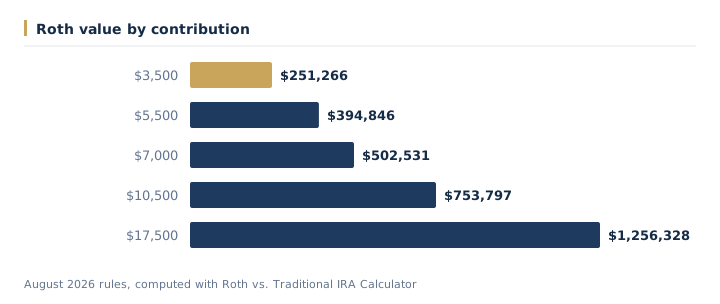
We ran 5 values of contribution through the calculator and left every other input at its default. As of August 2026, the output was:
| Contribution ($) | Roth value ($) | Traditional value ($) | Difference ($) |
|---|---|---|---|
| 3,500 | 251,265.69 | 257,877.95 | 6,612.26 |
| 5,500 | 394,846.09 | 405,236.77 | 10,390.69 |
| 7,000 | 502,531.38 | 515,755.89 | 13,224.51 |
| 10,500 | 753,797.07 | 773,633.84 | 19,836.77 |
| 17,500 | 1,256,328.46 | 1,289,389.73 | 33,061.28 |
Running contribution from $3,500 up to $17,500 moves roth value from $251,266 to $1,256,328 — a spread of $1,005,063. That gap is the part a single headline rate never shows.
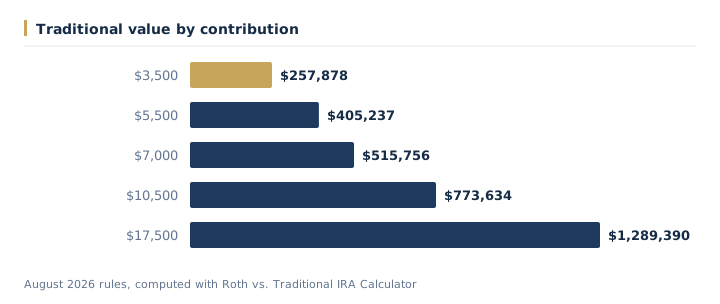
The same runs seen through traditional value
At $3,500, traditional value works out to $257,878; at $17,500 it is $1,289,390. Looking only at roth value tends to understate how much the outcome shifts across that range.
Assumptions behind these figures
| Input | Value |
|---|---|
| Current age | 35 |
| Retire age | 65 |
| Contribution | $7,000 |
| Tax now | 24% |
| Tax ret | 22% |
| Ret | 7% |
| As of | August 2026 |
| Method | identical to /tools/roth-vs-traditional-ira-calculator |
Brackets, thresholds and rates change from year to year, so treat these as August 2026 figures for the 2026 tax year. For your own situation, open the Roth vs. Traditional IRA Calculator and enter your real numbers — the calculator runs the same code that produced every figure on this page.
Frequently Asked Questions
What is a backdoor Roth IRA?
A backdoor Roth IRA is a two-step technique used by higher earners who are above the income limits for direct Roth IRA contributions: first making a nondeductible contribution to a traditional IRA, then converting that traditional IRA to a Roth IRA. Because there's generally no income limit on nondeductible contributions or on conversions, this combination lets high earners end up with Roth-style funds despite the direct contribution limit. It's meant only for people whose income exceeds the Roth contribution phase-out — if you're under that limit, contributing directly to a Roth is simpler.
What is the pro-rata rule for backdoor Roth conversions?
The pro-rata rule means the IRS treats all of your traditional, SEP, and SIMPLE IRAs as one combined pool when you do a conversion, and taxes the conversion proportionally based on how much of that whole pool is pre-tax versus after-tax money, as of December 31 of the conversion year. If you hold other pre-tax IRA money, such as an old 401(k) rolled into a traditional IRA, a large portion of what you intended to be a tax-free backdoor conversion can end up being taxable. This is one of the most common and costly mistakes people make with the backdoor Roth strategy.
How do I avoid the pro-rata rule trap?
Generally, the fix is to have no other pre-tax IRA balances by December 31 of the conversion year, since the pro-rata calculation is based on year-end aggregate balances across your traditional, SEP, and SIMPLE IRAs. One common approach is rolling existing pre-tax IRA money into a current employer's 401(k), if the plan accepts incoming rollovers, since 401(k) balances aren't included in the IRA aggregation. Because custodian transfers can take time, start this process well before the end of the year rather than waiting until December.
What is a mega backdoor Roth?
A mega backdoor Roth is generally a larger-scale version of the strategy that uses after-tax contributions to a 401(k) plan, if the plan allows them, which can then be converted or rolled into a Roth account, potentially allowing significantly more money into Roth-style savings than the standard IRA contribution limits permit. This strategy depends heavily on your specific 401(k) plan's rules, since not all plans allow after-tax contributions or in-plan conversions. It's a more advanced technique generally suited to high savers with access to the right plan features.
Do I need to file any special tax form for a backdoor Roth?
Yes, you generally need to file IRS Form 8606 for any year you make a nondeductible IRA contribution or complete a conversion. This form tracks your after-tax basis and reports the taxable portion of a conversion, and skipping it is a common mistake that can lead to paying tax twice on the same money down the road. Keeping accurate records and filing this form every relevant year is essential to the strategy working as intended.