Guides
Annuities Explained: Types, Pros, and Cons
By Editorial Team · Published April 5, 2026 · Updated August 22, 2026 · 13 min read
Separating the useful annuities from the costly ones: immediate vs. deferred, fixed/indexed/variable, SPIA and QLAC, with an income example.
Say the word "annuity" at a dinner party and watch the room split. Someone will call it a rip-off their brother-in-law got sold. Someone else will say it's the only thing that let their parents stop worrying about money. The strange part is that both people are usually telling the truth, because they're describing completely different products that happen to share a name.
That naming problem is the source of most of the confusion and most of the bad advice. So before defending or attacking annuities, the honest move is to put the category on trial and separate the handful of genuinely useful contracts from the expensive ones that earned the bad reputation.
Start with what the contract really is
An annuity is an insurance contract, not an investment, and getting that framing wrong is where most people go astray. You give an insurance company money — all at once or over time — and the company promises to pay you income, either starting now or at some future date, for a fixed period or for as long as you live.
The reason a lifetime annuity exists at all is to move one specific risk off your shoulders: the risk of living longer than your money lasts. A 401(k) can hit zero if you reach 100. A life-contingent annuity cannot, because the insurer is contractually on the hook to keep paying regardless of how old you get. That transfer of longevity risk is the entire product. Everything else is packaging.
One thing to be clear-eyed about up front: that promise is backed by the insurer's balance sheet, not the FDIC. Annuities are not federally insured. Each state runs a guaranty association with limited coverage if an insurer fails — frequently around $250,000 in present value, though the limit varies by state. That's why the insurer's credit rating matters and why large purchases are often split across multiple strong insurers.
The whole product family in one table
Rather than walk you through every variation in prose, here is the map. Two questions define almost every annuity: when does income start, and how is the money credited.
| Type | When income starts | How money grows | What you're really getting | The catch |
|---|---|---|---|---|
| SPIA (single-premium immediate) | Almost immediately | N/A — converts lump sum to income | Clean lifetime paycheck | Lump sum is gone; little/no legacy unless rider added |
| Deferred income annuity / QLAC | A chosen future date | Accumulates, then pays | Cheap insurance against extreme old age | Money committed years before any payout |
| Fixed deferred | Future | Guaranteed interest rate | A CD-like product from an insurer | Low growth; inflation erodes it |
| Fixed-indexed | Future | Tied to an index with a cap/floor | "No down years" with capped upside | Opaque crediting formulas; surrender charges |
| Variable | Future | Market subaccounts | Full market exposure inside a wrapper | Highest layered fees; real market losses |
Read that table as a spectrum of transparency. The top two rows are simple insurance you can comparison-shop in an afternoon. The bottom two are where the fees, the surrender schedules, and the sales commissions live, and where most of the horror stories originate.
A closer look at the simple end
SPIA. A single-premium immediate annuity takes a lump sum today and hands back a guaranteed paycheck for life starting almost immediately. It is the cleanest contract in the category — no accumulation phase, no crediting formula, no riders required. Because it's simple, you can request quotes from several insurers and compare the monthly payout side by side, which is something you genuinely cannot do with the complex products.
QLAC. A Qualified Longevity Annuity Contract is a deferred income annuity purchased inside a traditional IRA or 401(k). You commit a slice of the account now, payments begin at an advanced age (often 80–85), and the QLAC dollars are excluded from the balance used to compute required minimum distributions until income starts. SECURE 2.0 replaced the old percentage-based cap with a flat dollar ceiling near $200,000, indexed for inflation — confirm the current figure before relying on it. Deferring the start age that far buys a surprisingly large eventual payout for a modest premium, which is what makes it efficient longevity insurance rather than a growth play.
The complicated end, said plainly
Fixed deferred annuities credit a stated interest rate and behave roughly like an insurer-issued CD. Straightforward, but the rate is usually modest and inflation quietly eats it over a long retirement.
Fixed-indexed annuities are the ones marketed hardest. The pitch — "you won't lose money in a market crash" — is technically true because of a 0% floor, but the cost of that floor is a cap or participation rate that limits your upside, and those crediting formulas (caps, spreads, participation rates) are intricate and the insurer can often adjust them. The product is not as safe-and-free as the brochure implies; it's a trade you should be able to explain before you sign.
Variable annuities put your money in market subaccounts. They offer the most upside and the most ways to lose, and they stack the most fees: mortality-and-expense charges, subaccount expenses, and optional rider fees that can together top 2–3% a year. That drag compounds against you for decades, which is why this end of the family draws the most justified criticism.
What annuities genuinely do well
Set the marketing aside and a few real strengths survive scrutiny.
The headline one is guaranteed lifetime income — it is the only retirement vehicle that can mathematically promise you won't outlive a stream of payments. Underneath that sits the genuinely underappreciated engine: mortality credits. In a pool of annuitants, people who die earlier effectively subsidize those who live longer, so the insurer can pay a higher rate than a self-managed bond ladder of equivalent safety. No investment portfolio can manufacture this; it is purely an insurance phenomenon, and it is the real reason annuity income can look attractive.
There are two quieter benefits worth naming. Retirees whose essential expenses are covered by guaranteed income tend to spend more comfortably and stress less, because the floor holds no matter what markets do. And annuitized income is immune to a crash early in retirement, which neutralizes sequence-of-returns risk on that portion of the plan — one of the most dangerous risks a withdrawal-based strategy faces.
What's wrong with them, honestly
The criticisms aren't myths. Most are real, and a good plan accounts for them.
Once you annuitize, the lump sum is generally gone — you've swapped it for a payment stream and can't get it back. Deferred annuities pile on surrender charges, often running 5–10 years and starting high before declining, so an early exit can forfeit a meaningful slice of value. Fees and complexity are real on the variable and indexed end, where every rider has a price and the complexity reliably favors the seller. A level nominal payment also loses purchasing power across a 25- or 30-year retirement; inflation-adjusted versions exist but start materially lower. The guarantee carries credit risk because it rests on the insurer, not the FDIC. And there's opportunity cost: money locked in a low-rate fixed contract can trail a diversified portfolio over decades, and heirs may receive less than they would from an invested account unless you bolt on a costly death benefit.
Putting a number on it: a SPIA worked example
Concrete beats abstract. Robert is 65 with $250,000 he wants to turn into guaranteed income to bridge the gap between Social Security and his essential bills. He requests SPIA quotes.
- Premium: $250,000
- Age 65, single life, no period certain
- Illustrative payout rate at current interest rates: roughly 6.5% a year (rates move with interest rates and age — always get live quotes)
That throws off about $16,250 a year, roughly $1,354 a month, for life — and it keeps coming if Robert reaches 100. A 70-year-old buying the same structure gets a higher rate, thanks to a shorter expected payout window and richer mortality credits. Adding a 10-year period certain or a spousal survivor benefit lowers the monthly figure.
The trade-off is stark and worth stating: the $250,000 is no longer liquid, and with a pure life-only SPIA, nothing passes to heirs if Robert dies at 67. He can attach a period-certain or cash-refund feature to protect heirs in exchange for a smaller monthly check. Stress-test the payout and the structure with the Annuity Calculator, then see how a guaranteed income floor reshapes the whole plan using the Retirement Income Calculator.
Annuity income versus managing it yourself
The fair comparison isn't annuity-versus-stocks. It's annuity income against a self-managed portfolio withdrawal, like a 4%-style approach.
| Factor | Lifetime SPIA | Self-managed withdrawals |
|---|---|---|
| Can it run out? | No (life-only) | Yes, in bad markets or long life |
| Liquidity | Low | High |
| Inflation protection | Only with a COLA option (lower start) | Possible via growth assets |
| Legacy to heirs | Limited unless rider added | Whatever remains |
| Effect of an early crash | None on the income | Potentially severe |
| Mortality-credit boost | Yes | No |
The conclusion most thoughtful planners reach is a blend rather than a verdict: annuitize just enough to floor essential expenses, and keep the remainder invested for growth, inflation defense, liquidity, and legacy.
Riders: protection or sales padding?
Deferred annuities arrive stuffed with optional riders, each with an annual cost that quietly drags your return. Knowing the common ones tells you whether you're buying protection or financing marketing.
A guaranteed lifetime withdrawal benefit (GLWB) lets you draw a guaranteed percentage for life while still controlling the account — popular, but it usually costs 1%+ a year, and the headline "rollup" rate often applies to a hypothetical benefit base, not cash you can withdraw and keep. A death benefit rider guarantees heirs at least the premium or a stepped-up value; reasonable if legacy matters, but it raises fees and partially cancels the mortality-credit edge that made the annuity efficient. A cost-of-living adjustment fights inflation by escalating payments, at the price of a starting payment 20–30% lower at the same age. A long-term care rider boosts withdrawals if you can't perform daily activities — sometimes sensible for people who can't qualify for standalone LTC insurance, though the leverage is typically weaker than a dedicated policy.
The test for any rider is the same: does its annual cost justify the specific risk it covers? Three riders can push total fees past 3% a year, and that compounds against you for the life of the contract.
Treat the purchase like a competitive bid
Pricing for the identical guarantee varies widely between insurers, which means shopping isn't optional.
Get quotes from at least three highly rated insurers for the same structure — same age, premium, survivor option, and start date — so you're comparing like with like. Check independent financial-strength ratings and confirm your state guaranty association's coverage limit. Favor fee-only or fiduciary advice, because commissions on indexed and variable contracts can be large enough to bias a recommendation. And actually read the contract — particularly the surrender schedule and rider definitions — using any free-look period (commonly 10–30 days) to walk away without penalty if it isn't what you thought you were buying.
Where buyers most often go wrong
- Annuitizing everything and leaving no liquidity for emergencies or large one-off costs.
- Buying a contract you can't explain — if you can't describe how it credits interest, computes surrender charges, and prices its riders, you're not ready to sign.
- Ignoring inflation and accepting a level payment that loses a third of its purchasing power over a long retirement.
- Underweighting insurer strength and the limits of state guaranty coverage on large purchases.
- Treating an indexed annuity as if it were owning the stock index — it isn't, and expected long-run returns are far lower.
- Surrendering during the surrender period and forfeiting a large chunk of value.
- Buying for the salesperson's incentive rather than your own need.
Common questions, answered straight
Are annuities a good investment? Wrong question. An annuity is insurance, not an investment. As longevity insurance for essential income, a simple immediate annuity can be excellent. As a growth vehicle, high-fee variable and indexed contracts usually trail a low-cost diversified portfolio. Ask "what risk am I insuring," not "what return will I get."
What's the safest type? A SPIA from a highly rated insurer is the simplest and most transparent, with no market risk to the payment and no opaque crediting math. "Safe" still depends on insurer strength, since the backing is the insurer and limited state guaranty associations, not the FDIC.
Can I lose money? In a fixed or immediate annuity you generally can't lose principal to markets, but you can lose value to inflation, to surrender charges if you exit early, or to insurer insolvency beyond guaranty limits. In a variable annuity, subaccount losses hit your value directly.
Why would I want a QLAC? It's a deferred income annuity inside an IRA or 401(k) that starts at an advanced age and is excluded from RMD calculations until then (up to a limit near $200,000 under SECURE 2.0 — verify the current figure). It's inexpensive insurance against living far past average.
How are payments taxed? It depends on the funding source. Payments from an IRA or 401(k) (a "qualified" annuity) are generally fully taxable as ordinary income. Payments from a non-qualified annuity split into untaxed return of principal and taxable earnings under an exclusion ratio. Confirm specifics with a tax professional.
Should my whole 401(k) go into one at retirement? Almost never. The standard guidance is to annuitize only enough to cover essential expenses not already met by Social Security or a pension, and keep the rest for liquidity, growth, inflation protection, and heirs.
Sources
- Consumer Financial Protection Bureau — annuities and retirement income
- Social Security Administration — benefits and retirement income basics
- U.S. Department of Labor — retirement plan and lifetime income guidance
- IRS — taxation of annuities and qualified plan distributions
Verdict in five points
- An annuity is an insurance contract that trades a lump sum for income; its real value is protecting against outliving your money through lifetime guarantees and mortality credits.
- The name hides wildly different products: simple SPIAs and QLACs are transparent and shoppable; variable and indexed contracts are complex and often expensive.
- The most defensible use is income flooring — annuitize just enough to cover essentials and keep the rest invested.
- The drawbacks are real, not myths: illiquidity, surrender charges, layered fees, inflation erosion, and insurer credit risk, with no FDIC backing.
- A QLAC is an efficient, low-cost hedge against extreme longevity inside an IRA — confirm the current contribution ceiling before buying.
This is general educational material about annuities and retirement planning, not personalized financial, tax, or insurance advice. Contract terms vary by product and insurer; consult a qualified fiduciary and read the contract in full before purchasing.
Run the numbers
Everything below came out of this site's own Annuity Calculator. The figures are not quoted from anywhere else: each row is one run of the same calculation the tool page performs, using August 2026 rules. Put the same inputs in and you will get the same output.
How the result moves with premium
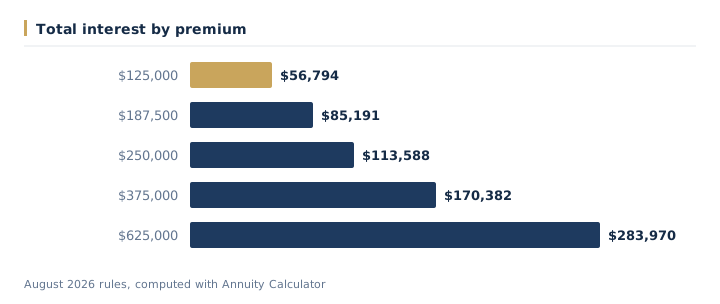
We ran 5 values of premium through the calculator and left every other input at its default. As of August 2026, the output was:
| Premium ($) | Total interest ($) | Total received ($) | Monthly payout ($) |
|---|---|---|---|
| 125,000 | 56,794.1 | 181,794.1 | 757.48 |
| 187,500 | 85,191.15 | 272,691.15 | 1,136.21 |
| 250,000 | 113,588.2 | 363,588.2 | 1,514.95 |
| 375,000 | 170,382.3 | 545,382.3 | 2,272.43 |
| 625,000 | 283,970.49 | 908,970.49 | 3,787.38 |
Running premium from $125,000 up to $625,000 moves total interest from $56,794 to $283,970 — a spread of $227,176. That gap is the part a single headline rate never shows.
The same runs seen through total received
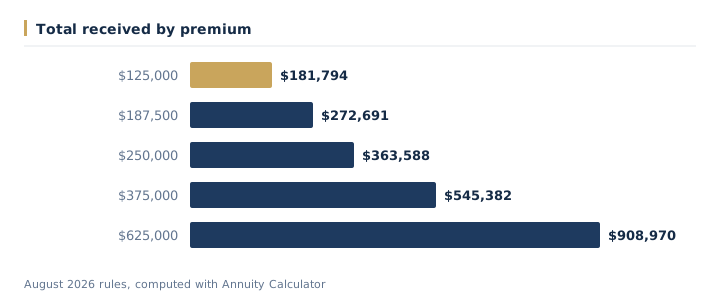
At $125,000, total received works out to $181,794; at $625,000 it is $908,970. Looking only at total interest tends to understate how much the outcome shifts across that range.
Assumptions behind these figures
| Input | Value |
|---|---|
| Premium | $250,000 |
| Rate | 4% |
| Years | 20 years |
| As of | August 2026 |
| Method | identical to /tools/annuity-calculator |
Brackets, thresholds and rates change from year to year, so treat these as August 2026 figures for the 2026 tax year. For your own situation, open the Annuity Calculator and enter your real numbers — the calculator runs the same code that produced every figure on this page.
Frequently Asked Questions
What is an annuity?
An annuity is an insurance contract, not an investment, where you give an insurance company money — either as a lump sum or over time — and the company promises to pay you income for a set period or for the rest of your life. Its core purpose is to transfer longevity risk, the risk of outliving your savings, from you to the insurer. Because that promise is backed by the insurer's financial strength rather than a government guarantee like FDIC insurance, the insurer's credit rating matters when evaluating a purchase.
What's the difference between a SPIA and a deferred annuity?
A single-premium immediate annuity (SPIA) converts a lump sum into guaranteed income that starts almost immediately, with no accumulation phase or complex crediting formula, making it relatively easy to compare across insurers. A deferred annuity instead accumulates value, or is credited interest, for a period before payments begin at a future date you choose. Generally, the simpler, immediate end of the annuity spectrum is easier to evaluate than the more complex deferred and variable products.
Are annuities a good investment for retirement income?
Whether an annuity is a good fit depends on your individual needs, but simpler products like SPIAs and QLACs are generally viewed as legitimate tools for guaranteeing lifetime income, since no investment portfolio alone can promise you won't outlive your money the way a lifetime annuity contractually can. More complex products, like variable and some indexed annuities, often carry higher and less transparent fees and draw more criticism. Because annuities are largely irreversible and contract-specific, it's worth comparing quotes and consulting a fee-only financial professional before purchasing.
What is a QLAC?
A Qualified Longevity Annuity Contract (QLAC) is a deferred income annuity purchased inside a traditional IRA or 401(k), where a portion of the account is committed now in exchange for payments that begin at an advanced age, often in the early-to-mid 80s. QLAC dollars are generally excluded from the balance used to calculate required minimum distributions until income begins, and there's a dollar cap on how much can be allocated this way, which is periodically adjusted — check current IRS rules before relying on a specific figure. It functions primarily as insurance against outliving your money at very old age rather than as a growth investment.
Are annuities insured like bank deposits?
No, annuities are not federally insured the way bank deposits are covered by the FDIC. Instead, each state runs a guaranty association that provides limited protection if an insurer fails, though coverage limits vary by state. Because of this, the insurer's financial strength and credit rating matter, and large annuity purchases are sometimes split across multiple insurers to manage that risk.