Comparisons
Roth IRA vs 401(k): Which Should You Prioritize?
By Editorial Team · Published May 11, 2026 · Updated August 22, 2026 · 13 min read
Not a binary but a priority order: match first, then the tax-rate-now-vs-later bet, income limits and the backdoor pro-rata trap, and the plan-fee tiebreaker.
"Roth IRA or 401(k)?" is the wrong question, and answering it as asked is how people end up optimizing the small decision while fumbling the large one. The phrasing implies a single fork in the road. In reality you're standing at a sequence of forks, and the order you take them in matters far more than any individual choice. A worker agonizing over Roth-versus-pre-tax while leaving an employer match on the table has won a coin-flip argument and lost a guaranteed 50% return in the same breath.
So this isn't a verdict on which account is "better." It's a priority order — what gets your next dollar, and the one after that — built from the few comparisons that actually move the outcome: the match, the tax-rate bet, the income rules, and the often-ignored question of what each account costs you to own.
The only part that isn't a judgment call: the match
Start with the one decision that involves no forecasting, no tax theory, and no opinion. If your employer matches 401(k) contributions, the matched portion is compensation you only receive by contributing. A 50%-on-the-first-6% match means that on $6,000 of contributions you receive $3,000 you would otherwise never see — an immediate, risk-free 50% return before the money is even invested.
No Roth IRA tax advantage competes with that. The most generous plausible tax arbitrage between account types plays out in single-digit percentages annualized; the match is a one-time 25%–100% on the matched dollars, instantly. This is why the priority order has an uncontested first rung: contribute to the 401(k) at least up to the full match, before funding anything else. Skipping it to "max the Roth first" is the single most expensive ordering mistake in this entire decision, and it's common precisely because the Roth-versus-pre-tax debate is more interesting to argue about than the match is to claim. Model what the match alone compounds to over a career with the 401(k) Calculator — the matched dollars frequently become the largest single line in the ending balance, and they cost nothing but the act of contributing.
One caveat worth stating because it changes behavior: many matches vest over time, and matched dollars you forfeit by leaving early were never really yours. That affects job-change timing, not the contribution priority — you still capture the match first; you just don't treat unvested money as a guaranteed balance.
The real argument: pay tax now or pay it later
Once the match is secured, the genuine comparison begins, and it has exactly one pivot: whether your tax rate is higher now or will be higher when you withdraw.
- A pre-tax (traditional) 401(k) or IRA deducts the contribution today and taxes every withdrawn dollar — contributions and growth alike — as ordinary income in retirement. You're betting your future rate is lower than today's.
- A Roth IRA or Roth 401(k) takes the money after tax today; qualified withdrawals, including all growth, come out entirely tax-free. You're betting your future rate is equal to or higher than today's, or simply buying certainty against rate risk.
The decision rule reduces to one sentence: fund Roth when your current marginal rate is low relative to your expected retirement rate, and fund pre-tax when it's high. Everything else is detail hanging off that sentence.
| Situation | Which way it points | Why |
|---|---|---|
| Early-career, lower bracket now | Roth | Paying tax at today's low rate locks it in before raises push you up |
| Peak-earning years, high bracket | Pre-tax | The deduction is worth most when your marginal rate is highest |
| Expect large pre-tax balances + Social Security later | Lean Roth at the margin | Big traditional balances force taxable RMDs that can push retirement rate up |
| Genuinely uncertain about future rates | Split | Tax diversification gives you withdrawal-side flexibility later |
That last row is doing quiet work. Because nobody actually knows future tax law or their own future income, holding both account types lets you choose, year by year in retirement, which spigot to open against the brackets in front of you. Tax diversification isn't fence-sitting; it's buying optionality, and the value of that option is highest for people with the least confidence in their forecast. Compare the after-tax ending value of the same contribution run through Roth versus traditional at different rate assumptions with the Roth vs. Traditional IRA Calculator; the crossover point is usually less obvious than intuition suggests.
A worked dollar example of the rate bet
Make it concrete. Take $7,000 of pre-tax income, a 30-year horizon, and growth that multiplies the invested amount roughly fivefold.
- Roth route: at a 12% current marginal rate, $7,000 of income leaves $6,160 to contribute after tax. Grown ~5×, that's about $30,800, all withdrawable tax-free.
- Pre-tax route, same low bracket now, higher later: the full $7,000 goes in, grows ~5× to ~$35,000, but is taxed on withdrawal at a 22% retirement rate, leaving about $27,300.
- Pre-tax route, high bracket now (32%), lower later (22%): the deduction is worth more today; the same $35,000 taxed at 22% still nets ~$27,300, but you also banked a 32%-rate deduction on the way in, which — if invested — tips the comparison toward pre-tax.
The numbers aren't the point; the structure is. When today's rate is low, Roth's tax-free growth usually wins. When today's rate is high and retirement's will be lower, the pre-tax deduction usually wins. The bracket figures and contribution limits change every year — state the mechanism and pull the current marginal-rate thresholds and contribution caps from the IRS, never from memory — but the rule that "Roth wins from a low bracket, pre-tax wins from a high one" is structural and stable.
The income rules that can make the choice for you
Sometimes the priority order isn't decided by the tax bet at all — it's decided by eligibility, and the rules differ sharply between the two account families.
The Roth IRA has a direct-contribution income ceiling: above a phase-out range tied to filing status, you can't contribute to one directly at all. The 401(k) — Roth or pre-tax — has no income limit on contributing; high earners locked out of a direct Roth IRA can still use the Roth 401(k) if the plan offers it. This single asymmetry reorders the priority list for high earners: their Roth exposure has to come through the workplace plan, not the IRA.
For those over the IRA income ceiling, the commonly cited route is the "backdoor" Roth — contributing to a non-deductible traditional IRA and converting it to Roth. It's mentioned here rather than walked through because it carries a real trap: the pro-rata rule aggregates all your traditional IRA balances when computing the taxable portion of any conversion, so a large existing pre-tax IRA can make a "backdoor" contribution mostly taxable and defeat the purpose. The mechanism is legitimate; the execution is rule-bound enough that the specifics — and the current income phase-out figures — should come straight from the IRS guidance and a tax professional, not a forum summary.
The structural takeaway survives the annually changing numbers: the 401(k) accepts everyone regardless of income; the Roth IRA does not. That fact alone often dictates where a high earner's Roth dollars must go.
The angle nobody checks: what each account costs to own
Two accounts can run the identical tax strategy and still deliver materially different ending balances because of a variable the tax debate ignores entirely — fees and investment menu.
A 401(k) is a closed menu. You invest only in the funds the plan offers, at whatever expense ratios it negotiated, plus any plan administrative fee. Some plans are excellent — institutional share classes, low-cost index funds, negligible overhead. Others bury participants in 1%+ fund expenses and recordkeeping charges that behave exactly like a permanent negative return every single year. A Roth IRA at a low-cost provider, by contrast, opens the entire market: you can hold a broad index fund at a few basis points.
This produces a refinement to the priority order that pure tax logic misses:
- 401(k) up to the full match — always, regardless of fees, because a 50% match swamps even a bad menu.
- Then assess the 401(k)'s costs. If the plan's funds and fees are reasonable, continuing in the 401(k) past the match is fine.
- If the plan is expensive, the next dollars after the match are often better placed in a low-cost Roth IRA (if income-eligible) than poured into a high-fee 401(k) — the fee drag can erase the tax advantage you were chasing.
- After exhausting the sensible tax-advantaged space, return to the 401(k) for additional pre-tax/Roth room, since it has no income limit and higher contribution capacity than an IRA.
The federal fee-disclosure documents your plan is required to provide are the input for step 2, and most participants have never opened them. A 1% all-in cost difference, compounded over 30 years, can cost more than the entire Roth-versus-pre-tax tax spread you spent so long deliberating. Cost is not a footnote to this decision; in expensive plans it's the deciding term.
Putting the order together
Assemble the rungs and the priority list is short, sequenced, and largely independent of any forecast for the first two steps:
- 401(k) to the full employer match. Non-negotiable, no forecasting required, highest guaranteed return available to you.
- Pay down genuinely high-interest debt before further investing, since a guaranteed double-digit interest saving beats an uncertain market return — a step often missing from purely account-type discussions but logically prior to step 3.
- Fund the Roth-versus-pre-tax choice by your tax-rate bet: Roth from a low bracket, pre-tax from a high one, split if uncertain — using the Roth IRA if income-eligible, the workplace Roth/pre-tax option otherwise.
- Mind the income rules: above the Roth IRA ceiling, route Roth dollars through the 401(k) or evaluate a backdoor conversion with a professional, watching the pro-rata trap.
- Let plan cost break ties: an expensive 401(k) past the match loses to a cheap Roth IRA; a cheap 401(k) is fine to keep funding.
- Then maximize remaining tax-advantaged room, favoring the 401(k)'s higher capacity and absent income limit for the overflow.
A full worked household
A 34-year-old earns $78,000, has no high-interest debt, an employer match of 50% on the first 6%, and a 401(k) menu with a 0.9% average fund expense.
- Step 1: Contribute 6% ($4,680) to the 401(k). The match adds $2,340 — an instant 50% on those dollars. Skipping this to fund a Roth IRA would forfeit $2,340 to chase a tax edge worth a fraction of that.
- Step 3: At a low marginal bracket relative to expected peak-earning years, the tax bet points toward Roth. Next dollars go to a Roth IRA at a low-cost provider, not more into the 0.9%-fee 401(k).
- Step 5: The 401(k)'s 0.9% expense is mediocre, reinforcing the choice to route post-match savings to the cheaper Roth IRA rather than overfunding the plan.
- Step 6: If they still have capacity after maxing the Roth IRA, additional dollars return to the 401(k) — Roth 401(k) if offered, to stay consistent with the low-bracket logic — because it accepts the contributions the IRA no longer can.
Run the same household's contributions through the 401(k) Calculator for the matched-and-fee-laden plan path and the Roth vs. Traditional IRA Calculator for the Roth-IRA path, and the post-match dollars visibly compound better in the low-cost Roth — exactly the refinement pure tax theory would have missed. The order, not the individual account, produced the result.
Why the order survives changing tax law
A reasonable objection: if future tax rates are unknowable, how can any priority list be stable? The answer is that the first two rungs don't depend on the forecast at all. A match is a guaranteed return regardless of what Congress does to brackets; paying off a 20% debt beats any market or tax outcome. Only rung three — the Roth-versus-pre-tax bet — is forecast-sensitive, and the recommended hedge there is precisely not to bet the whole position: split contributions so you hold both account types and decide at withdrawal, when the brackets are no longer hypothetical. The structure is deliberately built so that the forecast-dependent decision is also the one you're allowed to defer. That's why the order holds even though the numbers inside it won't: the high-certainty moves come first, and the uncertain move is designed to be hedged rather than guessed. A plan whose riskiest assumption is also its most postponable assumption is the one most likely to still look correct in thirty years.
Where this decision goes wrong
The recurring failures cluster: funding a Roth IRA before capturing the full match; treating the Roth-versus-pre-tax choice as a personality question instead of a present-versus-future tax-rate bet; assuming a forecast about 30-years-out tax law is reliable enough to skip tax diversification; not realizing the 401(k) has no income limit while the Roth IRA does, so routing Roth dollars suboptimally; attempting a backdoor Roth on top of a large pre-tax IRA and getting blindsided by the pro-rata rule; and never once reading the plan's fee disclosure, then wondering why a textbook-correct tax strategy underperformed. Every one of these is an ordering or input error, not a math error — which is why the priority sequence, not a single answer, is the deliverable.
Sources
- Internal Revenue Service — contribution limits, Roth IRA income phase-outs, and the conversion rules that govern the backdoor route
- U.S. Department of Labor — required 401(k) fee and investment disclosures that determine the cost-drag tiebreaker
- Consumer Financial Protection Bureau — consumer guidance on prioritizing employer matches and high-interest debt before discretionary investing
- Social Security Administration — benefit estimates that shape your expected retirement tax rate and the Roth-versus-pre-tax bet
Key takeaways
- The match comes first, always — it's a guaranteed 25%–100% return that no Roth-versus-pre-tax tax edge can beat, and funding the IRA ahead of it is the costliest ordering mistake.
- After the match, the real decision is a single bet: Roth from a low current bracket, pre-tax from a high one, split when the future rate is genuinely unknown.
- The 401(k) has no income limit; the Roth IRA does — high earners must route Roth dollars through the plan or a carefully executed backdoor conversion mindful of the pro-rata rule.
- Plan fees and menu are a deciding term, not a footnote: an expensive 401(k) past the match loses to a low-cost Roth IRA, and most people never read the required disclosure.
- The deliverable is a priority order, with current-year limits and bracket thresholds always pulled from the IRS rather than recalled — sequence and inputs, not a single account, determine the outcome.
This article explains the contribution-priority framework for general education only and is not personalized tax, legal, or investment advice; contribution limits, income phase-outs, and conversion rules change yearly and interact with your specific brackets, plan, and existing IRA balances — confirm the current figures with the IRS and a qualified tax professional before acting.
Run the numbers
Everything below came out of this site's own 401(k) Calculator. The figures are not quoted from anywhere else: each row is one run of the same calculation the tool page performs, using August 2026 rules. Put the same inputs in and you will get the same output.
How the result moves with salary
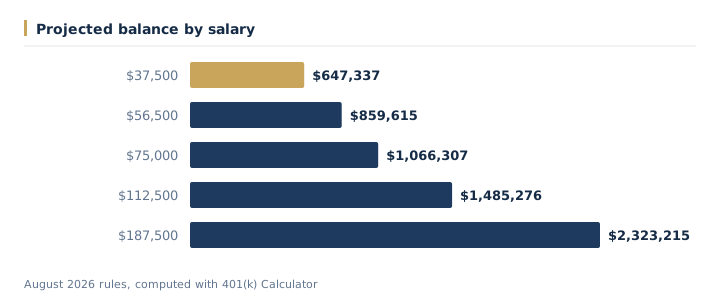
We ran 5 values of salary through the calculator and left every other input at its default. As of August 2026, the output was:
| Salary ($) | Projected balance ($) | Employee contributions ($) | Employer match ($) |
|---|---|---|---|
| 37,500 | 647,337.18 | 91,278.18 | 45,639.09 |
| 56,500 | 859,615.08 | 137,525.79 | 68,762.89 |
| 75,000 | 1,066,306.71 | 182,556.36 | 91,278.18 |
| 112,500 | 1,485,276.24 | 273,834.53 | 136,917.27 |
| 187,500 | 2,323,215.3 | 456,390.89 | 228,195.45 |
Running salary from $37,500 up to $187,500 moves projected balance from $647,337 to $2,323,215 — a spread of $1,675,878. That gap is the part a single headline rate never shows.
The same runs seen through employee contributions
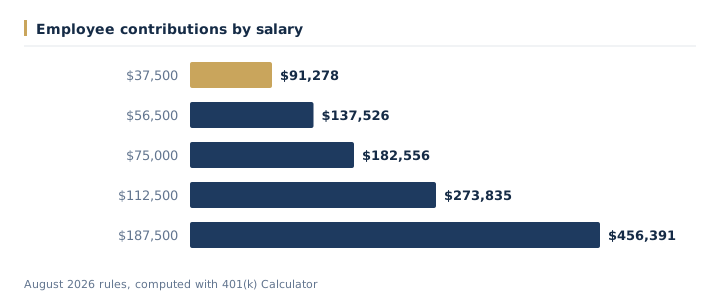
At $37,500, employee contributions works out to $91,278; at $187,500 it is $456,391. Looking only at projected balance tends to understate how much the outcome shifts across that range.
Assumptions behind these figures
| Input | Value |
|---|---|
| Current age | 35 |
| Retire age | 65 |
| Salary | $75,000 |
| Balance | $30,000 |
| Emp pct | 6% |
| Match pct | 50% |
| Match cap | $6 |
| Ret | 7% |
| Raise | 2% |
| As of | August 2026 |
| Method | identical to /tools/401k-calculator |
Brackets, thresholds and rates change from year to year, so treat these as August 2026 figures for the 2026 tax year. For your own situation, open the 401(k) Calculator and enter your real numbers — the calculator runs the same code that produced every figure on this page.
Frequently Asked Questions
Should I prioritize a Roth IRA or 401(k)?
Generally, the priority order starts with contributing enough to your 401(k) to capture the full employer match, since that's typically an immediate, guaranteed return that no other account can match. After securing the match, the choice between additional Roth or traditional contributions generally comes down to whether your current tax rate is lower or higher than you expect your retirement rate to be. If you're uncertain about future tax rates, splitting contributions between both account types can provide flexibility later.
What should I fund first, my 401(k) match or a Roth IRA?
Generally, the 401(k) match should come first, before funding a Roth IRA or any other additional retirement contribution, since skipping the match to prioritize a Roth means giving up what's typically an immediate, high, risk-free return on the matched dollars. No tax-rate advantage between Roth and traditional accounts is generally large enough to outweigh forfeiting an employer match. Once the full match is captured, deciding between a Roth IRA and additional 401(k) contributions becomes a tax-rate question.
Does income affect whether I can contribute to a Roth IRA or 401(k)?
Yes — Roth IRA contributions generally phase out above certain income levels, which differ for single and married filers and are adjusted periodically, while 401(k) contributions generally have no income limit, though the account may still restrict contributions to only pre-tax or Roth depending on the plan's offerings. High earners above the Roth IRA income limit sometimes use other techniques, like a backdoor Roth, to still access Roth-style savings. It's worth checking the current-year IRS income thresholds since they change over time.
Is it better to split contributions between Roth and traditional accounts?
For many people who are genuinely uncertain about their future tax rate, splitting contributions between Roth and traditional accounts can be a reasonable approach, since it builds flexibility to choose which account to draw from in retirement based on the tax brackets you actually land in each year. This tax diversification isn't indecision — many planners view it as a way to hedge against uncertain future tax policy and income. The ideal split depends on your specific income, expected retirement income sources, and risk tolerance, so discuss it with a financial professional.