Comparisons
Bonds vs Stocks in Retirement: Asset Allocation
By Editorial Team · Published June 11, 2026 · Updated August 22, 2026 · 15 min read
Bonds as a permission slip not to sell stocks: the two-job split, the rising-equity glidepath debate, bucket strategies, and a phased worked allocation.
Ask a working saver what stocks and bonds are for and the answer is usually one word: growth, and safety. Ask a retiree the same question and the honest answer is stranger. In retirement, bonds are not really there to make money. They are there to buy you permission not to sell stocks at the worst possible moment. That reframe — bonds as a behavioral and sequencing tool rather than a return engine — changes almost every allocation decision that follows, and most of the bad decisions retirees make about their mix come from never having made that switch.
The accumulation question was "how do I grow this fastest without panicking?" The decumulation question is different in kind, not degree: "how do I pull a paycheck out of this for thirty years without a bad first decade wrecking the whole plan?" Same two asset classes, completely different job description. The rest of this is about what each one actually does once the contributions stop and the withdrawals start.
The two jobs, stated plainly
Strip the portfolio down to its function and you get a clean division of labor.
Stocks are the only realistic answer to a thirty-year inflation problem. A 65-year-old today may be funding spending at 95. Over a span that long, a portfolio with too little equity doesn't fail dramatically — it fails slowly, by losing purchasing power while you watch. Bonds and cash have historically struggled to out-earn inflation by much after taxes. Stocks have been the asset that, over long horizons, grew faster than prices rose. Remove them and you've traded the visible risk of a crash for the invisible risk of a quietly shrinking standard of living.
Bonds are the shock absorber that lets the equity engine keep running. Their job in retirement is to be the thing you spend from during the years stocks are down, so you are not forced to liquidate equities into a falling market to fund groceries. That is the entire mechanism. A retiree with five years of spending in bonds can let a bear market run its course. A retiree who is 100% equities has to sell shares at depressed prices to eat — and those forced sales, early in retirement, are what permanently break plans.
| Asset | Accumulation role | Decumulation role |
|---|---|---|
| Stocks | Primary growth engine | Long-horizon inflation defense; the part that must keep compounding |
| Bonds | Volatility dampener, diversifier | Spending reservoir that prevents forced equity sales in downturns |
| Cash | Emergency buffer | Near-term withdrawals; the first one to two years of spending |
The single most useful sentence a retiree can internalize: in decumulation, the bond allocation is sized by how many years of bad markets you need to survive without touching stocks, not by a textbook risk-tolerance quiz.
Why the order of returns is the whole game
Two retirees earn the exact same average annual return over thirty years. One ends with millions to spare; the other runs out at 84. The only difference is the order the returns arrived in. This is sequence-of-returns risk, and it is the reason retirement allocation is a genuinely different problem from accumulation allocation.
During accumulation, a crash early in your career is arguably good — you buy years of cheap shares before you have much to lose. During decumulation the asymmetry flips and turns vicious. A poor first few years, while you are withdrawing inflation-adjusted income from a shrinking balance, removes shares permanently. Those shares are not there to participate in the eventual recovery. The portfolio can post a perfectly respectable thirty-year average and still be dead, because the damage was done in the years that mattered most and nothing later could undo it.
This is exactly why the bond allocation earns its keep. Bonds don't have to beat stocks. They have to be uncorrelated enough and stable enough that you can spend from them for the two-to-five years a bad equity stretch typically lasts, leaving the stock sleeve untouched and intact for the rebound. Model how long a balance survives under hostile versus benign return ordering with the Money Longevity Calculator; the gap between the two, holding the average constant, is the entire argument for holding bonds at all.
The number that matters is the withdrawal, not the allocation
A subtle point that reframes the debate: allocation only matters in retirement because you are withdrawing. A portfolio nobody draws from can ride out any drawdown. The danger is the combination — a withdrawal plus a downturn plus a rigid spending rule. That means your safe allocation and your safe withdrawal rate are not two separate questions; they are one question asked twice. Pressure-test the pair together with the Retirement Savings Calculator before locking in either.
The glidepath fight: should equity rise into retirement?
For decades the default advice ran one direction: glide steadily down in stocks as you age, on the logic that an older investor has less time to recover from a crash. Most target-date funds still do this. Then a body of research argued something that sounds backwards and isn't.
The counterintuitive idea is the rising equity glidepath, often called the bond tent. Picture it as a tent in profile. In the years right around retirement — roughly the last few working years through the first decade of retirement — you hold an unusually high bond allocation. That is the peak of the tent, and it sits directly over the period when sequence risk is most lethal. Then, as you move past that danger zone, you deliberately let the equity percentage climb again.
The reasoning, once you see it, is hard to unsee. Sequence risk is overwhelmingly concentrated in the years immediately surrounding the retirement date, because that is when the portfolio is largest relative to remaining contributions and a drawdown does maximum compounding damage. Pile bonds high precisely there. Survive that window with the stock sleeve unsold, and you've cleared the most dangerous stretch — at which point a higher equity allocation again becomes both safe enough and necessary for the long inflation fight that remains.
| Approach | Equity path | Core bet |
|---|---|---|
| Traditional declining glidepath | High → low with age | Older investors can't tolerate or recover from equity risk |
| Static allocation (e.g., 60/40) | Flat for life | Simplicity and discipline beat market-timing the glide |
| Rising equity glidepath / bond tent | Dip near retirement, then rise | Sequence risk is front-loaded; defend the danger window, then re-risk |
This is not settled doctrine, and you should distrust anyone who presents it as such. The bond-tent research is well-argued; critics note it can leave money on the table in the common case where markets don't crash at the worst time, and that it demands discipline most people lack — deliberately buying more stock in your 70s after a scary decade is psychologically brutal. Reasonable, informed people land in different places here. What is not in dispute is the underlying fact the debate is built on: the years around your retirement date carry far more sequence danger than the years deep into it.
Bucket strategies: the same idea, made tangible
The bond-tent logic is mathematically elegant and emotionally useless to most people, because "manage your sequence-risk exposure across a glidepath" is not something a human feels. The bucket strategy is the same defense rebuilt as something you can actually picture, which is most of why it works.
You divide the portfolio by when you'll spend the money, not by asset class for its own sake:
- Bucket 1 — near-term (roughly years 1–2). Cash and equivalents. This is the literal money you live on now. It does not move with markets, so a crash has no vote on next month's grocery budget.
- Bucket 2 — mid-term (roughly years 3–10). High-quality bonds and bond funds. This is the reservoir that refills Bucket 1 and, critically, the buffer that lets you not sell stocks during a multi-year downturn.
- Bucket 3 — long-term (roughly year 10 onward). Equities. Untouched for a decade or more, this is the sleeve doing the inflation fighting, given the one thing stocks most need: time.
The mechanics in practice: you spend from Bucket 1; in normal or good years you refill it from Bucket 2 and trim winners from Bucket 3; in bad equity years you deliberately stop refilling from stocks and let Bucket 1 and 2 carry spending until equities recover. That pause — spending bonds and cash instead of selling depressed shares — is sequence-risk defense expressed as a chore you can remember on a Sunday afternoon. The strategy's real value is arguably less mathematical than behavioral: it gives a frightened retiree a concrete reason not to panic-sell, because the rule already told them which bucket to spend from this year.
Working a real allocation across the retirement arc
Numbers make this concrete. Take a 65-year-old with a $1,200,000 portfolio whose own savings must cover $48,000 a year of spending (the rest comes from Social Security). Run the spending shape through the three classic phases of retirement.
Go-go years (roughly 65–75): defend the danger zone. Spending is highest here — travel, the long-deferred plans, an active life. Sequence risk is also at its peak here. A bond-tent-flavored mix might look like 50% stocks / 45% bonds / 5% cash: roughly $600,000 equities, $540,000 bonds, $60,000 cash. That cash and bond block is deliberately fat — it is over a decade of the portfolio's $48,000 share of spending, enough to ride out almost any historical equity drawdown without selling a single share of stock.
Slow-go years (roughly 76–85): re-risk gently. You've cleared the worst of the sequence window. Discretionary spending naturally tapers as travel winds down. Now the rising glidepath says let equity drift back up — say 60% stocks / 38% bonds / 2% cash. The inflation fight is the dominant remaining risk over a potential twenty more years, and stocks are the only credible answer to it.
No-go years (roughly 86+): function over elegance. Spending often falls again, then can spike late for healthcare or long-term care. Allocation here is less about optimization and more about simplicity, low cost, and not requiring the holder to make sharp decisions. Many retirees hold something like 45–55% stocks with the rest in short and intermediate high-quality bonds, prioritizing a mix a less-engaged 88-year-old (or a helping family member) can manage without active trading.
| Phase | Illustrative mix | What's driving it |
|---|---|---|
| Go-go (65–75) | ~50/45/5 | Maximum sequence-risk defense; thick spending reservoir |
| Slow-go (76–85) | ~60/38/2 | Danger window cleared; inflation becomes the lead risk |
| No-go (86+) | ~50/48/2 | Simplicity, low maintenance, late-life cost contingency |
These percentages are illustrations of a shape, not prescriptions — your guaranteed income, your spending flexibility, and your tolerance for a bad first decade move every number. Re-run your own figures, because the right mix for someone with a pension covering essentials looks nothing like the right mix for someone whose portfolio funds the entire grocery bill. The Retirement Income Calculator is built to coordinate the guaranteed sources first, so you can see how much volatility the portfolio sleeve actually has to carry.
When guaranteed income changes the entire calculation
Here is the move most allocation discussions skip. If Social Security, and possibly a pension or annuity, already cover your essential spending, then your portfolio is only funding discretionary spending — and discretionary spending can flex in a bad year. A retiree whose floor is fully covered can responsibly hold more equity, not less, because a crash threatens the travel budget rather than the rent. The retiree with no guaranteed floor beyond Social Security has to hold a thicker bond buffer, because there is no release valve. Allocation is downstream of how much of your life is already insured against the market. Decide the floor first; let it set the equity ceiling.
Rebalancing: the part that quietly does the work
An allocation you set and never touch isn't a strategy; it's a starting condition that decays. Rebalancing — periodically selling what's grown and buying what's lagged to return to target weights — is the discipline that turns an allocation into a system. It does two things at once that are easy to underrate.
First, it is automated, unemotional contrarianism. After a strong equity run, rebalancing forces you to trim stocks high. After a crash, it forces you to buy them low. You will not want to do either; that reluctance is exactly why writing the rule down in advance matters more than the rule's precise parameters.
Second, in decumulation rebalancing and withdrawals can be the same action. You don't have to sell across the board to fund spending — you fund the year by trimming whichever asset class is above its target. In a year stocks soared, your withdrawal comes from stocks and incidentally rebalances you. In a year stocks fell, you spend from bonds — funding the year and avoiding the forced sale of depressed equity in one move. That is the bucket logic and the rebalancing logic revealing themselves to be the same idea.
Practical guardrails most evidence supports: rebalance on a schedule (annually is plenty) or on a tolerance band (when an asset drifts more than ~5 percentage points off target), whichever you'll actually follow. Mind the tax location — rebalance inside tax-advantaged accounts where trades don't trigger capital gains, and be deliberate about taxable accounts. And resist the urge to rebalance constantly; the edge comes from the discipline, not the frequency.
Where retirees go wrong with the mix
The most common error is carrying an accumulation mindset into decumulation — treating allocation as a pure risk-tolerance question when it has become a sequence-and-spending question. Close behind: holding too little equity out of crash fear and slowly losing the inflation war over thirty years; or holding too much equity with no bond buffer, so the first bad market forces share sales that never recover. Then there's setting an allocation and never rebalancing, so a long bull market silently turns a 60/40 plan into an 80/20 portfolio right before the retiree needed the 40. And the quiet one: sizing bonds off a questionnaire instead of off the number of years of spending you need protected from a down market.
Questions worth answering directly
Is there a single right stock/bond split for retirement? No, and anyone who gives you one without asking about your guaranteed income is guessing. Static mixes from roughly 40/60 to 70/30 have all survived long historical retirements at moderate withdrawal rates; the right one depends on how much of your spending is already covered by Social Security and pensions and how much your budget can flex.
Should I really increase stocks as I age? It's a defensible, research-backed strategy for managing front-loaded sequence risk — not a consensus mandate. The well-established part is the underlying fact: the danger window is concentrated near your retirement date. Whether you respond with a formal rising glidepath, a bond tent, buckets, or a disciplined static mix matters less than respecting that the early years carry outsized risk.
Do bonds even help when they fall alongside stocks? They help less in the periods they fall with equities, which is a real and acknowledged weakness. But high-quality bonds still typically fall far less than stocks and recover differently, so they remain the better thing to spend from in a downturn. "Imperfect shock absorber" still beats "no shock absorber and forced to sell stocks."
How big should the cash/bond buffer be? A common frame is enough near-term cash and high-quality bonds to fund several years — often cited around five to ten years of the portfolio's share of spending — so an equity drawdown can run its course untouched. Size it to your own spending gap, not a generic rule.
What about an annuity or pension in all this? Treat guaranteed lifetime income as a bond-like floor that lets the rest of the portfolio hold more equity, because essential spending is no longer exposed to the market. The more of your essentials are insured, the more aggressive the remaining sleeve can responsibly be.
Sources
- U.S. Securities and Exchange Commission — investor education on asset allocation, diversification, and rebalancing for long-term goals
- Consumer Financial Protection Bureau — guidance on managing retirement savings and turning a portfolio into sustainable income
- Internal Revenue Service — tax treatment of withdrawals and account location that shapes where rebalancing trades belong
- Social Security Administration — benefit estimates that determine how much guaranteed income offsets portfolio risk
Key takeaways
- In retirement, bonds are not a return engine — they exist to let you avoid selling stocks into a downturn, which is the failure that actually breaks plans.
- Sequence-of-returns risk is front-loaded around the retirement date, so the years just before and after retiring deserve the heaviest defensive allocation.
- The rising equity glidepath / bond tent and bucket strategies are the same sequence-risk defense in different clothing; buckets win on behavior, glidepaths on theory, and neither is settled doctrine.
- Across go-go, slow-go, and no-go phases, allocation should track changing spending and risk — defensive early, gradually re-risked, simple and low-maintenance late.
- Guaranteed income sets your equity ceiling, and disciplined rebalancing — often the same action as funding a year's withdrawal — is what turns an allocation into a working system.
This article is general education about portfolio construction in retirement, not personalized investment, tax, or financial advice; every allocation example here is an illustration of a structure, not a recommendation, and your own mix depends on facts no article can see — discuss it with a qualified fiduciary against your real horizon, income sources, and stomach for a bad first decade.
Run the numbers
Everything below came out of this site's own Retirement Savings Calculator. The figures are not quoted from anywhere else: each row is one run of the same calculation the tool page performs, using August 2026 rules. Put the same inputs in and you will get the same output.
How the result moves with current savings
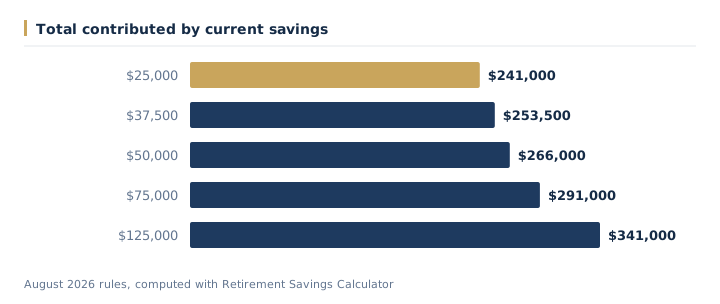
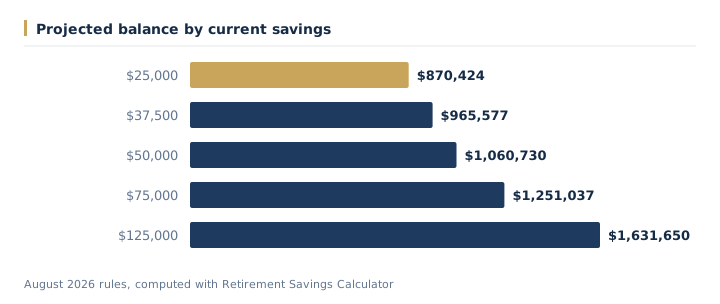
We ran 5 values of current savings through the calculator and left every other input at its default. As of August 2026, the output was:
| Current savings ($) | Total contributed ($) | Projected balance ($) | Real balance today dollars ($) |
|---|---|---|---|
| 25,000 | 241,000 | 870,424.04 | 358,603.18 |
| 37,500 | 253,500 | 965,577.23 | 397,805.03 |
| 50,000 | 266,000 | 1,060,730.41 | 437,006.89 |
| 75,000 | 291,000 | 1,251,036.79 | 515,410.59 |
| 125,000 | 341,000 | 1,631,649.54 | 672,218.01 |
Running current savings from $25,000 up to $125,000 moves total contributed from $241,000 to $341,000 — a spread of $100,000. That gap is the part a single headline rate never shows.
The same runs seen through projected balance
At $25,000, projected balance works out to $870,424; at $125,000 it is $1,631,650. Looking only at total contributed tends to understate how much the outcome shifts across that range.
Assumptions behind these figures
| Input | Value |
|---|---|
| Current age | 35 |
| Retire age | 65 |
| Current savings | $50,000 |
| Monthly | $600 |
| Ret | 7% |
| Infl | 3% |
| As of | August 2026 |
| Method | identical to /tools/retirement-savings-calculator |
Brackets, thresholds and rates change from year to year, so treat these as August 2026 figures for the 2026 tax year. For your own situation, open the Retirement Savings Calculator and enter your real numbers — the calculator runs the same code that produced every figure on this page.
Frequently Asked Questions
What role do bonds play in a retirement portfolio?
In retirement, bonds are generally viewed less as a growth engine and more as a shock absorber — a reservoir of relatively stable value you can spend from during years when stocks are down, so you're not forced to sell equities at a loss to cover living expenses. This lets your stock allocation, generally considered the primary long-term defense against inflation over a multi-decade retirement, stay largely intact through market downturns. The general principle many planners use is sizing your bond allocation based on how many years of a bad stock market you want to be able to cover without touching equities.
Should retirees hold more bonds or more stocks?
There's no single right mix, since it depends on your spending needs, other income sources, and risk tolerance, but many retirees hold a meaningful bond allocation specifically to avoid being forced to sell stocks during a downturn. Removing stocks entirely from a portfolio can expose a retiree to a different risk — a portfolio can quietly lose purchasing power to inflation over a long retirement if it's too conservative. Because getting this balance wrong in either direction carries real risk, work through your specific allocation with a financial professional.
What is a rising equity glidepath (bond tent)?
A rising equity glidepath, sometimes called a bond tent, is a strategy where you hold an unusually high bond allocation in the years right around your retirement date, when a market downturn would do the most damage, and then gradually let your stock allocation increase again as you move further into retirement. This contrasts with the traditional advice of steadily reducing stock exposure as you age. The reasoning is that sequence-of-returns risk is concentrated most heavily in the years immediately surrounding retirement, so that's when extra bond protection is most valuable.
Why does the order of investment returns matter more in retirement?
During the saving years, an early market downturn can actually be beneficial, since it lets you buy shares at lower prices before you have much invested. In retirement, that dynamic reverses — a poor sequence of returns early on, combined with ongoing withdrawals, can permanently deplete a portfolio, because shares sold during a downturn aren't there to participate in any later recovery. Two retirees can earn identical average returns over a full retirement and end up in dramatically different financial positions purely based on the order those returns occurred in, which is why bond allocation and withdrawal strategy are often considered together.