Comparisons
Lean FIRE vs Fat FIRE vs Coast FIRE
By Editorial Team · Published May 15, 2026 · Updated August 22, 2026 · 12 min read
Lean and Fat are target-size strategies; Coast is a contribution-timing strategy. Separate worked households, Barista FIRE, and the pre-59.5 access constraint.
People treat Lean FIRE, Fat FIRE, and Coast FIRE as three points on a single dial labeled "how much money" — as if they're the same plan run at different volumes. They aren't. Two of them are about the size of your number; the third is about its timing and barely shares a mechanism with the other two. Collapsing all three into "rich FIRE versus frugal FIRE" is why so many people pick the variant that sounds appealing rather than the one their actual cash flow can support.
Sorted properly, the distinction is sharper. Lean and Fat answer "how big does the pile need to be?" Coast answers "when can I stop adding to the pile?" Conflating a target-size question with a contribution-timing question produces plans that quietly don't work. The fix is to define each precisely, compute the very different numbers each demands, and match the variant to a household rather than a fantasy.
The unit they all share, and the one that splits them
Every variant runs on the same underlying multiple: roughly 25× the annual spending the portfolio must cover, the inverse of a ~4% withdrawal rate. That shared unit is why they feel like one idea. What actually separates them is which spending level you multiply and whether you're still contributing while it compounds.
- Lean FIRE multiplies a deliberately compressed budget. Small target, reached fast, financed by an extreme savings rate and a permanently lean lifestyle.
- Fat FIRE multiplies a comfortable-to-generous budget. Large target, reached slowly, financed by high income and a high dollar savings rate without lifestyle suppression.
- Coast FIRE doesn't change the target spending at all. It changes the timeline: contribute aggressively early until the existing balance is mathematically guaranteed to grow into a full Fat- or regular-FIRE number by traditional retirement age with zero further contributions, then stop saving and merely cover current expenses.
- Barista FIRE is the close cousin worth naming: a partial version where you stop full-time work but keep part-time income (often for health coverage), so the portfolio only has to bridge a gap, not fund everything. It sits between Coast and full FIRE in commitment.
Hold the 25× engine constant and the three main variants are just different answers to "25× of what, and am I still feeding it?" That reframing is the whole article in one sentence; the rest is arithmetic and fit.
Lean FIRE: small number, severe constraints
Lean FIRE's defining trait isn't frugality for its own sake — it's that the entire plan's safety margin is thin by construction. A compressed budget produces a small target, which is the appeal, but it also removes the slack that absorbs surprises.
Worked example. The Reyes household targets $30,000/year of portfolio-funded spending. At 25×, the number is $750,000. On a $95,000 combined income saving 55% ($52,250/year) with growth roughly doubling contributions over the accumulation window, they reach it strikingly fast compared with conventional retirement timelines.
The catch is on the other side of the finish line. A 4% draw on $750,000 is $30,000 with essentially no discretionary cushion — a serious medical year, a roof, or a stretch of high inflation lands directly on essentials, because there's no flexible spending to cut. This is exactly the profile the safe-withdrawal research flags as needing a lower starting rate, not the standard 4%, since a budget with nothing optional in it has no release valve in a bad sequence. Stress-test a lean number against a hostile early market with the Money Longevity Calculator; lean plans show their fragility precisely in the bad-sequence runs, where there's no discretionary line to trim.
Who it suits: people genuinely content with a low-cost life, often in low-cost geographies, with high adaptability and ideally some ability to earn marginal income if needed. It does not suit anyone whose budget is lean only because they've assumed nothing will ever go wrong.
Fat FIRE: large number, bought with income, not deprivation
Fat FIRE inverts Lean's trade. It removes the post-retirement fragility by funding a comfortable budget — but it pays for that comfort with a much larger target and, usually, a longer or higher-earning accumulation phase.
Worked example. The Okafor household wants $120,000/year of portfolio-funded spending without lifestyle compromise. At 25×, the target is $3,000,000. They don't get there by extreme frugality; they get there by earning $260,000 combined and saving a high dollar amount — say $110,000/year — while still spending comfortably. The savings rate may be moderate; the savings dollars are large, and that's the engine.
The post-retirement picture is the mirror image of Lean: a 4% draw on $3,000,000 is $120,000, and because much of that is discretionary, the plan has a built-in shock absorber — a bad year can be met by trimming travel and dining rather than threatening essentials. That flexibility is itself worth real money in withdrawal-rate terms, which is part of why Fat plans can responsibly run nearer a standard 4% (or use guardrails to start higher) where Lean plans should start lower. Model the target and the savings runway with the FIRE Calculator to see how sensitive a $3M number is to income and savings rate versus how sensitive a $750K number is to spending discipline.
Who it suits: high earners unwilling to permanently compress their standard of living, people with variable or lumpy expenses, and anyone who values the spending flexibility that a large discretionary cushion provides in down markets.
Coast FIRE: a timing strategy wearing a FIRE costume
Coast FIRE is the one that doesn't belong on the same axis. It does not lower your target or your eventual spending. It exploits compounding to relocate when you must contribute.
The mechanic: front-load savings hard and early, until the existing balance — with no further contributions — will compound on its own into your full target by a conventional retirement age. Once you hit that "Coast number," you stop saving entirely. You still work, but only enough to cover current living costs; every additional dollar of savings becomes optional.
Worked example. The Brooks household, both 32, want a $1,500,000 portfolio (a comfortable, near-Fat target) by age 62. With growth that historically multiplies a balance roughly fourfold over 30 years, the balance they need today to coast is about $375,000. Hit $375,000 by 32 and, on those historical-style return assumptions, contributing nothing more still lands them near $1.5M at 62. From 32 onward they only need income that covers present expenses — they've bought back their savings rate, not their job.
Two honest caveats keep this from being magic. First, the projection is only as good as the assumed return; a weak multi-decade stretch leaves a coaster short with no contribution habit to fall back on, so most coasters keep some flexibility to resume saving. Second, "Coast" still requires working — it's freedom from saving, not freedom from earning. Compare the with-contributions and zero-contributions glide paths to the same target with the FIRE Calculator; the gap between them is exactly the savings burden Coast eliminates, and seeing it plotted makes the strategy's real claim obvious.
Who it suits: people who saved hard young, value lower-stress or lower-pay work over an early full stop, and are comfortable with a long horizon and the model risk of a multi-decade return assumption. Barista FIRE suits a related profile: those who'll keep deliberate part-time work — frequently for employer health coverage — so the portfolio bridges only a gap rather than carrying everything.
Side by side
The variants only make sense compared directly, because each one's strength is another's weakness.
| Dimension | Lean FIRE | Fat FIRE | Coast FIRE | Barista FIRE |
|---|---|---|---|---|
| What it optimizes | Smallest target, fastest exit | Comfortable spending, large cushion | Earliest end of saving | Earliest end of full-time work |
| Example target | ~$750,000 ($30k spend) | ~$3,000,000 ($120k spend) | ~$375,000 today → grows to ~$1.5M | Portfolio covers only the gap part-time income leaves |
| Savings intensity | Extreme rate, modest dollars | Moderate rate, large dollars | Very high early, then zero | Moderate, ongoing but lighter |
| Post-exit fragility | High — no discretionary cushion | Low — large flexible buffer | N/A until traditional retirement | Low–moderate — wages absorb shocks |
| Sensible withdrawal posture | Below standard rate; little slack | Standard rate or guardrails-higher | Standard plan applies later | Smaller draw; wages cover the rest |
| Biggest risk | A bad sequence with no budget to cut | Under-saving relative to a big number | Multi-decade return assumption fails | Losing the part-time income/benefits |
| Best fit | Genuinely low-cost life, adaptable | High earners, comfort-prioritizing | Hard-saved young, want low-stress work | Want to downshift, not fully stop |
Read the table by columns and a pattern emerges: Lean trades post-retirement safety for speed, Fat trades a bigger number for safety, Coast trades nothing about the target and instead buys back the savings rate, and Barista offloads part of the portfolio's job onto continued wages. They are answers to different questions that only look alike because they share the 25× arithmetic.
Choosing by household, not by label
The right variant falls out of a few honest answers, not the name that sounds best.
- How compressible is your real budget, permanently? If you can live well on little without resentment, Lean's small number is reachable. If permanent compression would feel like deprivation, Lean's fragility will eventually bite — look at Fat or Barista instead.
- Is your constraint income or lifestyle? High income with no desire to economize points to Fat (large-dollar saving, comfortable draw). Modest income with high frugality tolerance points to Lean.
- Did you save heavily young? A large early balance makes Coast viable — you may already be closer to "stop saving" than to "stop working," which is a different and often better freedom.
- Do you want to stop working, or stop needing the income? Coast and Barista keep you earning by design; Lean and Fat aim at a full stop. Mistaking which freedom you actually want is the most common selection error.
- How much sequence risk can your plan absorb? Lean has the least slack and should pair with a conservative withdrawal posture; Fat's discretionary cushion is itself a risk buffer.
A household that could choose any of them
Consider a couple, both 35, $140,000 combined income, $260,000 already invested, currently spending $70,000.
- Lean path: compress to a $34,000 retired budget → ~$850,000 target. Aggressive saving reaches it fast, but the retired life is tightly constrained and bad-sequence-fragile.
- Fat path: keep the $70,000+ comfort → ~$1,750,000 target. Slower, income-dependent, but a large discretionary cushion in retirement.
- Coast path: their $260,000 at 35, untouched, on historical-style growth, plausibly reaches a comfortable seven-figure sum by 65 — meaning they may already be near a Coast number and could downshift to lower-stress work now, contributing nothing further.
- Barista path: stop full-time work sooner, keep $25,000 of part-time income plus benefits, and the portfolio only has to cover the remaining ~$45,000 gap — a far smaller target than full Fat FIRE.
Same household, same arithmetic engine, four legitimately different lives — separated not by income but by which question they decided to answer. Run their figures through the FIRE Calculator for the Lean and Fat target sizes and the Coast glide path, and stress the Lean number through a hostile sequence in the Money Longevity Calculator to see why the smallest target is not automatically the safest plan.
The access problem every variant shares before age 59½
There's a constraint that cuts across all four and that target-size math hides entirely: most tax-advantaged retirement money carries an early-withdrawal penalty before your late fifties, which is a problem for anyone retiring at 45 or 50. A Lean retiree with a perfectly sized $750,000 can still be cash-trapped if most of it sits in accounts that penalize early access. The practical fixes — a taxable brokerage bridge sized to cover the years before penalty-free access, or a structured series of substantially equal periodic payments under the IRS rules — don't change how big the pile must be, but they change how it's composed. An early-retirement FIRE plan that nails the 25× number and ignores the bridge has solved the wrong half of the problem. The exact penalty mechanics and the periodic-payment rules change and are rule-bound enough that the current specifics belong with the IRS and a professional, but the structural point is permanent: a correct total can still be an unreachable total if it's locked behind an age you haven't reached.
Where people go wrong
The errors are predictable once you separate the questions. Treating Lean FIRE as merely "Fat FIRE with less money," ignoring that its thin budget removes the flexibility a bad market sequence requires. Choosing Fat's comfort while planning Lean's savings rate, then never reaching the larger number. Believing Coast FIRE means you can stop working, when it only means you can stop saving. Assuming a single optimistic return for Coast's multi-decade projection with no contribution habit left as a backstop. Forgetting Barista FIRE's quiet dependency: the plan only works while the part-time income — and often the health coverage attached to it — actually continues. Each mistake comes from forcing a timing strategy and two sizing strategies onto one imaginary dial.
Sources
- Consumer Financial Protection Bureau — guidance on building a sustainable spending plan and assessing how compressible a household budget really is
- Social Security Administration — benefit estimates that reduce the portfolio target every FIRE variant must otherwise reach alone
- Internal Revenue Service — tax-advantaged account rules and early-withdrawal mechanics that constrain how FIRE balances are actually accessed before traditional retirement age
- U.S. Department of Labor — fee and plan disclosures relevant to the cost drag that quietly raises every variant's required number
Key takeaways
- Lean and Fat are target-size strategies; Coast (and Barista) are timing strategies — they only look alike because all share the ~25× / 4% engine.
- Lean FIRE buys a fast, small number ($30k spend ≈ $750k) at the cost of a fragile, cushion-free retirement that warrants a below-standard withdrawal rate.
- Fat FIRE buys post-retirement flexibility with a large number ($120k spend ≈ $3M), funded by high savings dollars rather than deprivation.
- Coast FIRE doesn't lower the target — it stops contributions once an existing balance will compound to the goal alone, trading savings burden for continued (often lighter) work; Barista FIRE offloads part of the portfolio's job onto part-time income and benefits.
- Pick by honest household answers — budget compressibility, income-vs-lifestyle constraint, early-saving history, and which freedom you actually want — not by the label that sounds most appealing.
This is general financial education, not personalized advice; the targets, savings rates, and growth multiples shown are illustrative and rest on historical-style assumptions that carry no guarantee of repeating — your own variant, withdrawal rate, and timeline should be set with a qualified advisor against your real budget, income stability, and tolerance for a bad early market.
Run the numbers
Everything below came out of this site's own FIRE Calculator. The figures are not quoted from anywhere else: each row is one run of the same calculation the tool page performs, using August 2026 rules. Put the same inputs in and you will get the same output.
How the result moves with assets
We ran 5 values of assets through the calculator and left every other input at its default. As of August 2026, the output was:
| Assets ($) | Fire age | Years to fire (years) |
|---|---|---|
| 50,000 | 56 | 21 years |
| 75,000 | 55 | 20 years |
| 100,000 | 54 | 19 years |
| 150,000 | 53 | 18 years |
| 250,000 | 50 | 15 years |
Running assets from $50,000 up to $250,000 moves fire age from 56 to 50 — a spread of 6. That gap is the part a single headline rate never shows.
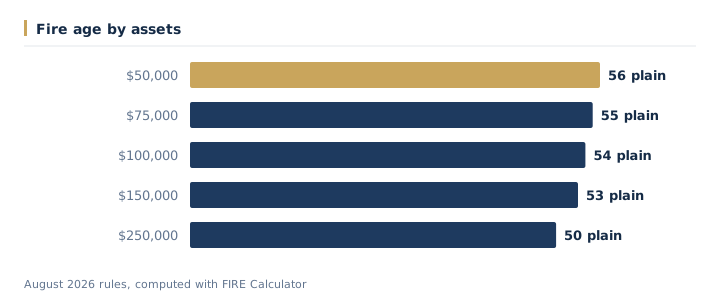
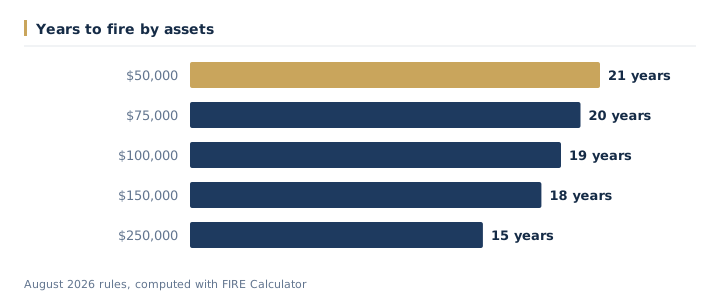
The same runs seen through years to fire
At $50,000, years to fire works out to 21 years; at $250,000 it is 15 years. Looking only at fire age tends to understate how much the outcome shifts across that range.
Assumptions behind these figures
| Input | Value |
|---|---|
| Age | 35 |
| Assets | $100,000 |
| Expenses | $50,000 |
| Savings | $25,000 |
| Ret | 7% |
| Swr | 4% |
| Coast target | 65 |
| As of | August 2026 |
| Method | identical to /tools/fire-calculator |
Brackets, thresholds and rates change from year to year, so treat these as August 2026 figures for the 2026 tax year. For your own situation, open the FIRE Calculator and enter your real numbers — the calculator runs the same code that produced every figure on this page.
Frequently Asked Questions
What's the difference between Lean FIRE and Fat FIRE?
Lean FIRE and Fat FIRE both target financial independence but at very different spending levels — Lean FIRE multiplies a deliberately compressed, minimal budget to reach a smaller savings target relatively quickly, while Fat FIRE multiplies a comfortable or generous budget, requiring a much larger target usually funded by high income rather than extreme frugality. Because a lean budget generally has little discretionary spending to cut in a bad year, Lean FIRE plans are often considered more fragile and may warrant a more conservative withdrawal rate than the standard 4% guideline. Fat FIRE plans, with more discretionary spending built in, generally have more flexibility to absorb a market downturn.
What is Coast FIRE?
Coast FIRE is generally a timing strategy rather than a target-size strategy — you save aggressively early in your career until your existing balance is projected to grow, with no further contributions, into a full retirement-size portfolio by a traditional retirement age. Once that threshold is reached, you can stop contributing to retirement accounts and only need to cover current living expenses. It doesn't change your eventual retirement spending target, only when you're required to keep actively saving toward it.
What is Barista FIRE?
Barista FIRE is generally a partial version of financial independence where you stop full-time work but keep some part-time income, often specifically to access benefits like health insurance or simply to cover a portion of expenses. This means your portfolio only needs to bridge the remaining spending gap rather than fund your entire lifestyle, which can allow you to step back from full-time work sooner than a full FIRE target would require. It sits between Coast FIRE and complete financial independence in terms of commitment and portfolio size needed.
Is Lean FIRE riskier than Fat FIRE?
Generally, yes, in the sense that a lean budget has little to no discretionary spending, so an unexpected cost like a medical expense or major repair lands directly on essential spending with no flexible cushion to absorb it. Fat FIRE plans, by having more discretionary spending built into the budget, generally have more room to trim expenses during a market downturn without threatening essentials. Because of this, some planners suggest Lean FIRE budgets use a lower, more conservative starting withdrawal rate than the standard 4% guideline.