News
SECURE Act 2.0: What Changed for Retirement Planning
By Editorial Team · Published July 9, 2026 · Updated August 22, 2026 · 13 min read
SECURE 2.0 did not happen on one day. What changed, organized by person and effective date — with the "RMDs start at 75 for everyone" myth corrected up front.
SECURE 2.0 is not really one law that happened on one day. It was signed in December 2022, but it was written to switch on in pieces over a span of years — some provisions live immediately, some on a future January 1, a few with effective dates that were themselves later adjusted by follow-up IRS guidance. The practical consequence is that "what changed" is the wrong question. The right one is "what changed for me, and when does it actually take effect" — because a retiree, a 61-year-old high earner, and a parent with a stranded 529 are each living in a different part of the same statute's rollout.
So this is organized by the person, not the section number. We'll walk the changes that matter, grouped by who they help and what they let that person do differently — with one rule applied throughout: where a date or figure is the kind of detail that gets revised, the rule is described and the official source is cited rather than a number stated as if it were carved in stone.
First, the one number everyone gets wrong
Before the people, clear the most common confusion, because it poisons a lot of planning conversations.
SECURE 2.0 raised the age at which required minimum distributions begin — but it did so in two steps tied to your birth year, not as a single new universal age. The required-beginning age moved to 73, and is scheduled to rise further to 75 for a later cohort, with your birth year determining which applies to you. It is emphatically not "RMDs now start at 75 for everyone."
| Birth year | RMD start age |
|---|---|
| 1950 or earlier | Already subject (prior rules: 72, or 70½ earlier) |
| 1951–1959 | 73 |
| 1960 or later | 75 |
Because these ages were changed by SECURE 2.0 and the boundaries are exactly the sort of thing people misquote, confirm the current start age for your specific birth year with the IRS before acting. The planning value of the change is real, though: every extra year before RMDs begin is a year you decide your taxable income — prime territory for Roth conversions or harvesting gains in a low bracket. See how the delay shrinks the early required withdrawals with the RMD Calculator.
A related, immediately useful change rode in alongside it: the penalty for missing an RMD, formerly a punishing 50% excise tax on the shortfall, was cut to 25%, and to 10% if corrected promptly within a defined window. Still a real toll on money you merely forgot to move — but a far less ruinous one than before.
For the person already retired (or close to it)
A wider runway before forced withdrawals
The RMD age increase isn't just a number; it's a strategic window. Take a 72-year-old born in 1953. Under the old regime they'd already be taking RMDs. Under SECURE 2.0 their start age is 73, buying a year. Someone born in 1960 gets all the way to 75. Those gap years are when a retiree can convert traditional balances to Roth at controlled tax cost before RMDs force a higher baseline of taxable income and potentially drag up Medicare premiums two years later. The change effectively lengthens the most valuable tax-planning window in retirement.
A worked example of what the extra years are worth
Consider a retiree, call him David, who stops working at 65 with $700,000 in a traditional IRA and modest other income, born in 1960 so his RMDs don't begin until 75. That's a ten-year window of unusually low taxable income. Suppose he converts roughly $40,000 a year from the traditional IRA to a Roth during that window, deliberately filling up a lower tax bracket but stopping before the next one. Over ten years he's moved on the order of $400,000 (plus growth) into a Roth that will never have an RMD and will come out tax-free — and he's shrunk the traditional balance that will be subject to RMDs at 75, lowering those future required withdrawals and their bracket and IRMAA ripple. The dollar figures are illustrative, but the structure is the point: SECURE 2.0 made that conversion runway materially longer. Test the conversion-versus-leave-it tradeoff with the Roth vs. Traditional IRA Calculator, and see how the lower future RMDs land with the RMD Calculator.
Roth employer accounts no longer force lifetime RMDs
A smaller but clean fix: SECURE 2.0 ended lifetime RMDs on Roth-designated employer accounts (Roth 401(k), Roth 403(b)), aligning them with Roth IRAs, effective for tax years beginning in 2024. Previously, savers sidestepped this oddity by rolling Roth 401(k)s into Roth IRAs; the rollover workaround is no longer mandatory. If your plan didn't apply the change, that's a conversation to have with the administrator.
For the high-saver in their late 50s and early 60s
A bigger, age-banded catch-up
SECURE 2.0 didn't only keep the age-50 catch-up; it added a larger catch-up for participants ages 60 through 63 in employer plans. For those four specific calendar years, the catch-up is set higher than the standard 50+ amount — defined by the statute as the greater of a fixed dollar figure or a multiple of the regular catch-up, then inflation-indexed.
The planning mechanics that actually matter:
- It is a four-year window — ages 60, 61, 62, 63 — then it reverts to the ordinary 50+ catch-up at 64. Treat it as a temporary opportunity to shovel more in, not a permanent raise.
- The plan must adopt the provision for participants to use it; it isn't automatic.
- SECURE 2.0 also requires that catch-up contributions by higher earners (above an income threshold) be made on a Roth basis in employer plans. The exact effective timing of this Roth-catch-up requirement was adjusted by IRS guidance after enactment, which makes it a textbook case for confirming current rules rather than relying on the originally announced date.
The actionable read: a saver approaching 60 should ask whether the plan adopted the enhanced catch-up, plan for a four-year contribution bump, and check whether the Roth-basis requirement applies to their income — accepting an upfront tax bill now in exchange for tax-free growth later, which flips the usual catch-up math.
Roth employer match becomes possible
For the first time, SECURE 2.0 lets employers offer matching (and nonelective) contributions as Roth — after-tax — if the plan permits and the participant elects it. Traditionally all employer money landed in the pre-tax bucket.
The implication is a genuine tax decision, not a clerical one. A Roth match means you pay tax on the matched amount in the year it's contributed, in exchange for tax-free growth and withdrawals. For someone expecting higher rates later, or wanting to build tax-free assets that escape RMDs, that's attractive; for someone in a high bracket now who'll drop in retirement, the traditional pre-tax match may still win. It's optional on both sides — the plan must offer it and you must elect it — so its existence is a new lever, not a default. Weigh the now-versus-later tax tradeoff with the Roth vs. Traditional IRA Calculator, and see how either path compounds toward your number with the Retirement Savings Calculator.
For the parent, the early-career worker, and the over-extended
The 529-to-Roth rollover
One of the most talked-about provisions addresses a real fear that kept families from funding 529 education accounts: what if the money isn't all needed for school? SECURE 2.0 created a path to roll unused 529 funds into the beneficiary's Roth IRA, subject to a fenced set of conditions designed to prevent abuse:
- The 529 account must have been open for a long minimum period (the statute specifies a lengthy seasoning requirement) before a rollover is allowed.
- There is a lifetime cap on how much can move from a 529 to a Roth this way.
- Rollovers are still bounded by the annual Roth IRA contribution limit for the beneficiary, and the beneficiary generally needs earned income — so it's a multi-year drain, not a lump transfer.
- Recently contributed amounts are excluded from eligibility.
Because the seasoning period, the lifetime cap, and the interaction with annual limits are precisely the details most likely to be summarized inaccurately, treat the structure above as the durable part and confirm the current specifics with the IRS before executing one. The planning shift is meaningful regardless: overfunding a 529 is far less risky now, because leftover money has a tax-advantaged retirement exit instead of a penalty.
Automatic enrollment becomes the default for new plans
SECURE 2.0 requires most newly established 401(k) and 403(b) plans to automatically enroll eligible employees (with the ability to opt out), at a starting deferral rate that escalates annually within a defined band, beginning with plan years after a set date. Older plans are generally grandfathered, and small and new businesses have exceptions.
The behavioral logic is well established: defaults dominate outcomes. People stay in what they're put in. For a worker, the practical note is twofold — if you're auto-enrolled, you're saving (good), but the default rate may be below your employer's full match, so check that you're contributing enough to capture all of it. Auto-enrollment starts the habit; it does not guarantee it's optimized.
The student-loan match
A genuinely novel provision lets employers treat an employee's qualified student loan payments as if they were retirement contributions for matching purposes. An employee paying down student debt — and therefore unable to also fund a 401(k) — can still receive the employer match into their retirement account based on those loan payments.
This closes a long-standing trap where early-career workers had to choose between debt and the match, and effectively forfeited free retirement money for years. It is optional for employers to offer, so the action item is simply to ask whether your plan has adopted it; if it has and you're paying student loans, you may be leaving an employer match on the table by assuming you're ineligible.
Emergency savings, and penalty-free access for genuine hardship
SECURE 2.0 added provisions aimed at the reason many people won't lock money in a retirement plan at all — fear of not being able to reach it in a crisis:
- Plans may offer a linked emergency savings account (a small, Roth-style sidecar with capped balance) so employees can save for emergencies inside the plan rather than avoid the plan entirely.
- The law expanded penalty-free early withdrawal exceptions, including a limited annual withdrawal for an unforeseeable personal or family emergency, and specific provisions for domestic-abuse and terminal-illness situations, with rules allowing repayment.
These are optional plan features layered on top of statutory rights, and the specific dollar caps and repayment windows are indexed or rule-bound — exactly the kind of figures to verify currently rather than memorize. The planning point stands on its own: the access changes are designed to make contributing feel less like locking money in a box you can't open, which is itself a reason to revisit a deferral rate you'd kept low out of liquidity fear.
A timeline frame to keep it straight
Because the rollout is staggered, it helps to hold the shape rather than dates that may have shifted:
| Roughly when | Examples of what switched on |
|---|---|
| Immediately on enactment (Dec 2022) | Reduced missed-RMD penalty (50% → 25%/10%) |
| Within a year or two | RMD age to 73; Roth employer match permitted |
| Tax years from 2024 onward | End of lifetime RMDs on Roth employer accounts; 529-to-Roth path; student-loan match availability |
| Phased later years | Ages 60–63 enhanced catch-up; Roth-basis catch-up requirement for higher earners; broader auto-enrollment mandate; RMD age to 75 cohort |
The dates in that fourth row are the ones most exposed to revision by subsequent IRS guidance — which is the entire reason this article cites sources instead of stating each effective date as final.
Where people go wrong with SECURE 2.0
The biggest error is "RMDs start at 75 now" — they start at 73 or 75 by birth year, and getting it wrong by two years can cost a 25% excise tax. Close behind: assuming the enhanced 60–63 catch-up or the student-loan match is automatic when each requires the plan to adopt it; treating the Roth employer match as a default rather than an election with a current-year tax cost; rolling 529 money to a Roth without respecting the seasoning period and lifetime cap; and relying on a 2022-era summary for an effective date that IRS guidance later moved.
Questions worth answering directly
Did SECURE 2.0 change my RMD age? Probably, if you were born in 1951 or later. It's 73 for 1951–1959 and 75 for 1960 and later, phased in steps. Confirm your exact birth-year start age with the IRS, since this is the most commonly misstated point in the whole law.
Is the missed-RMD penalty really lower? Yes — reduced from 50% to 25% of the shortfall, and to 10% if you correct it within the defined window. This took effect early and is one of the few clean, immediate wins in the statute.
Can my employer's match go into a Roth now? It can, if the plan offers it and you elect it. It triggers tax in the contribution year in exchange for tax-free growth — a real decision, not a formality.
Is the 529-to-Roth rollover a way to dodge income limits? Not freely. It's bounded by a long account-seasoning requirement, a lifetime cap, the beneficiary's annual Roth limit, and an earned-income condition. It de-risks overfunding a 529; it isn't an unlimited Roth backdoor.
Does the bigger catch-up apply to me forever once I hit 60? No. It's only for the calendar years you're 60 through 63, then it reverts. And the plan must have adopted it. Treat it as a four-year window to maximize.
Why does this article avoid stating some effective dates? Because several SECURE 2.0 dates and figures were adjusted by IRS guidance after enactment. Stating a stale date as fact would be worse than describing the rule and pointing you to the current official source.
Sources
- Congress.gov — the enacted text of the SECURE 2.0 Act of 2022 and its provision-by-provision effective dates
- Internal Revenue Service — current guidance on RMD ages, the reduced missed-RMD penalty, catch-up rules, and the 529-to-Roth conditions
- U.S. Department of Labor — employer-plan implementation, automatic enrollment, and the student-loan match for workplace plans
- Consumer Financial Protection Bureau — consumer-facing guidance on emergency savings access and prioritizing retirement contributions
Key takeaways
- SECURE 2.0 is a phased rollout, not a single-day change — the right question is what applies to you and when, because several effective dates were later adjusted by IRS guidance.
- The RMD age moved to 73, then 75 for a later birth cohort — not a universal 75 — and the missed-RMD penalty dropped from 50% to 25% (10% if corrected promptly).
- The pre-RMD years are now a longer, more valuable Roth-conversion window; the ages-60–63 enhanced catch-up adds a temporary four-year shelter the plan must adopt.
- The Roth employer match, 529-to-Roth rollover, student-loan match, broader auto-enrollment, and emergency-access provisions each reshape a specific planning decision — most are optional plan features, so confirm adoption.
- Where a date or dollar figure could be stale, verify it with the IRS or Congress.gov rather than a 2022-era summary, because the boundaries are exactly what people misquote.
This article is general U.S. retirement-planning education about SECURE 2.0, not personalized tax, legal, or financial advice; the statute's provisions phase in over time and have been refined by subsequent IRS guidance, so confirm every effective date and figure with the IRS, Congress.gov, or a qualified professional before you act.
Run the numbers
Everything below came out of this site's own Retirement Savings Calculator. The figures are not quoted from anywhere else: each row is one run of the same calculation the tool page performs, using August 2026 rules. Put the same inputs in and you will get the same output.
How the result moves with current savings
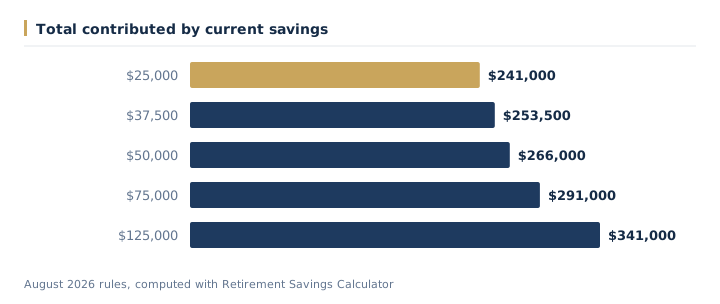
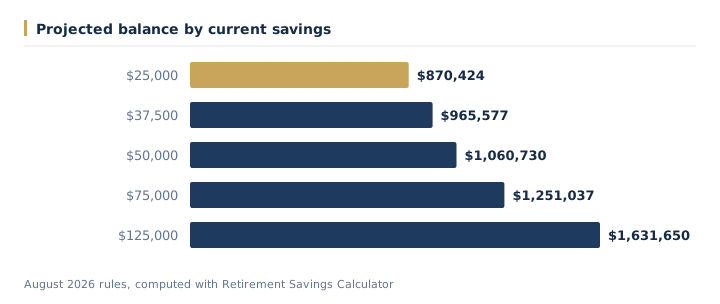
We ran 5 values of current savings through the calculator and left every other input at its default. As of August 2026, the output was:
| Current savings ($) | Total contributed ($) | Projected balance ($) | Real balance today dollars ($) |
|---|---|---|---|
| 25,000 | 241,000 | 870,424.04 | 358,603.18 |
| 37,500 | 253,500 | 965,577.23 | 397,805.03 |
| 50,000 | 266,000 | 1,060,730.41 | 437,006.89 |
| 75,000 | 291,000 | 1,251,036.79 | 515,410.59 |
| 125,000 | 341,000 | 1,631,649.54 | 672,218.01 |
Running current savings from $25,000 up to $125,000 moves total contributed from $241,000 to $341,000 — a spread of $100,000. That gap is the part a single headline rate never shows.
The same runs seen through projected balance
At $25,000, projected balance works out to $870,424; at $125,000 it is $1,631,650. Looking only at total contributed tends to understate how much the outcome shifts across that range.
Assumptions behind these figures
| Input | Value |
|---|---|
| Current age | 35 |
| Retire age | 65 |
| Current savings | $50,000 |
| Monthly | $600 |
| Ret | 7% |
| Infl | 3% |
| As of | August 2026 |
| Method | identical to /tools/retirement-savings-calculator |
Brackets, thresholds and rates change from year to year, so treat these as August 2026 figures for the 2026 tax year. For your own situation, open the Retirement Savings Calculator and enter your real numbers — the calculator runs the same code that produced every figure on this page.
Frequently Asked Questions
What did SECURE Act 2.0 change about RMDs?
SECURE Act 2.0 raised the age at which required minimum distributions must begin, moving it to 73 for many current retirees, with a further increase to 75 scheduled for people born in 1960 or later. It also reduced the penalty for missing an RMD from a historical 50% down to 25%, and further to 10% if corrected within a defined window. Because the law rolled out these changes gradually over several years, confirm which specific rules apply to your birth year and situation with the IRS or a tax professional.
Does everyone's RMD now start at age 75?
No, this is a common misconception — SECURE Act 2.0 raised the required minimum distribution age in two steps tied to birth year, not as a single new universal age. Generally, those born between 1951 and 1959 have a required beginning age of 73, while those born in 1960 or later have a required beginning age of 75. Confirm your specific starting age based on your birth year with the IRS rather than assuming the newer age applies to everyone.
What is the SECURE 2.0 catch-up contribution for ages 60-63?
SECURE Act 2.0 generally introduced an enhanced super catch-up contribution available specifically to participants ages 60 through 63 in employer retirement plans, set higher than the standard age-50-plus catch-up amount. This is a temporary, four-year window that reverts to the ordinary catch-up limit at age 64, and the employer's plan must specifically adopt the provision for participants to use it. Because the exact dollar figures and some implementation details have been adjusted by subsequent IRS guidance, confirm the current rules and whether your plan has adopted this feature.
Did SECURE 2.0 reduce the RMD penalty?
Yes, generally — the excise tax penalty for missing a required minimum distribution was reduced from a historical 50% of the shortfall down to 25%, and further to 10% if the mistake is corrected within a defined window. This is a meaningful reduction, but it's still a real cost on money that was simply forgotten rather than intentionally withheld, so it doesn't remove the importance of tracking RMD deadlines carefully. If you do miss an RMD, correcting it promptly and documenting the correction generally matters for minimizing the penalty.
Do Roth 401(k)s still require RMDs under SECURE 2.0?
No, generally not — SECURE Act 2.0 eliminated lifetime required minimum distributions for the original owner of Roth-designated employer accounts, such as Roth 401(k)s and Roth 403(b)s, starting with tax years beginning in 2024. This aligned Roth employer accounts with Roth IRAs, which have never had lifetime RMDs for the original owner. Before this change, savers often avoided the issue by rolling a Roth 401(k) into a Roth IRA, a workaround that is no longer necessary, though it's worth confirming your specific plan has implemented the change.