News
2026 Retirement Account Contribution Limits
By Editorial Team · Published July 8, 2026 · Updated August 22, 2026 · 13 min read
Do not memorize the table — learn the machine: the COLA rounding mechanism, each account limit type, the Roth phase-out, and where the IRS publishes 2026.
Every January, a predictable thing happens online: someone publishes a confident table of the new year's retirement contribution limits, the numbers spread, and a meaningful share of them turn out to be wrong — guessed early, copied widely, never corrected. The reason this keeps happening is that almost nobody explains the part that actually protects you: not what the 2026 numbers are, but how they're built. Learn the machine that produces the limits and you stop needing anyone's table. You can read the one official page that settles it and know you're looking at the real figure.
So this is deliberately not a number sheet. It's an explanation of which accounts have limits, what kind of limit each one has, how the IRS recalculates them every autumn, and exactly where the 2026 figures are published. Wherever a specific dollar amount appears below, it is a clearly labeled illustration of how the arithmetic works — never a claim about 2026. The real 2026 numbers live in one place, named at the end, and that place is the only one you should trust.
The mechanism: why these numbers move at all
Retirement contribution limits are not set by Congress each year. Congress writes the rules and the base amounts into law; the Internal Revenue Service then adjusts most of those amounts annually for inflation through a process called the cost-of-living adjustment, or COLA.
Here is the part worth understanding. Each fall, the IRS measures a specified inflation index over a defined period, applies the statutory formula, and — critically — rounds the result to a legally specified increment. That rounding is why limits don't rise smoothly. A limit might sit unchanged for two years because inflation wasn't quite enough to push it over the next rounding step, then jump in a single year. The increase you "expected" based on headline inflation often doesn't match the published figure, because the rounding rule, not raw inflation, decides the final number.
The IRS announces the results in an annual news release and an accompanying Notice (the contribution-limit changes typically arrive in the IRS retirement-plan COLA announcement issued in the autumn before the year begins). Until that announcement exists, every "2026 limit" is a projection. After it exists, the projection is irrelevant. The single most useful habit in this entire topic: confirm the figure on the IRS COLA page before you act on it.
Which accounts have limits, and what kind of limit
Not all retirement accounts work the same way, and "the limit" means something different depending on the account. Group them by mechanism, not by name.
| Account family | What's capped | Inflation-adjusted? |
|---|---|---|
| Employer plans: 401(k), 403(b), most 457(b) | Your elective deferral (what you choose to contribute from pay) | Yes, via IRS COLA |
| Traditional & Roth IRA | Combined annual contribution across all your IRAs | Yes, via IRS COLA |
| Catch-up contributions (age 50+) | Extra amount on top of the standard limit | Yes, indexed (with rounding) |
| SECURE 2.0 enhanced catch-up (ages 60–63) | A higher catch-up for that specific age band | Yes, defined by formula |
| Health Savings Account (HSA) | Annual contribution (self-only vs. family) | Yes, separate HSA COLA |
| Overall employer-plan additions | Total of employee + employer contributions to a plan | Yes, via IRS COLA |
The takeaway from the table: when someone says "the limit went up," always ask which limit. The 401(k) elective-deferral limit, the IRA limit, the catch-up, and the total-additions cap are four different numbers that move on the same schedule but by different amounts and rounding rules.
Employer plans: the elective-deferral limit
For a 401(k), 403(b), or governmental 457(b), the headline number is the elective deferral limit — the maximum you can choose to contribute from your own paycheck in a calendar year. It is indexed annually.
A purely illustrative walk-through of the arithmetic, so you can replicate it once you have the real figure. Suppose — strictly as an example, not a 2026 claim — the elective-deferral limit for the year were $X. If you're paid twice a month (24 paychecks), funding it evenly means contributing about $X ÷ 24 per check. Most savers overlook one consequence of this: if you front-load contributions and hit $X by October, your paycheck deferrals stop, and so does any per-paycheck employer match for the rest of the year — a "true-up" provision in some plans fixes this, but not all plans have one. The limit isn't just a ceiling; it's a pacing problem. Model the long-run effect of different deferral rates with the 401(k) Calculator, then plug the official figure in once it's published.
One important boundary: the elective-deferral limit is yours across all employers in the year combined. Change jobs mid-year and contribute to two 401(k)s, and it's still one shared limit. Going over triggers an "excess deferral" you have to correct, with tax consequences, so two plans in one year is a tracking responsibility, not a doubled allowance.
The overall additions limit (the bigger, less-known cap)
Above the elective-deferral limit sits a second, larger ceiling almost no one budgets around: the overall annual additions limit, which caps the total going into your employer plan in a year — your deferrals plus employer match plus profit sharing plus any after-tax contributions. It too is indexed annually.
This matters for high savers and anyone whose plan allows large after-tax contributions (the mechanism behind the "mega backdoor Roth" some plans permit). Your own deferrals might stop at the elective-deferral limit, but employer and after-tax dollars can keep filling the account up to this much higher overall cap. If that strategy is on your radar, the overall additions number — confirmed on the IRS page, not estimated — is the one that governs it.
IRA limits, and the income test most people miss
Traditional and Roth IRAs share a single, combined annual contribution limit — not one each. Put money in both in the same year and the total across them can't exceed the year's IRA limit (plus the age-50 catch-up, if eligible). It's indexed by the same COLA process, with its own rounding step, so it doesn't move in lockstep with the 401(k) number.
The genuinely tricky part of IRAs isn't the contribution cap — it's the Roth IRA income phase-out, a mechanism many savers don't realize applies to them until they've already overcontributed.
How the Roth income phase-out actually works
Direct Roth IRA contributions are restricted by income. As your modified adjusted gross income (MAGI) rises, your allowed Roth contribution shrinks across a defined phase-out range that depends on your tax filing status, and above the top of the range it reaches zero. This range itself is inflation-adjusted, so it shifts every year.
The mechanism, stated as a procedure rather than with invented 2026 dollars:
- Find the phase-out range for your filing status on the IRS page for the year.
- If your MAGI is below the bottom of the range, you can contribute the full IRA limit to a Roth.
- If your MAGI is inside the range, your maximum Roth contribution is reduced proportionally — the further into the range you are, the smaller the allowed amount.
- If your MAGI is above the top of the range, your allowed direct Roth contribution is zero.
A neutral illustration of the proportional math (numbers invented purely to show the method): if a phase-out range ran from $A to $B and your MAGI landed exactly halfway between, your allowable Roth contribution would be roughly half the standard limit, then rounded per the IRS rules. The structure is what's stable year to year; the endpoints $A and $B move with inflation and must be read off the official page for 2026.
Two related boundaries worth knowing. Traditional IRA contributions are always allowed with earned income, but the deductibility of a traditional IRA contribution has its own separate phase-out that depends on whether you (or a spouse) are covered by a workplace plan. And exceeding the IRA limit, or contributing to a Roth above the income ceiling, creates an excess contribution subject to a recurring excise tax until corrected — which is why confirming the current range matters before you fund, not after.
Catch-up contributions, including the SECURE 2.0 wrinkle
Starting in the year you turn 50, the law allows an additional catch-up contribution on top of the standard limit — a separate, smaller indexed amount for both employer plans and IRAs. Conceptually it's simple: standard limit plus catch-up equals your personal maximum once you're 50+.
SECURE 2.0 added a layer that trips people up: an enhanced catch-up for ages 60 through 63. For participants in that specific four-year age band, the employer-plan catch-up is set higher than the regular 50+ catch-up — defined by the statute as the greater of a fixed amount or a multiple of the regular catch-up, then indexed. The mechanics that matter for planning:
- It applies only in the calendar years you are 60, 61, 62, or 63. At 64 the catch-up reverts to the regular 50+ amount. It is a four-year window, not a permanent raise.
- It is an employer-plan feature (401(k)/403(b)/457(b) type plans), separate from the IRA catch-up.
- SECURE 2.0 also layers a rule requiring higher earners' catch-up contributions to be made on a Roth (after-tax) basis in employer plans, phased in per IRS guidance. Whether and exactly when this Roth-catch-up requirement bites for a given year and income level is precisely the kind of detail to confirm in current IRS guidance rather than assume.
The planning implication is concrete: a saver hitting 60 should check whether their plan has adopted the enhanced catch-up (plans must offer it for participants to use it) and budget for a temporary four-year bump in how much they can shelter — then plan for it to step back down at 64.
HSAs: a separate limit, a separate schedule
Health Savings Accounts deserve their own paragraph because savers routinely lump them in with retirement accounts and then misread the limit. HSA contribution limits are inflation-adjusted, but on their own COLA schedule and their own IRS announcement, distinct from the retirement-plan notice — and they're announced earlier in the year than the retirement-plan figures.
Structurally: there are two HSA limits, self-only and family coverage, plus a flat age-55 catch-up (notably, the HSA catch-up is set by statute and is not inflation-indexed, unlike the retirement-plan catch-ups). To contribute at all you must be enrolled in a qualifying high-deductible health plan. Because the HSA's triple-tax-advantaged treatment makes it one of the most efficient retirement vehicles available, knowing its limit comes from a different page — and confirming that year's figures separately — is part of doing this correctly.
A worked example: building one year's plan around the structure
Picture a 61-year-old, married, contributing to a workplace 401(k) and wanting to also fund a Roth IRA. Without inventing a single 2026 figure, here's the procedure the structure dictates:
- 401(k) deferral. Maximum personal contribution = the year's elective-deferral limit plus the ages-60–63 enhanced catch-up (if the plan adopted it). Pace it across paychecks so a per-check match isn't lost late in the year.
- Roth IRA eligibility. Estimate household MAGI, then check it against the year's married-filing-jointly Roth phase-out range on the IRS page. Below the range: full IRA limit plus the 50+ catch-up. Inside it: a proportionally reduced amount. Above it: zero direct Roth — at which point a backdoor Roth becomes the question, which is its own analysis.
- Total employer-plan check. Confirm employee deferrals + employer match stay under the overall annual additions limit, especially if after-tax contributions are in play.
- HSA, if eligible. Separately, against the HSA notice, contribute up to the self-only or family limit plus the flat age-55 catch-up.
Every step references the structure, and every dollar figure is looked up, not assumed. Run the long-term trajectory of these contribution levels with the Retirement Savings Calculator to see what a maxed plan compounds to over your remaining horizon — then update the inputs the day the official numbers post.
Where people go wrong with the limits
The most damaging error is acting on an early-published estimate that later proved wrong, then having to unwind an excess contribution. Close behind: treating the 401(k) and IRA limits as one shared bucket (they're independent) or treating traditional and Roth IRA limits as separate (they're combined). Then there's missing the Roth income phase-out entirely and overcontributing into the excise-tax zone; assuming the enhanced 60–63 catch-up is automatic when the plan must adopt it; front-loading 401(k) deferrals and forfeiting late-year match; and reading an HSA limit off a retirement-plan table when it lives on a different schedule.
Questions worth answering directly
What are the exact 2026 numbers? Deliberately not stated here, because a fabricated-looking precise figure is worse than no figure. The authoritative 2026 amounts are published in the IRS retirement-plan COLA announcement and the related Notice — that page, linked in Sources, is the only correct answer to this question.
Are the 401(k) and IRA limits the same number? No. They're entirely separate limits that happen to be indexed by the same general process. You can generally contribute up to each, subject to your income for the Roth side.
Can I contribute to both a Roth IRA and a traditional IRA? Yes, but their combined total can't exceed the single annual IRA limit (plus catch-up if 50+). They share one bucket.
Why did a limit not increase one year? The rounding rule. The COLA formula's result is rounded to a statutory increment; if inflation didn't push the calculation past the next step, the published limit can stay flat even when prices rose.
Does the age 60–63 catch-up happen automatically? No. The plan must offer it, and it applies only in the four calendar years you're 60 through 63. Confirm your plan adopted it and budget for it to revert at 64.
Where do I confirm everything for 2026? The IRS COLA / retirement-plan limits page for the year, plus the separate IRS HSA inflation-adjustment guidance. Treat any other source as a preview to be verified there.
Sources
- Internal Revenue Service — official annual retirement-plan COLA limits, the Notice setting each year's figures, and HSA inflation-adjustment guidance
- U.S. Department of Labor — employer-plan rules, true-up and matching disclosure, and participant rights under workplace plans
- Congress.gov — the statutory text of SECURE 2.0 establishing the enhanced age-60–63 catch-up and Roth catch-up provisions
- Consumer Financial Protection Bureau — consumer guidance on prioritizing and funding retirement accounts within the limits
Key takeaways
- Contribution limits are set by a statutory COLA formula the IRS applies and rounds each autumn — which is why limits jump unevenly and why early-published numbers are often wrong.
- "The limit" is several different numbers: elective deferral, IRA (traditional and Roth combined), age-50 catch-up, the SECURE 2.0 ages-60–63 enhanced catch-up, the overall employer-plan additions cap, and HSAs on a separate schedule.
- The Roth IRA income phase-out shrinks your allowed contribution proportionally across an inflation-adjusted MAGI range that shifts every year — confirm it before funding.
- The ages-60–63 enhanced catch-up is a temporary four-year bump that the plan must adopt and that reverts at 64; it is not automatic.
- Every specific dollar figure in this article is a labeled illustration of the mechanism; the only correct source for the actual 2026 amounts is the IRS COLA page named in Sources.
This article explains how U.S. retirement contribution limits are structured and adjusted, not what any specific 2026 dollar amount is; nothing here is tax or financial advice, and you should verify every current figure directly with the IRS or a qualified tax professional before contributing.
Run the numbers
Everything below came out of this site's own Retirement Savings Calculator. The figures are not quoted from anywhere else: each row is one run of the same calculation the tool page performs, using August 2026 rules. Put the same inputs in and you will get the same output.
How the result moves with current savings
We ran 5 values of current savings through the calculator and left every other input at its default. As of August 2026, the output was:
| Current savings ($) | Total contributed ($) | Projected balance ($) | Real balance today dollars ($) |
|---|---|---|---|
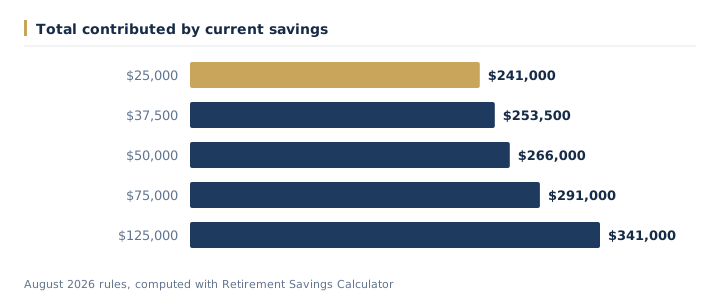
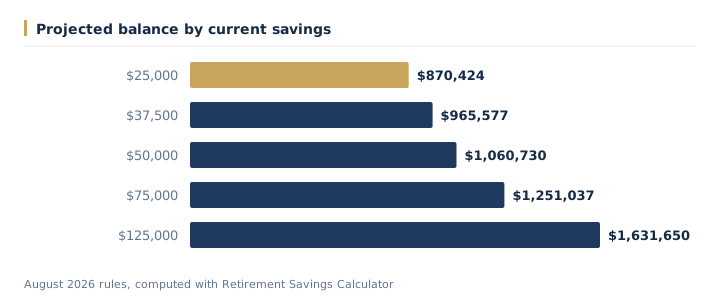
| 25,000 | 241,000 | 870,424.04 | 358,603.18 |
| 37,500 | 253,500 | 965,577.23 | 397,805.03 |
| 50,000 | 266,000 | 1,060,730.41 | 437,006.89 |
| 75,000 | 291,000 | 1,251,036.79 | 515,410.59 |
| 125,000 | 341,000 | 1,631,649.54 | 672,218.01 |
Running current savings from $25,000 up to $125,000 moves total contributed from $241,000 to $341,000 — a spread of $100,000. That gap is the part a single headline rate never shows.
The same runs seen through projected balance
At $25,000, projected balance works out to $870,424; at $125,000 it is $1,631,650. Looking only at total contributed tends to understate how much the outcome shifts across that range.
Assumptions behind these figures
| Input | Value |
|---|---|
| Current age | 35 |
| Retire age | 65 |
| Current savings | $50,000 |
| Monthly | $600 |
| Ret | 7% |
| Infl | 3% |
| As of | August 2026 |
| Method | identical to /tools/retirement-savings-calculator |
Brackets, thresholds and rates change from year to year, so treat these as August 2026 figures for the 2026 tax year. For your own situation, open the Retirement Savings Calculator and enter your real numbers — the calculator runs the same code that produced every figure on this page.
Frequently Asked Questions
How are retirement contribution limits determined each year?
Contribution limits are generally set through a cost-of-living adjustment process where the IRS measures inflation over a defined period each fall and applies a statutory formula, rounding the result to a specified increment. Because of this rounding, limits don't rise smoothly every year — a limit can stay flat for a period and then jump in a single year once inflation crosses a rounding threshold. The official figures are published in an annual IRS news release and notice, generally in the autumn before the new year begins, and that source should always be checked before relying on any specific number.
What retirement accounts have annual contribution limits?
Most major retirement accounts have some form of annual limit, including employer plans like 401(k)s, 403(b)s, and most 457(b)s, which cap your elective deferral, traditional and Roth IRAs, which share a combined annual limit, and Health Savings Accounts. Additional catch-up contribution limits generally apply for those age 50 and older, with an enhanced catch-up for a specific age band in the early 60s under SECURE Act 2.0. Because these limits move on different schedules and by different amounts, check each account type's current limit separately rather than assuming they all change together.
What is the overall annual additions limit for a 401(k)?
The overall annual additions limit is generally a larger, less-known cap that sits above the individual elective-deferral limit, covering the total of your own contributions plus employer match, profit sharing, and any after-tax contributions combined. This matters most for high savers and for strategies like the mega backdoor Roth, which relies on contributing after-tax dollars up to this higher combined limit. Because it's indexed and adjusted annually, confirm the current figure directly with the IRS or your plan administrator.
Where can I find the official current-year retirement contribution limits?
The IRS publishes official contribution limits each year through an annual news release and accompanying notice, generally issued in the autumn before the new tax year begins, and this is considered the authoritative source rather than any third-party table or article. Until that official announcement is published, any next-year figures circulating online are only projections and can turn out to be wrong. Checking the current IRS retirement-plan COLA page directly is the most reliable way to confirm the exact figure for your account type before contributing.