Tutorials
How to Maximize Your 401(k) Match
By Editorial Team · Published December 29, 2025 · Updated August 22, 2026 · 12 min read
How employer match formulas, vesting, and true-up work — and the front-loading mistake that quietly forfeits free money every year.
Start with the number that should bother you. A worker earning $80,000 with a typical employer match who contributes too little to capture all of it commonly forfeits $800 to $1,500 a year. Run that forfeiture for thirty years and add the growth it would have thrown off, and you are looking at a six-figure hole in the final balance — money the employer was holding out, ready to hand over, that simply never got claimed. Surveys of plan data consistently find a meaningful share of employees do exactly this. They are, in effect, declining a raise every payday.
The match is the highest-return, lowest-risk move available in personal finance. A 50% match is an instant 50% return on the dollars you put in. A dollar-for-dollar match is 100%, on day one, before a single dollar is invested. No market does that on demand. So this article is not a meditation. It is a checklist. Work the steps in order.
A quick note on the figures: IRS deferral limits are indexed and move annually. The numbers here are year-labeled to show the rule's shape. Confirm the current IRS limit before you set a contribution rate.
Step 1: Find your exact formula
Open your Summary Plan Description. Do not rely on hallway summaries or what a coworker thinks the match is. The document states it precisely. Employers use a few common shapes:
| Formula type | Example | Contribute this to get it all |
|---|---|---|
| Dollar-for-dollar to a cap | 100% of first 4% of pay | 4% |
| Partial match to a cap | 50% of first 6% of pay | 6% |
| Tiered / "stretch" match | 100% of first 3% + 50% of next 2% | 5% |
| Nonelective | 3% of pay regardless | 0% (you get it anyway) |
The stretch formula is the one that bites people. "The company matches 4%" gets misheard as "I should contribute 4%." Under 100% of the first 3% plus 50% of the next 2%, contributing 4% leaves real money behind — you need 5% to collect the full 4% of employer money. Contribute only 3% and you forfeit a chunk every year without ever seeing it on a statement.
Step 2: Translate the formula into one number
Reduce whatever your plan says to a single figure: the percentage of pay you must defer to collect every employer dollar. For the four rows above, that number is 4%, 6%, 5%, and 0%. Write it down. That is your floor. The rule for the rest of your career is short: never let your contribution rate drop below that number. Everything else in this article is just protecting that floor against the ways it gets breached.
Step 3: Set the rate at or above your floor — then automate it
Set your deferral to your floor or a notch above. Turn on any automatic annual increase the plan offers. Check the rate once a year, and pick the moment deliberately: right after a raise, which is exactly when lifestyle creep tempts people to quietly trim the contribution back down. A match collected automatically every pay period for thirty years beats one you intend to maximize but keep interrupting during stressful months. Remove yourself from the decision and the decision stops getting made wrong.
Step 4: Understand why this outranks almost everything
It is natural to feel that paying down a loan or padding savings is the responsible move before "risking" money in a retirement account. Reframe it. The match is not an investment-risk decision. It is a compensation decision. Declining the match to make an extra debt payment is economically close to asking your employer to cut your pay so a creditor gets paid faster. Stated that way, the priority is obvious.
The genuine exceptions are narrow. No emergency cushion whatsoever. Or debt at an interest rate that plausibly clears even a one-time 50% match. Even in those cases, a split — capture the match and throw everything else at the problem — usually beats abandoning the match outright. After the match is locked, broaden out: an HSA if you're eligible, an IRA, then back toward the 401(k) limit. But the match comes first. The Retirement Savings Calculator makes the long-run gap between "captured the match" and "didn't" hard to argue with.
Step 5: Verify the match is actually landing
Setting a contribution rate is not the same as confirming the employer money arrived. Two or three times a year, open a recent statement and check that the employer contribution line is there and is the size you expect from your formula. This is not paranoia. Payroll changes, plan-administrator switches, a mid-year formula change buried in an open-enrollment packet, or a contribution-rate reset after a system migration can all silently interrupt the match. The employee who set 5% in 2019 and never looked again may have spent years at a default rate after a payroll vendor change without noticing. A two-minute check beats a multi-year leak. If the number looks wrong, contact HR or the plan administrator in writing and keep the reply — match disputes are far easier to resolve with a paper trail than from memory.
A related habit: when you get a raise, confirm your contribution is still a percentage, not a fixed dollar amount. Some plans let you elect a flat dollar deferral. A flat dollar amount that captured the full match at your old salary may fall below the matched percentage after a raise, quietly breaching your floor precisely when you felt most financially comfortable.
The free-money math, worked
Take Priya. She earns $80,000 with a "100% of first 3% + 50% of next 2%" formula.
- To capture everything she contributes 5% of pay = $4,000/year.
- Employer match: 100% of the first 3% ($2,400) + 50% of the next 2% ($800) = $3,200/year.
- On her $4,000 she receives $3,200 immediately — an 80% return before any market growth.
Now the contrast. A coworker on identical pay and the identical plan contributes only 3%. He collects $2,400. He forfeits $800 every year. Over a career, that $800-a-year gap plus its lost growth commonly exceeds the price of a car. Run your own version with the 401(k) Calculator and check the floor you wrote down in Step 2 against what you're actually deferring.
Here is the part people wave off: "$800 a year, who cares." The damage is not $800. It is $800 plus everything $800 would have become. A dollar forfeited at 30 loses not one year of growth but roughly 35 years of compounding. That is the same exponential math that makes early saving powerful, running in reverse. The employee who "only misses a little" each year is, in compounding terms, missing a great deal.
Gotcha #1: Vesting decides whether the match is actually yours
Capturing the match is one job. Keeping it is another, and it runs on a vesting schedule — the rules for how much of the employer's money you own if you leave. Your own contributions are always 100% yours, immediately. The employer's portion may not be.
- Immediate vesting. Employer money is yours right away.
- Cliff vesting. You own 0% until a set date — say, three years — then 100% at once. Leave one day early and you can forfeit all of it.
- Graded vesting. Ownership climbs in steps, often 20% a year until fully vested.
This turns job-change timing into math. Suppose you hold $18,000 of unvested employer match and you hit 100% vested in four months under a three-year cliff. A competing job offers $4,000 more in annual salary. Leave now and you forfeit the full $18,000 to gain about $1,333 of extra salary over those four months. Bad trade. Wait four months, leave with the $18,000 and the raise. This is one of the few money decisions that comes down to checking a date on a document before you act. The Summary Plan Description states the schedule exactly; one email to HR confirms where you stand. Check before you resign.
Gotcha #2: The front-loading trap, and the true-up that may or may not save you
Here is the subtle one. The match is usually calculated per pay period, not annually. Contribute very aggressively early in the year, hit the IRS employee deferral limit ($23,500 in 2025; confirm the current figure) before December, and your contributions stop. So does the per-paycheck match for every remaining pay period. You can max your own deferral and still forfeit thousands in match.
Say you hit the limit in September. October through December you contribute nothing, so there is nothing for the employer to match in those pay periods. You maxed your deferral and collected nine months of match instead of twelve.
Some plans defuse this with a true-up: an annual reconciliation that pays you any match you would have received had contributions been spread evenly. If your plan has one, front-loading is harmless for match purposes. If it does not, pace your contributions so you reach the annual limit near year-end, or at minimum keep deferring at least the matched percentage every pay period. Search your plan documents for the phrase "true-up." If it is not there, do not front-load.
Watch Marcus pay for ignoring this. He earns $150,000 with a "100% of first 5%" match worth up to $7,500/year, and his plan has no true-up.
- He front-loads: heavy contributions January through August hit the $23,500 limit by late August.
- September through December: zero employee contributions, therefore zero employer match those four months.
- He captures roughly 8/12 of the annual match ≈ $5,000 instead of $7,500 — a $2,500 forfeiture, repeated every year the habit continues.
Steady contributions running through December would have collected the full $7,500. The fix costs nothing but attention.
The front-loading trap has a cousin that catches job-changers. The IRS deferral limit follows the person, but each employer's plan only knows what was contributed to it. Max your deferral at Employer A by July, start at Employer B in August, and you cannot defer more — you've hit the personal limit — so Employer B may match nothing for the rest of the year even though its plan would have matched contributions you're no longer allowed to make. If you change jobs in a year you were contributing aggressively, map the limit across both plans before setting the new rate. Otherwise you hand the second employer's match back entirely.
The mistakes, listed plainly
- Contributing below the match threshold. The single most expensive retirement error; it is declining part of your pay.
- Front-loading without a true-up, hitting the IRS limit early and forfeiting later-period match.
- Misreading a tiered formula — assuming "matches 4%" means contribute 4% when 5% or 6% is required.
- Ignoring vesting and walking away from unvested employer money days before a cliff.
- Botching a mid-year job change by maxing the deferral at the first employer and forfeiting the second's match.
- Cashing out at a job change — surrenders growth, may trigger tax and penalty. Roll it over.
- Cutting contributions below the match level during a tight month. Protect the matched percentage if there is any way to.
- Assuming the auto-enrollment default captures the full match. It frequently does not.
Questions people ask
How much do I contribute to get my full match? Entirely plan-dependent. For "100% of first 3% + 50% of next 2%" it's 5%; for "50% of first 6%" it's 6%. Read the Summary Plan Description, reduce the formula to one number (Step 2), and never let your rate fall under it.
Does the match count against the IRS contribution limit? Not against your employee deferral limit ($23,500 in 2025; confirm current figure). It falls under a separate, much higher combined employer-plus-employee limit, so the match never reduces how much you can personally defer.
What is a true-up? An annual reconciliation some plans run to pay back any match lost to front-loading, calculated as if you'd contributed evenly all year. Have one: front-loading is harmless for match purposes. Don't have one: pace contributions through December.
What happens to unvested match money if I quit? You keep 100% of your own contributions and their growth. Unvested employer money is forfeited per your vesting schedule. Timing a departure around a vesting milestone can be worth thousands — check the schedule first.
Match before paying off debt? Usually yes; the guaranteed match return (often 50–100%) typically beats the debt's interest rate. The exception is very high-interest debt with no emergency cushion — and even then, capturing the match usually still wins.
Worth it if I might leave before vesting? Often yes, but it depends on the schedule. With immediate or short graded vesting you keep at least part of every match dollar, so it's clearly worthwhile. With a multi-year cliff and a strong chance you'll leave first, discount the match by the forfeiture risk — but still contribute, because your own money grows tax-advantaged regardless. Just weigh the unvested balance heavily in any early-exit decision.
Key takeaways
- The match is guaranteed compensation; fund it to the floor before nearly every other goal.
- Reduce your formula to one number — the percentage that collects every employer dollar — and never drop below it. Stretch formulas often demand 5–6%.
- Automate the rate and the annual increase so a busy month can't quietly breach the floor.
- Vesting can make staying four extra months worth more than a raise; check the schedule before you resign.
- Without a true-up, do not front-load, and map the deferral limit across both plans in any mid-year job change.
Sources
- Internal Revenue Service — 401(k) plans and contribution limits
- U.S. Department of Labor — 401(k) plan information and your rights
- Consumer Financial Protection Bureau — employer retirement plans
- Pension Benefit Guaranty Corporation — retirement plan basics
This is general educational information about U.S. 401(k) plans for a broad audience, not advice tailored to your finances, and not investment, tax, or legal counsel. Plan rules and IRS limits differ by employer and change every year — read your own Summary Plan Description, confirm the current IRS figures, and consult a qualified professional about your situation.
Run the numbers
Everything below came out of this site's own 401(k) Calculator. The figures are not quoted from anywhere else: each row is one run of the same calculation the tool page performs, using August 2026 rules. Put the same inputs in and you will get the same output.
How the result moves with salary
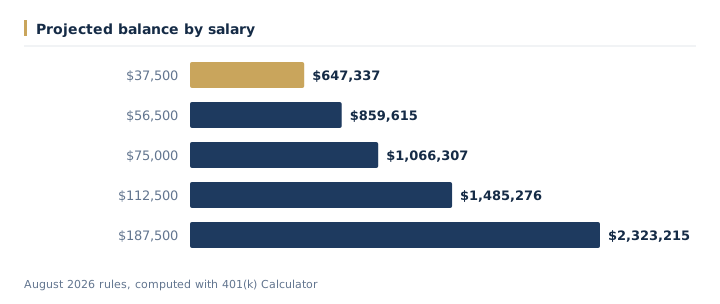
We ran 5 values of salary through the calculator and left every other input at its default. As of August 2026, the output was:
| Salary ($) | Projected balance ($) | Employee contributions ($) | Employer match ($) |
|---|---|---|---|
| 37,500 | 647,337.18 | 91,278.18 | 45,639.09 |
| 56,500 | 859,615.08 | 137,525.79 | 68,762.89 |
| 75,000 | 1,066,306.71 | 182,556.36 | 91,278.18 |
| 112,500 | 1,485,276.24 | 273,834.53 | 136,917.27 |
| 187,500 | 2,323,215.3 | 456,390.89 | 228,195.45 |
Running salary from $37,500 up to $187,500 moves projected balance from $647,337 to $2,323,215 — a spread of $1,675,878. That gap is the part a single headline rate never shows.
The same runs seen through employee contributions
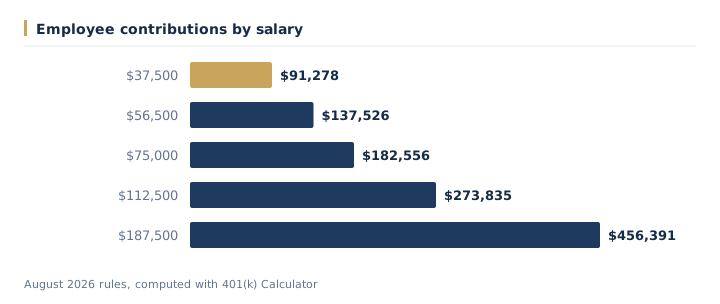
At $37,500, employee contributions works out to $91,278; at $187,500 it is $456,391. Looking only at projected balance tends to understate how much the outcome shifts across that range.
Assumptions behind these figures
| Input | Value |
|---|---|
| Current age | 35 |
| Retire age | 65 |
| Salary | $75,000 |
| Balance | $30,000 |
| Emp pct | 6% |
| Match pct | 50% |
| Match cap | $6 |
| Ret | 7% |
| Raise | 2% |
| As of | August 2026 |
| Method | identical to /tools/401k-calculator |
Brackets, thresholds and rates change from year to year, so treat these as August 2026 figures for the 2026 tax year. For your own situation, open the 401(k) Calculator and enter your real numbers — the calculator runs the same code that produced every figure on this page.
Frequently Asked Questions
How much should I contribute to get my full 401(k) match?
This depends entirely on your specific plan's match formula, which is generally stated precisely in your Summary Plan Description rather than in an informal summary from a coworker. Common formulas include a dollar-for-dollar match up to a cap, a partial match like 50% up to a cap, or a tiered stretch match combining different rates at different contribution levels, and under a stretch formula you often need to contribute more than the headline match percentage to capture all of it. Translate your specific formula into a single contribution percentage and treat that as a floor you never drop below.
What is a stretch or tiered 401(k) match formula?
A stretch or tiered match formula generally combines different match rates at different contribution levels, such as 100% of the first 3% of pay plus 50% of the next 2%. This structure is easy to misread — hearing that the company matches 4% doesn't necessarily mean contributing 4% captures the full match, since a stretch formula might require a higher contribution percentage to receive the full employer amount. Checking your plan's exact formula and calculating the required contribution percentage is the only reliable way to avoid leaving matched money unclaimed.
Should I skip my 401(k) match to pay off debt first?
Generally, most guidance suggests capturing the match first even while paying down debt, since forfeiting a match is often close to declining part of your compensation, and the guaranteed return from a match is difficult for almost any other financial move to beat. The main exceptions typically discussed are having no emergency savings at all, or carrying debt at an interest rate high enough to plausibly outweigh even a generous match. Even in those cases, many planners suggest capturing the match while directing everything else toward the debt, though your specific situation may call for different priorities, so discuss it with a financial professional.
How can I make sure my employer match is actually being deposited?
It's generally recommended to check your account statement periodically, a couple of times a year, and confirm that the employer contribution line matches what your plan's formula should produce based on your own contributions. Payroll system changes, plan administrator switches, or a forgotten adjustment after a raise can silently interrupt a match without any obvious notification. If something looks off, contacting HR or the plan administrator in writing and keeping a record of the response is generally the most effective way to resolve a discrepancy.